

Haryana has taken a fresh planning step for its upcoming rapid rail link to Delhi. The state has formally added the 136.30-km Delhi-Panipat-Karnal Namo Bharat corridor to its Transit Oriented Development, or TOD, Policy, opening the door for structured, higher-density development around the corridor’s future stations.
The change is procedural on paper, but it carries real weight for towns along the route. It means planners can now treat land use and the rail line as one connected exercise, rather than adding a transit corridor to areas that were planned without it in mind.
What Has Changed
The Haryana Town and Country Planning Department notified the amendment on 22 September 2026. It updates the state’s TOD Policy, first notified in 2016, by adding the Delhi-Panipat-Karnal Namo Bharat RRTS corridor to the list of Mass Rapid Transit System corridors eligible for TOD planning.
The notification took effect immediately. According to the Tribune, the corridor had already been approved by the state government on the recommendation of the Haryana Mass Rapid Transport Corporation, and HMRTC had asked for the alignment to be formally added to the TOD Policy’s annexure.
In practical terms, TOD status means the areas around future stations can be planned for higher floor area ratios, mixed use development and better last-mile connectivity, instead of being governed only by standard zoning rules.
Also Read- Faridabad Is Turning Into Haryana’s Next Big Growth Story
The Route at a Glance
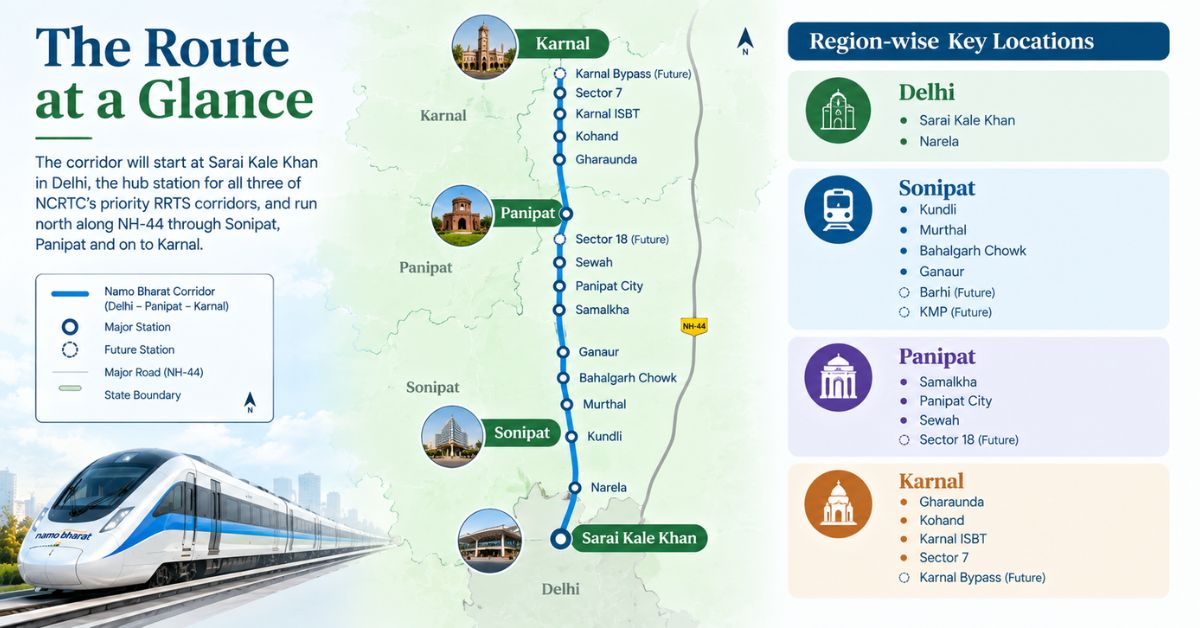
The corridor will start at Sarai Kale Khan in Delhi, the hub station for all three of NCRTC’s priority RRTS corridors, and run north along NH-44 through Sonipat, Panipat and on to Karnal.
| Region | Key locations on the alignment |
|---|---|
| Delhi | Sarai Kale Khan, Narela |
| Sonipat | Kundli, Murthal, Bahalgarh Chowk, Ganaur, and future stations at Barhi and KMP |
| Panipat | Samalkha, Panipat City, Sewah, and a future station at Sector 18 |
| Karnal | Gharaunda, Kohand, Karnal ISBT, Sector 7, and a future station at Karnal Bypass |
A Closer Look at the Alignment and Onboard Features
The corridor’s proposed stations, as listed by NCRTC and covered in project reporting, include the following.
- Sarai Kale Khan, the hub station where the corridor joins the wider Namo Bharat network
- Narela
- Kundli
- Sonipat
- Murthal
- Ganaur
- Samalkha
- Panipat City
- Sewah
- Gharaunda
- Kohand
- Karnal ISBT
- Sector 7, Karnal
A few locations are listed as future stations rather than confirmed for the initial phase, including a Barhi station and a KMP station near Sonipat, a Sector 18 station near Panipat, and a Karnal Bypass station.
On the trains themselves, officials have said the corridor will follow the same passenger amenities used on the operational Delhi-Meerut Namo Bharat line. These include designated luggage storage space, coaches reserved for women, and facilities built in for passengers with disabilities, aimed at making the service usable for a wide range of daily commuters rather than just point to point travellers.
Also Read- NDC Haryana: Complete Guide to ULB Portal, Login & NDC
Project Cost and Approval Timeline
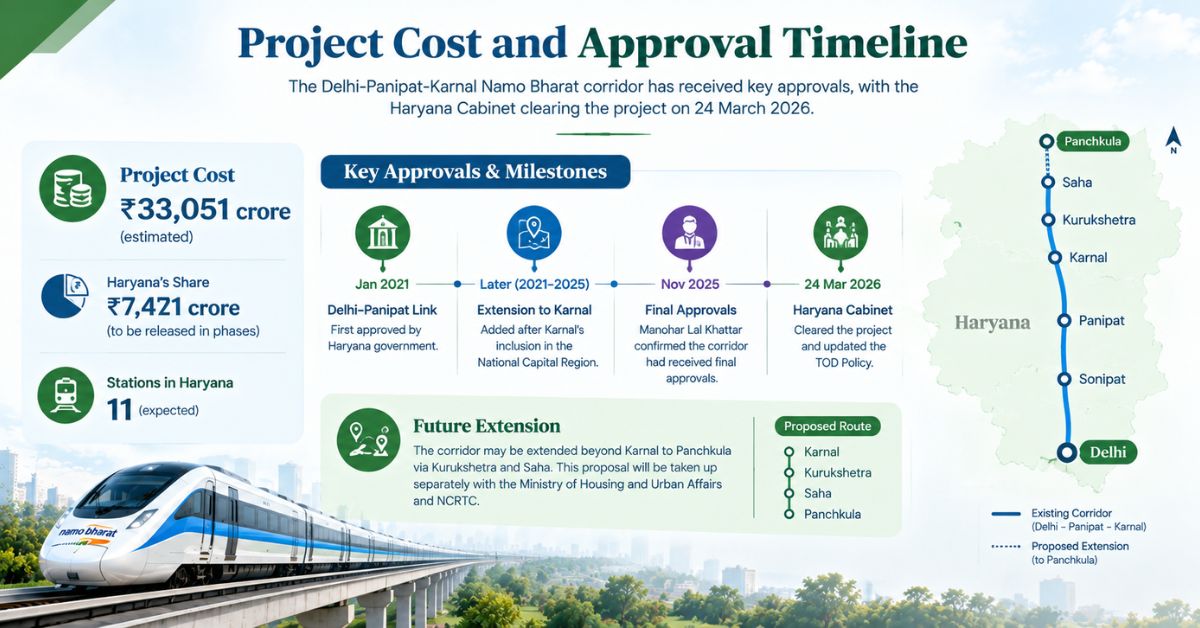
The corridor was cleared by the Haryana Cabinet on 24 March 2026. According to Swarajya’s report on the cabinet decision, the project is estimated to cost around Rs 33,051 crore, of which Haryana’s share is about Rs 7,472 crore, to be released in phases. The corridor is expected to include 11 stations within the state.
The project builds on years of planning. The Delhi-Panipat link was first approved by the Haryana government in January 2021, and the extension to Karnal was added later after Karnal’s inclusion in the National Capital Region. In November 2025, then Union Housing and Urban Affairs Minister Manohar Lal Khattar confirmed the corridor had received its final approvals, clearing the way for execution to begin.
The cabinet has also asked that the corridor eventually be extended beyond Karnal to Panchkula, via Kurukshetra and Saha, a proposal that is to be taken up separately with the Ministry of Housing and Urban Affairs and NCRTC.
Ground Work Already Under Way
Full construction has not started across the alignment, but preparatory work has begun in sections. NCRTC has floated tenders for road widening and restoration along the Delhi-Panipat-Karnal road, intended to keep traffic moving smoothly once heavier construction begins.
Utility relocation work is also under way. According to a report on NCRTC’s pre-construction activities, a tender covering the shifting of low-tension electrical utilities and the relocation of streetlights along the Delhi section of the alignment, between roughly the 9.5-km and 20.7-km marks, has been issued, with the work expected to be completed within a year.
Separately, Haryana has approved a faster land-purchase mechanism for NCRTC’s Haryana corridors, allowing direct acquisition of private land and property through negotiation, extending a framework first used for the Gurugram Metro project.
Also Read- Digital Land Record Haryana: A Complete Guide for Property Buyers
Why This Update Matters
For towns like Panipat, Sonipat and Karnal, a confirmed TOD framework changes how future development around stations can be approached. Rather than retrofitting transit into an already built-up area, planners can shape roads, housing density and commercial space around the corridor from an earlier stage.
For Panipat, station points at Samalkha, Sewah and Panipat City open up several locations for transit-linked development, and a planned link between the Sewah station and the local bus stand could strengthen the connection between road and rail transport in the city.
For Karnal, stations at Karnal ISBT, Sector 7, Gharaunda and Kohand bring established urban pockets directly into the transit network, a point local officials have described as central to the district’s broader connectivity push.
For Sonipat, the alignment through Kundli, Murthal, Bahalgarh Chowk and Ganaur adds to an area that already sits close to Delhi’s northern boundary, reinforcing its position as one of the more active markets in the corridor’s catchment.
What Comes Next
The corridor is still some distance from full construction. With enabling works such as road widening and utility shifting progressing, and land acquisition now easier to carry out under the new purchase policy, the next milestones to watch are the start of station and viaduct construction and further clarity on a construction timeline from NCRTC and HMRTC.
Residents along the route, particularly in Karnal, have described the TOD inclusion as a sign that the long-pending project may move faster, though officials have not announced a firm date for civil construction to begin end to end.
Looking for a home in one of these growing NCR corridors. Explore our ready to move flats, apartments and penthouses, and book a site visit to see the locations and layouts for yourself.
Frequently Asked Questions
What did Haryana just announce about the Namo Bharat corridor?
On 22 September 2026, Haryana’s Town and Country Planning Department added the Delhi-Panipat-Karnal Namo Bharat corridor to the state’s TOD Policy, allowing transit oriented planning around its future stations.
How long is the Delhi-Panipat-Karnal corridor and what will it cost?
The corridor runs about 136.30 km and is estimated to cost around Rs 33,051 crore, with Haryana’s share pegged at about Rs 7,472 crore, released in phases.
Which cities and towns will the corridor pass through?
The alignment covers Delhi, Narela, Sonipat, Murthal, Ganaur, Samalkha, Panipat, Gharaunda and Karnal, converging with the wider Namo Bharat network at Sarai Kale Khan.
Has construction started on this corridor?
Full construction has not begun, but preparatory work including road widening, restoration and utility relocation is under way in sections of the alignment.
What does TOD status mean for property near the stations?
TOD status allows for planning changes such as higher floor area ratios and mixed use development around stations, which can support more organised residential and commercial growth in these areas over time.
