
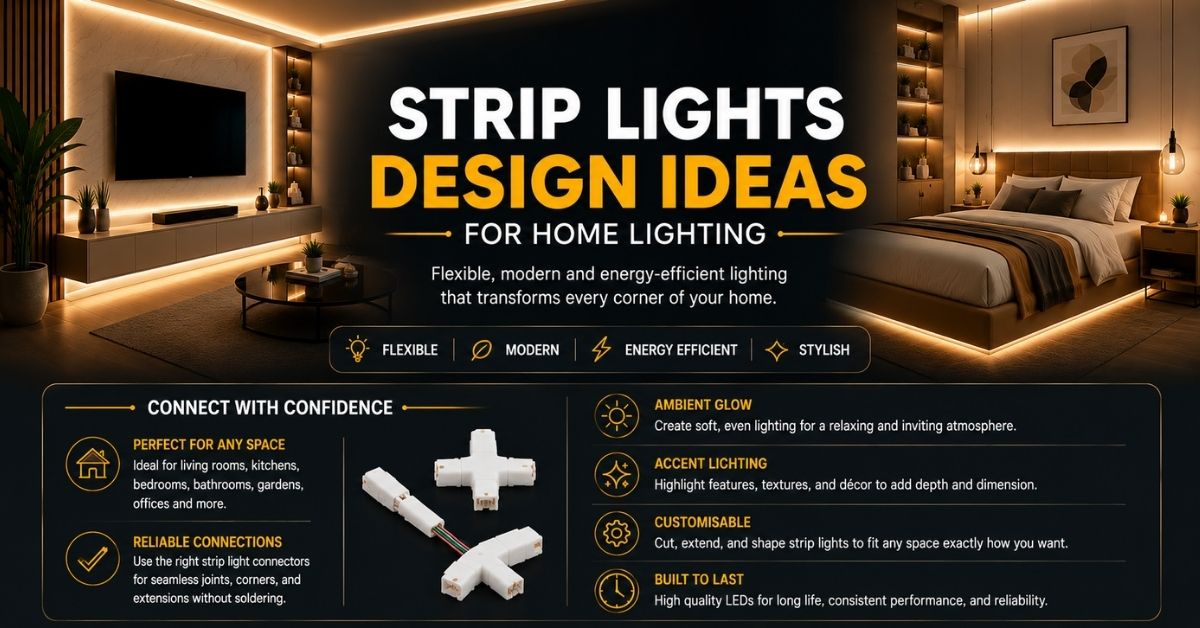
Lighting design has shifted considerably over the past decade, moving away from single fixed fixtures toward more flexible, layered lighting solutions, and strip lights sit right at the centre of this change. These slim, flexible lighting strips allow homeowners to add illumination in places that traditional bulbs and fixtures simply cannot reach, from tight cabinet edges to long ceiling coves. Their popularity continues to grow because they combine practicality with striking visual effect, transforming ordinary spaces into something far more dynamic.
This guide explains how strip lights work, why they have become such a popular lighting choice, and how homeowners can plan installations across different rooms. It covers the main types available, connector systems, and practical placement ideas suited to various interior styles. Whether you want subtle ceiling accents or bold colour changing effects, there is a strip light solution that fits your space.
Understanding How Strip Lights Work
A strip light consists of a flexible circuit board embedded with a series of small light emitting diodes, all housed within a thin, adhesive backed strip that can bend and curve around corners, edges, and curved surfaces. This flexibility sets strip lights apart from traditional bulb based fixtures, since they can be installed in places that would otherwise remain completely unlit, such as beneath kitchen cabinets, along staircase edges, or behind a television for ambient backlighting.
Most modern led strip lights run on low voltage direct current, which typically requires a separate power adapter or driver to convert standard household electricity into a usable form. This low voltage design makes strip lights considerably safer to handle during installation compared to traditional high voltage wiring, and it also contributes to their energy efficient performance, since LED technology consumes significantly less electricity than older incandescent or halogen alternatives.
The adhesive backing found on most led light strips allows for straightforward installation without requiring extensive tools or professional wiring work in many cases, though larger installations covering entire rooms or ceilings often benefit from professional planning to ensure proper power distribution and secure mounting.
Also Read- Kitchen Lights Ideas Worth Considering
Popular Types of Strip Lights to Consider
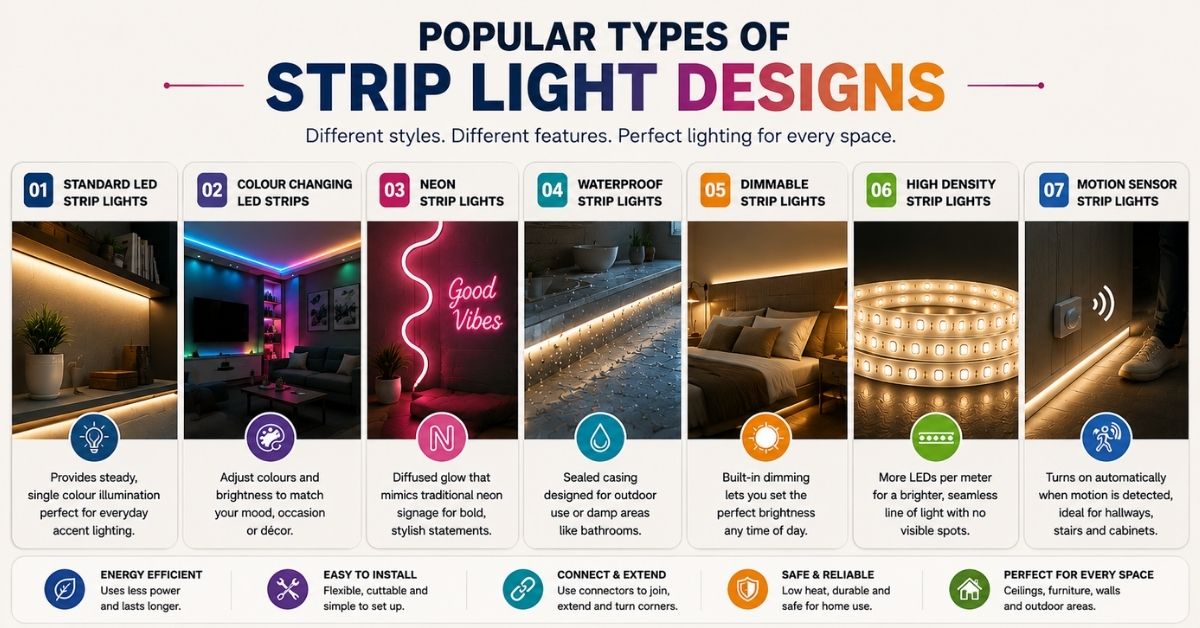
Strip lights come in several distinct categories, each suited to different applications and visual effects. Understanding these common types helps homeowners select the right option for their specific lighting goals.
- Single colour LED strips: Offers a fixed white or coloured light output, suited to straightforward accent or task lighting.
- Colour changing RGB strips: Allows users to switch between multiple colours, often controlled through a remote or app.
- Neon strip lights: Features a diffused, tube like glow that mimics the look of traditional neon signage.
- Dimmable LED strips: Includes adjustable brightness settings for flexible ambient lighting throughout the day.
- Waterproof LED strips: Designed with a protective coating suited to bathrooms, kitchens, or outdoor installations.
- High density LED strips: Packs more diodes per length for a brighter, more even glow without visible dots.
- Smart connected strips: Integrates with home automation systems for voice or app based control.
Each of these types serves a different purpose depending on the room and desired effect. Neon strip lights tend to suit bold, statement making installations, such as wall art or signage, while dimmable and colour changing strips work particularly well for ambient lighting in living rooms and bedrooms where flexibility matters most.
Why LED Strip Lights Continue to Grow in Popularity
The appeal of led strip lights largely comes down to their combination of energy efficiency, flexibility, and relatively low installation cost compared to more elaborate lighting systems. Since LED technology consumes far less power than traditional bulbs while producing comparable or even superior brightness, homeowners can run these lights for extended periods without a significant impact on their electricity bills.
Beyond efficiency, led light strips also offer a level of design flexibility that few other lighting solutions can match. A single continuous strip can wrap around curved furniture edges, follow the contour of a ceiling cove, or trace the outline of a mirror, creating lighting effects that would be nearly impossible to achieve with individual bulbs or fixtures. This adaptability explains why interior designers and homeowners alike increasingly reach for strip lighting when planning both functional task lighting and purely decorative accent lighting.
The long operational lifespan of LED diodes also contributes to their growing popularity, since most led strip lights last for many thousands of hours before requiring replacement, significantly reducing the ongoing maintenance typically associated with traditional lighting fixtures. This durability makes strip lights a particularly practical choice for hard to reach installations, such as high ceilings or built in furniture, where frequent bulb changes would otherwise prove inconvenient.
Also Read- False Ceiling Lights: Designs, Colours & Ideas That Transform Any Room
Ceiling Strip Lights for Ambient Illumination
Ceiling strip lights have become an especially popular application, since they allow homeowners to introduce soft, even illumination across an entire room without relying solely on a central overhead fixture. Installed along the perimeter of a ceiling, often within a recessed cove or false ceiling design, these strips create a gentle wash of light that reflects off the ceiling surface, producing a soft glow rather than harsh, direct illumination.
This approach works particularly well when combined with false ceiling designs, since the recessed channel conceals the strip itself while still allowing the emitted light to spread evenly across the room. Ceiling led strip lights also pair effectively with dimmable controls, allowing homeowners to adjust brightness levels throughout the day, shifting from brighter functional lighting during work or study hours to a softer, more relaxed glow in the evening. Many homeowners also use ceiling mounted strips to define distinct zones within an open plan space, subtly separating a living area from a dining section purely through variations in overhead lighting.
Neon Strip Lights for Bold Statement Pieces
While standard LED strips typically produce distinct points of light along their length, neon strip lights use a diffusing cover that spreads the light evenly, creating a continuous glowing line that closely resembles traditional glass neon signage. This visual effect has made neon strips particularly popular for decorative applications, such as custom wall art, signage, or accent lighting behind furniture.
The flexible nature of neon strip lights allows them to be shaped into curves, letters, or custom outlines, giving homeowners considerably more creative freedom compared to rigid traditional neon tubing. Since these strips typically run on the same low voltage LED technology as standard strip lights, they also offer similar energy efficiency and safety advantages, without the fragility associated with glass based neon signs. Many homeowners choose neon strips for home bars, entertainment rooms, or children’s bedrooms, where a playful, glowing accent adds personality without requiring permanent structural changes.
Also Read- Magnetic Track Lighting: Guide to Styles and Uses
Understanding Strip Light Connectors
Any installation involving multiple strip light sections, corners, or extended runs typically requires strip light connectors to join individual pieces together seamlessly. These connectors allow strips to bend around corners, extend across longer distances, or branch into multiple directions without interrupting the electrical circuit that powers the diodes.
Led strip light connectors generally fall into a few common categories, including straight connectors for joining two strip ends in a line, corner connectors for turning a strip around a ninety degree angle, and clip style connectors that allow strips to be joined without soldering. Choosing the right connector type depends largely on the specific installation layout, since a straightforward straight run along a single wall requires far simpler connectors compared to a complex installation wrapping around multiple furniture edges or ceiling angles. Proper connector selection also affects the long term reliability of the installation, since poorly matched or loosely fitted connectors can lead to flickering or intermittent lighting over time.
Also Read- Living Room Pop Design Ideas for Walls and Ceilings
Practical Placement Ideas for Strip Lights
Strip lights suit a remarkably wide range of placements throughout a home, extending well beyond their common use under kitchen cabinets. Staircases benefit significantly from strip lighting installed along the edge of each step, improving safety during low light conditions while also adding a striking visual effect. Behind a television or media unit, a strip light creates a soft backlight that reduces eye strain during evening viewing, since the ambient glow lessens the contrast between the bright screen and a dark room.
Wardrobes and cabinets also benefit from strip lighting installed along interior shelves, making it considerably easier to locate items stored in deeper or darker sections. Mirror surrounds, particularly in bathrooms or dressing areas, gain both function and style from a well placed strip light, since the even illumination reduces shadows during grooming tasks. Outdoor spaces, provided a waterproof rated strip is used, can also benefit from strip lighting along pathways, decking edges, or garden features, extending the same flexible lighting approach beyond the interior of the home.
Conclusion
Strip lights offer a flexible, energy efficient way to bring both functional and decorative lighting into nearly every corner of a home. From subtle ceiling accents to bold neon statement pieces, there is a style suited to every room and design preference. Careful planning around connectors, placement, and power supply ensures the final installation performs beautifully for years to come.
Explore Express Builders ongoing residential projects across Noida and Greater Noida West. See the quality and planning behind every home firsthand.
Book a free site visit today with Express Builders. Walk through our ongoing projects and see construction quality up close. Check out floor plans, amenities, and location advantages in person. Meet our team and get your property-related questions answered directly. Schedule a visit at your convenience.
Frequently Asked Questions
What is the difference between LED strip lights and neon strip lights?
LED strips typically show individual light points, while neon strip lights use a diffusing cover for a continuous, even glow.
Do strip lights require professional installation?
Simple adhesive backed installations can often be done without professional help, though larger or ceiling based setups may need expert planning.
Can strip light connectors be used to join strips around corners?
Yes, corner connectors are specifically designed to allow strip lights to bend around ninety degree angles without breaking the circuit.
Are ceiling strip lights suitable for every room?
Yes, ceiling strip lights work well in most rooms, particularly when paired with a false ceiling or recessed cove design.
Do LED strip lights consume a lot of electricity?
No, LED strip lights are highly energy efficient and consume significantly less power compared to traditional incandescent lighting.
