

A staircase built with granite carries a certain permanence that few other materials can match, both in how it looks and in how long it genuinely lasts under daily foot traffic. Granite stairs design has remained a consistent favourite across Indian homes for decades, valued for its natural strength, wide range of colour options, and the way it ages gracefully rather than showing wear as softer materials often do. This guide walks through the finishes, patterns, and planning decisions behind a strong granite stairs design.
Why Granite Remains a Top Choice for Staircases
Granite earns its long-standing popularity through a rare combination of durability, visual richness, and relatively low maintenance once properly sealed. Unlike engineered materials that can chip or discolour within a few years, a well-installed stair design granite surface tends to hold its finish and structural integrity for decades, making it a practical long-term investment rather than a purely decorative choice. The natural variation within each slab also means no two staircases look entirely identical, giving homeowners a genuine sense of individuality manufactured alternatives struggle to replicate.
Granite also performs well under the specific stresses a staircase faces daily, including foot traffic and occasional impact, which explains why granite design for stairs continues to appear consistently across both budget and premium projects.
Types and Finishes of Granite Worth Knowing
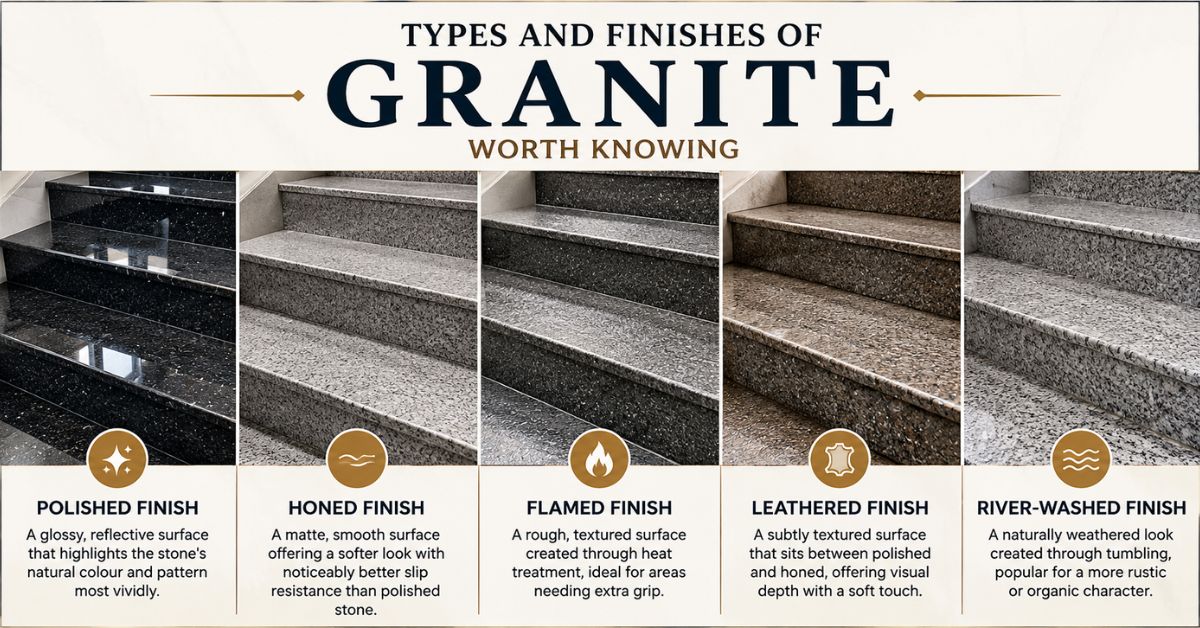
Granite comes in a genuinely wide range of finishes, each altering both the visual character and the practical performance of the final staircase. Understanding these options in advance makes it much easier to select a finish that suits both your taste and your household’s daily needs.
- Polished finish – a glossy, reflective surface that highlights the stone’s natural colour and pattern most vividly
- Honed finish – a matte, smooth surface offering a softer look with noticeably better slip resistance than polished stone
- Flamed finish – a rough, textured surface created through heat treatment, ideal for areas needing extra grip
- Leathered finish – a subtly textured surface that sits between polished and honed, offering visual depth with a soft touch
- River-washed finish – a naturally weathered look created through tumbling, popular for a more rustic or organic character
Choosing between these finishes often comes down to balancing appearance against practicality, since a highly polished staircase looks striking but can become genuinely slippery underfoot, particularly in humid climates or households with young children and elderly residents.
Popular Patterns and Layouts for Granite Staircases
Design patterns in stairs made by granite have grown considerably more varied over the past decade, moving beyond simple single-slab steps into compositions that treat the staircase as a genuine design feature. Many homeowners now choose a two-tone approach, pairing a darker granite tread with a lighter riser, creating visual rhythm as the eye moves up the staircase. Book-matched slabs, where adjacent granite pieces are arranged so their veining mirrors symmetrically, have also grown popular for statement staircases, since the effect signals a higher level of craftsmanship. Some designs add a contrasting granite border along each step edge, both as an accent and as a practical way to improve step visibility in low-light stairwells.
Also Read- Floating Stairs Design Guide: Modern Ideas and Benefits
Choosing Granite for a Modern Home
A modern granite stairs design typically favours simpler, more restrained patterns over the heavily veined slabs that suited more traditional interiors in earlier decades. Homeowners building contemporary homes often gravitate toward muted greys, soft beiges, or near-black tones with minimal veining, since these integrate more seamlessly with the clean lines common in modern architecture.
A modern granite stairs design also tends to favour a honed or leathered finish over high-gloss polish, since the softer sheen suits minimalist interiors and reduces slip risk. Pairing granite steps with slim steel railings or glass balustrades further reinforces this look, keeping the natural stone as the visual focus without competing hardware.
How Granite Stone Compares to Other Stair Materials
A granite stone stair design offers several distinct advantages when weighed against materials like marble, engineered quartz, and wood. Compared to marble, granite generally offers better resistance to scratching and etching from acidic substances, making it more forgiving for a high-traffic area like a staircase. Against engineered quartz, natural granite offers a more authentic, one-of-a-kind character, though quartz offers more consistent colour matching if uniformity matters more than natural variation.
Wood brings undeniable warmth but requires considerably more maintenance and performs worse under moisture compared to a properly sealed granite stone stair design. This generally favours granite for homeowners prioritising long-term durability, while those seeking colour uniformity might lean toward an alternative.
Planning Granite Design for Stairs in Home Settings
Planning a granite design for stairs in home construction requires coordinating several practical factors before the material arrives on site. The staircase structure needs to be finalised first, since granite slabs are cut to precise measurements and late changes to riser height can create costly delays. Homeowners should also account for the additional structural weight granite adds, which matters particularly for older homes or upper-floor installations where load capacity needs confirmation beforehand.
Sourcing enough granite from a single batch matters considerably too, since colour and veining vary between production runs, leading to a visibly inconsistent staircase otherwise. Working with a fabricator experienced specifically in staircase installation, not just flooring, makes a genuine difference in how precisely the steps align.
Key Factors to Check Before You Finalise Your Stairs
Before committing to any specific granite stairs design, a handful of practical checks can help you avoid costly mistakes or performance issues later. Reviewing this list carefully during your planning process ensures the staircase performs as well as it looks once installed.
- Slip resistance rating – confirm the chosen finish offers adequate grip, particularly for a honed or leathered surface over polished stone
- Slab consistency – source enough material from a single batch to avoid visible colour or veining mismatches across steps
- Structural load capacity – verify the staircase and supporting structure can bear granite’s additional weight compared to lighter materials
- Edge profile – decide on a bullnose, beveled, or square edge finish, since this affects both safety and overall appearance
- Sealing requirements – confirm the specific granite type’s sealing needs, since porosity varies meaningfully between different stone varieties
- Fabricator experience – choose an installer specifically experienced with staircase work, not only flooring or countertop installation
Matching Granite Stairs With Your Home’s Interior

A granite stairs design should feel like a natural extension of the home’s broader material palette, rather than a standalone decision made independently of the flooring and walls nearby. Homes using granite or a similar stone elsewhere, such as flooring or countertops, often benefit from carrying a complementary tone through to the staircase, creating continuity as a person moves between rooms. Where the staircase sits within an open-plan layout visible from the living area, treating it as a genuine design feature tends to produce a more cohesive result. Lighting also plays a meaningful role, since natural stone reveals its full depth best under strong, well-placed lighting.
Also Read- Duplex House Stairs Design: Materials, Styles, and Tips
Maintenance Tips for Long-Lasting Granite Stairs
Even a well-installed granite stairs design benefits from some basic ongoing care to preserve its finish and appearance over many years of daily use. Sweep or wipe steps regularly to prevent grit and dust from acting as an abrasive under foot traffic, which can gradually dull a polished surface over time. Reseal the granite periodically, generally every one to two years depending on the specific stone’s porosity, to maintain its resistance to staining from spills or general household use. Avoid harsh acidic cleaners, since these can degrade the sealant and, in rare cases, etch the stone’s surface with repeated exposure. Address any chips or cracks promptly with professional repair, since small damage left unaddressed can worsen under the ongoing stress of daily staircase use.
Common Mistakes to Avoid in Granite Stair Selection
Many homeowners select granite purely from a small showroom sample, without considering how the pattern reads across the full staircase under their home’s actual lighting. Avoid a high-gloss polished finish without weighing the slip risk, particularly with young children or elderly residents using the stairs daily. Do not overlook the additional structural weight granite introduces, since skipping this check can create real safety concerns in older structures. Sourcing slabs from multiple, inconsistent batches is another common misstep, often resulting in visibly mismatched colour between steps. Avoid rushing fabricator selection too, since a granite stairs design installed by an inexperienced team can result in uneven steps or poor edge finishing.
Bringing It All Together
Granite stairs design sits at the intersection of everyday durability and long-term visual richness, making it a decision worth genuine research rather than a rushed, last-minute choice. From selecting the right finish and pattern to planning around structural weight and sourcing consistent slabs, every choice contributes to how the staircase performs and looks for decades to come. Taking the time to compare a few options, check practical factors like slip resistance and load capacity, and work with an experienced fabricator ensures the granite stairs design you choose serves your home safely and beautifully for many years ahead.
Explore Express Builders ongoing residential projects across Noida and Greater Noida West. See the quality and planning behind every home firsthand.
Book a free site visit today with Express Builders. Walk through our ongoing projects and see construction quality up close. Check out floor plans, amenities, and location advantages in person. Meet our team and get your property-related questions answered directly. Schedule a visit at your convenience.
Frequently Asked Questions
1. Is granite a good choice for a staircase in humid climates?
Yes, granite performs well in humid conditions when properly sealed, resisting moisture damage better than many alternative materials.
2. Which granite finish offers the best slip resistance for stairs?
A honed or flamed finish generally offers better grip than a polished surface, making it a safer choice for daily staircase use.
3. How often does a granite stairs design need resealing?
Most granite staircases need resealing every one to two years, though this can vary depending on the specific stone’s porosity.
4. Is granite heavier than other common stair materials?
Yes, granite is generally heavier than wood or engineered alternatives, so structural load capacity should be confirmed before installation.
5. Can granite stairs be customised with patterns or borders?
Yes, options like two-tone treads, book-matched slabs, and contrasting borders are increasingly popular ways to personalise a granite staircase.
