
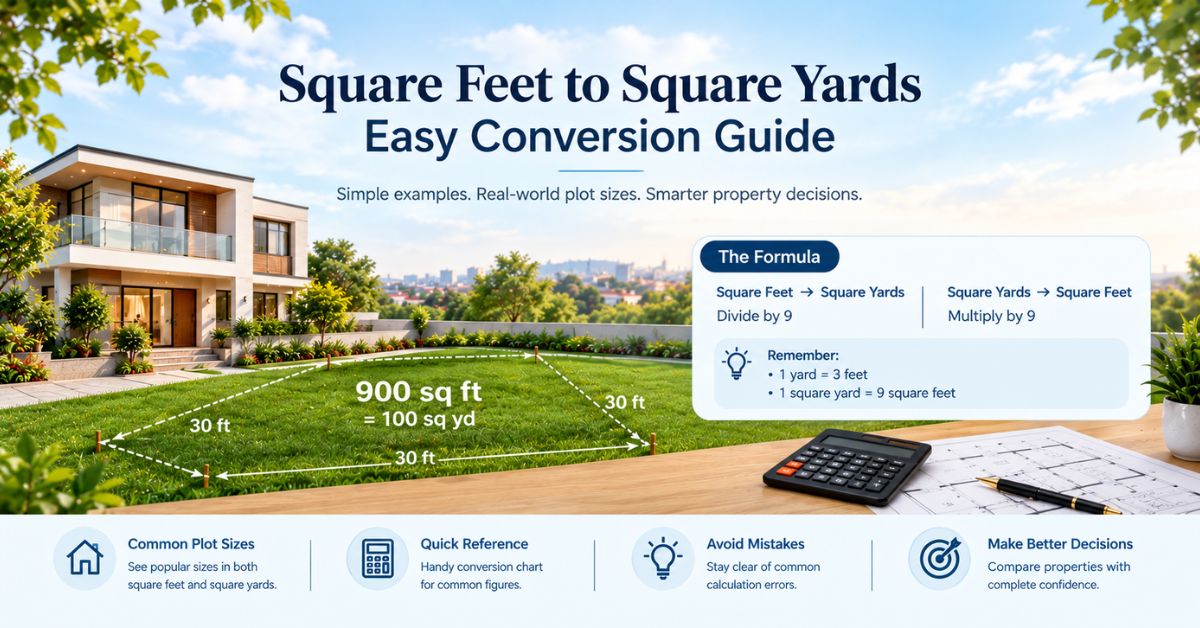
Anyone who has shopped for a plot, flat, or piece of land has likely run into two different units of measurement being used almost interchangeably, square feet and square yards. Builders, brokers, and government land records do not always stick to the same unit, which means buyers frequently need to convert square feet to square yards just to compare two properties fairly. Understanding this conversion is not just a matter of mathematical curiosity. It directly affects how accurately a buyer can judge pricing, plot size, and overall value when exploring real estate options.
Property measurements can look confusing at first, especially when a listing quotes square yards while another nearby property uses square feet. Knowing how to move between these units confidently removes this confusion entirely, allowing buyers to compare properties on equal footing regardless of which unit a specific listing or document happens to use. This guide walks through the conversion itself, along with practical examples and common plot sizes that make the numbers easier to picture in real terms.
Why This Conversion Matters in Real Estate
Square yards remain a particularly common unit in many parts of India, especially for plots and land parcels, while square feet tends to dominate listings for built up flats and apartments. This split in convention means buyers often need to convert square feet to square yard measurements simply to understand what they are actually being offered, particularly when comparing a plot priced per square yard against a flat priced per square foot.
Getting this conversion right also protects buyers from potential confusion or miscalculation during price negotiations. A seemingly small error in converting between units can lead to a meaningfully different understanding of total cost, since property prices are often quoted on a per unit basis. A buyer who mistakenly treats a square yard figure as though it were square feet, or the reverse, risks significantly misjudging both the size and the value of a property under consideration.
Beyond pricing, accurate unit conversion matters for practical planning as well. Knowing the precise area of a plot in both square feet and square yards helps when discussing construction plans, comparing against local building regulations, or simply visualising how much usable space a property actually offers. This clarity becomes especially important when a buyer is comparing multiple properties that have been listed using different units by different sellers or agents.
Also Read- Hectare to Bigha: Easy Land Conversion Guide
The Core Conversion Formula
Converting square feet to square yards relies on a simple, fixed relationship between the two units. Since one yard equals three feet, one square yard equals nine square feet, because squaring the three feet measurement in each direction gives three multiplied by three. In mathematical terms, this base relationship is written as:
1 yard = 3 feet 1 square yard = (3 feet) squared = 9 square feet
This single relationship forms the basis for every conversion in either direction.
To convert square feet to square yards, the total square footage simply needs to be divided by nine. Written as a formula, this is:
Area in square yards = Area in square feet divided by 9
For example, a plot measuring 900 square feet converts directly to 100 square yards, since 900 divided by nine equals 100, or 900 sq ft divided by 9 = 100 sq yd. This straightforward division works for any square footage figure, making it easy to calculate on the spot without needing specialised tools or calculators for most everyday property comparisons.
Converting in the opposite direction, from square yards to square feet, works just as simply by multiplying the square yard figure by nine. Written as a formula, this is:
Area in square feet = Area in square yards multiplied by 9
A plot measuring 200 square yards, for instance, converts to 1,800 square feet, since 200 multiplied by nine equals 1,800, or 200 sq yd multiplied by 9 = 1,800 sq ft. Keeping this multiplication and division relationship in mind makes switching between the two units a quick mental calculation rather than a cause for confusion.
Common Plot Sizes in Square Yards
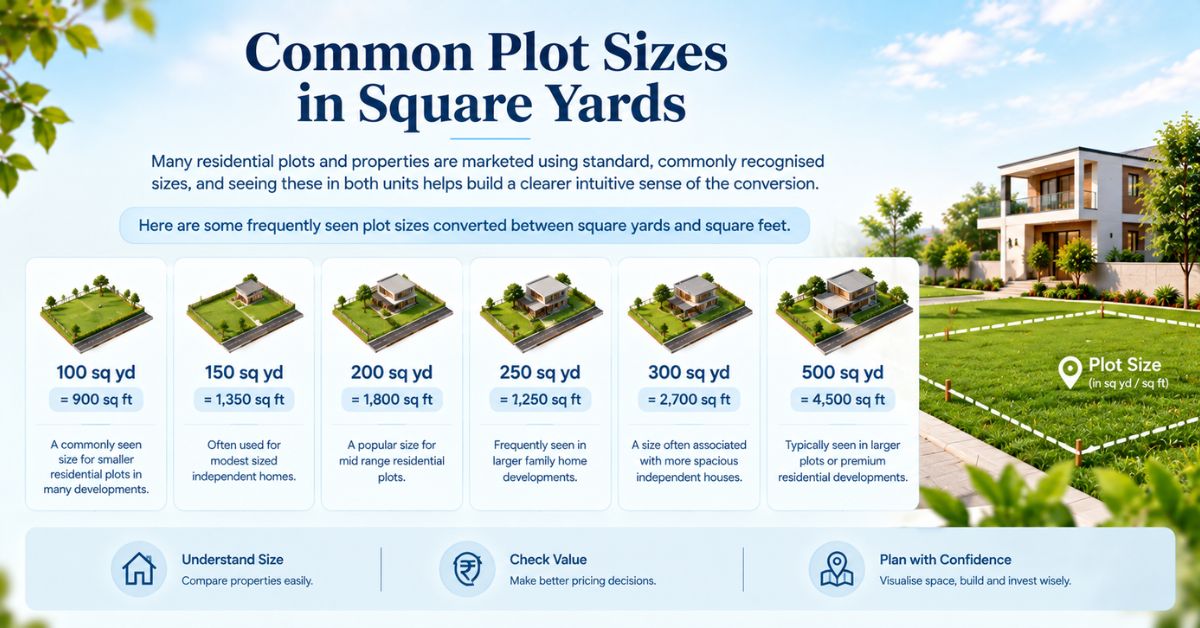
Many residential plots and properties are marketed using standard, commonly recognised sizes, and seeing these in both units helps build a clearer intuitive sense of the conversion. Here are some frequently seen plot sizes converted between square yards and square feet.
- 100 square yards equals 900 square feet, a commonly seen size for smaller residential plots in many developments.
- 150 square yards equals 1,350 square feet, often used for modest sized independent homes.
- 200 square yards equals 1,800 square feet, a popular size for mid range residential plots.
- 250 square yards equals 2,250 square feet, frequently seen in larger family home developments.
- 300 square yards equals 2,700 square feet, a size often associated with more spacious independent houses.
- 500 square yards equals 4,500 square feet, typically seen in larger plots or premium residential developments.
Also Read- 1 Hectare to Acre: Simple Conversion Guide & Formula
Quick Reference Conversion Chart
For buyers who prefer to check conversions quickly without doing the maths each time, a simple reference chart covering frequently needed figures can be particularly useful.
- 1 square yard to square feet equals 9 square feet exactly.
- 10 square yards to square feet equals 90 square feet.
- 50 square yards to square feet equals 450 square feet.
- 1,000 square ft to square yards equals approximately 111.1 square yards.
- 2,000 square ft to square yards equals approximately 222.2 square yards.
- 5,000 square ft to square yards equals approximately 555.6 square yards.
Keeping a reference like this on hand, whether mentally memorised or jotted down, makes it considerably easier to quickly sense check figures while comparing property listings or discussing measurements with an agent or developer.
Understanding Yards and Feet as Units
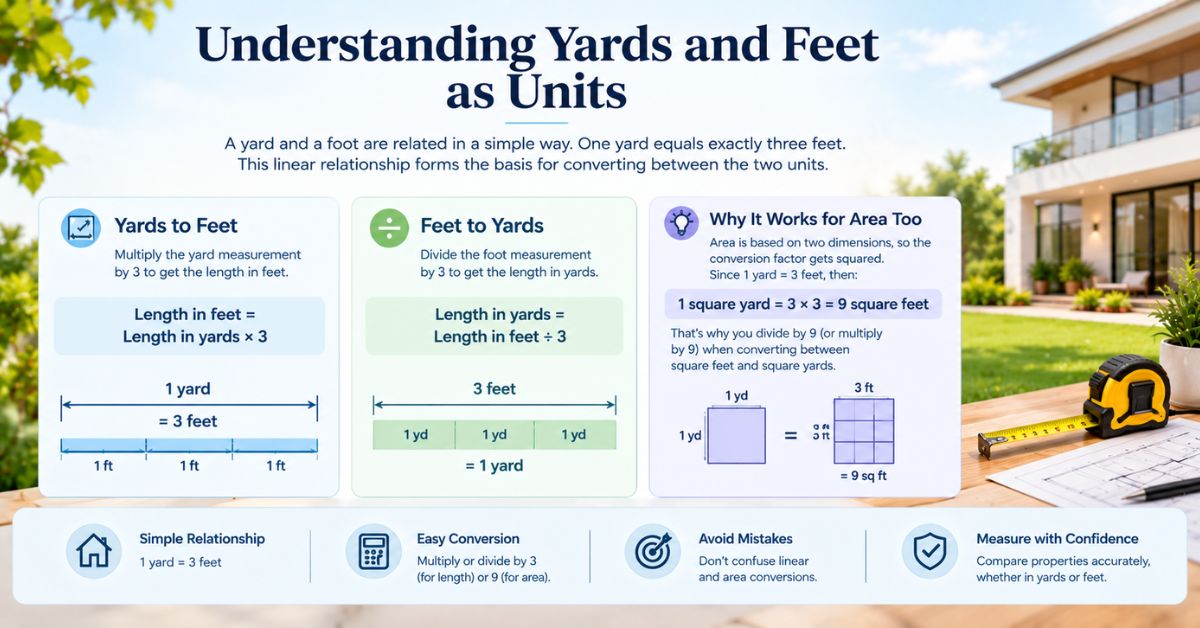
Before diving deeper into area conversions, it helps to understand the basic linear relationship behind these units. One yard to feet converts directly to three feet, since a yard is defined as exactly three feet in length. In formula form, this is written as:
Length in feet = Length in yards multiplied by 3
This same relationship works in reverse as well, with feet to yard conversion requiring the feet figure to be divided by three to arrive at the equivalent yard measurement, written as:
Length in yards = Length in feet divided by 3
This linear relationship is what ultimately drives the area conversion discussed earlier, since squaring a linear measurement naturally squares its conversion factor as well. Understanding this underlying logic, rather than simply memorising the final multiplication or division factor, makes the entire conversion process feel more intuitive and easier to apply confidently across different situations, whether converting a simple length or a full property area.
Also Read- Market Value of Land: A Complete Guide for Property Buyers
Common Mistakes to Avoid While Converting
A few recurring errors tend to trip up buyers when converting between square feet and square yards, and being aware of them helps avoid costly misunderstandings. One frequent mistake involves confusing linear conversion with area conversion, mistakenly dividing or multiplying by three instead of nine when working with area figures rather than simple length measurements. Since area involves two dimensions rather than one, the conversion factor for square measurements is always the square of the linear conversion factor.
Another common error involves rounding too aggressively during calculations, particularly when converting square ft to square yards, where the result often involves a recurring decimal rather than a clean whole number. Rounding prematurely during an intermediate step, rather than at the very end of a calculation, can introduce small but meaningful inaccuracies, especially when dealing with larger property sizes where even minor rounding errors can add up to a noticeable difference in total area.
Mixing up which unit a specific listing or document is actually using also causes confusion. Since both units are common in Indian real estate, always double checking the stated unit before performing any calculation helps avoid applying the wrong conversion formula entirely, which could otherwise lead to a significantly skewed understanding of a property’s true size.
Why Builders and Buyers Use Square Yards
Square yards have remained a popular unit for plot sizes and land measurement across many regions, partly due to historical convention and partly because the unit tends to produce more manageable, easier to visualise numbers for larger land parcels compared to square feet. A 200 square yard plot, for instance, feels more immediately graspable than its 1,800 square foot equivalent for many buyers accustomed to thinking in yards.
This preference for square yards is particularly common in property registration documents, government land records, and traditional real estate transactions, while square feet tends to dominate more modern listings, especially for flats and apartments where built up area is the primary focus rather than open land. Recognising which context typically uses which unit helps buyers anticipate what kind of conversion they are likely to need when reviewing different types of property documentation.
Also Read- Property Registration 2026: Best Purchase Dates
Bringing It All Together
Converting square feet to square yards is a simple but genuinely useful skill for anyone navigating property searches, comparisons, or documentation. Understanding that one square yard equals nine square feet, and applying this relationship through straightforward division or multiplication, removes much of the confusion that can otherwise arise when comparing listings quoted in different units. Keeping common plot sizes and a quick reference chart in mind further simplifies the process, making it easy to sense check figures on the spot.
Taking the time to understand this conversion thoroughly, along with the common mistakes to watch for, ensures buyers can approach property comparisons with genuine confidence rather than uncertainty. Whether reviewing a plot listed in square yards or a flat quoted in square feet, this small piece of knowledge makes the entire property search process considerably smoother and more transparent.
Ready to explore properties measured and priced with complete transparency. Explore Express Builders ongoing residential projects across Noida and Greater Noida West. See the quality and planning behind every home firsthand.
Book a free site visit today with Express Builders. Walk through our ongoing projects and see construction quality up close. Check out floor plans, amenities, and location advantages in person. Meet our team and get your property-related questions answered directly. Schedule a visit at your convenience.
Frequently Asked Questions
How many square feet are in one square yard?
One square yard equals exactly nine square feet, since one yard equals three feet and squaring this linear measurement gives nine square feet per square yard.
How do I convert square feet to square yards quickly?
Divide the total square footage by nine to get the equivalent measurement in square yards, which works for any property size or area figure.
Why do some property listings use square yards while others use square feet?
Square yards are commonly used for plots and land, particularly in registration documents, while square feet is more often used for built up flats and apartments, reflecting different regional and historical conventions.
Is one yard the same as three feet?
Yes, one yard equals exactly three feet, and this linear relationship forms the basis for converting square yard and square feet area measurements as well.
What is a quick way to estimate square yards from square feet without a calculator?
Dividing the square footage by nine gives an accurate result, though a rough mental estimate can also be made by dividing by ten and adjusting slightly upward for a close approximation.
