
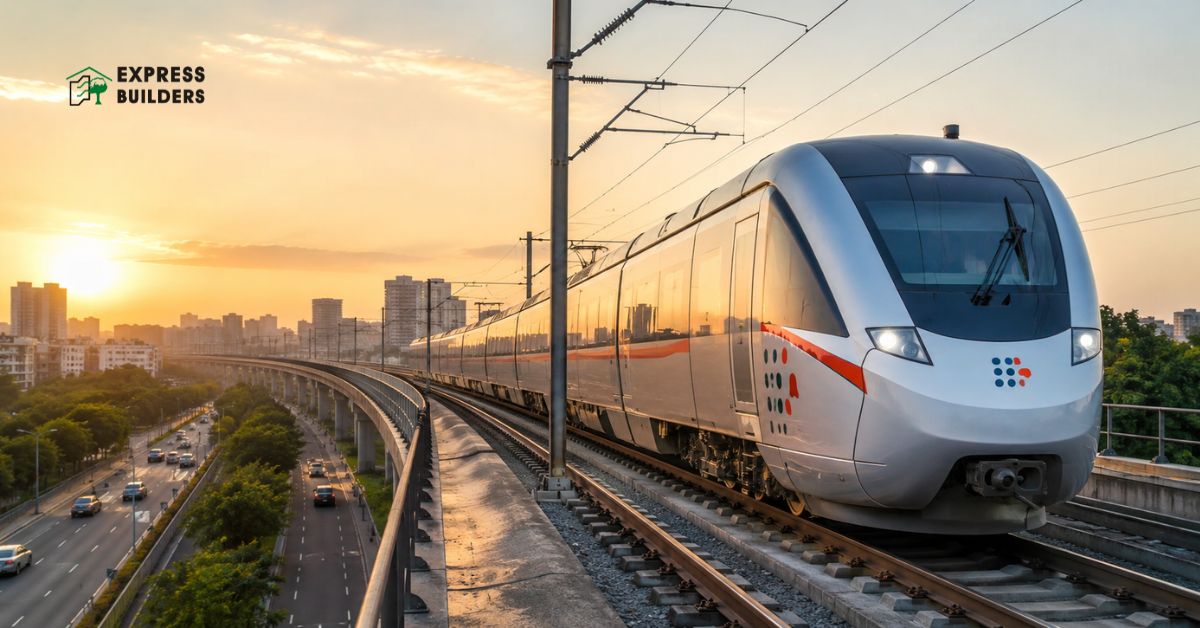
Imagine cutting your Delhi-to-Meerut commute from over two hours down to less than 60 minutes. That is exactly what the RRTS metro route delivers. It is not just another transit project, it is a complete transformation of how the National Capital Region moves, breathes, and grows.
If you are a daily commuter, a home buyer or simply curious about NCR’s future, understanding the RRTS metro route is a must. Let’s explain it all in plain terms thoroughly.
What Is RRTS? A Quick Overview
RRTS stands for Regional Rapid Transit System. The National Capital Region Transport Corporation (NCRTC) owns and develops this ambitious infrastructure project. Branded as RapidX or Namo Bharat, it operates as a semi-high-speed rail system. Trains run at a maximum speed of 160 km/h, making it India’s fastest urban rail network.
RRTS will be used for regional connectivity whereas Delhi Metro will be used for intra-city connectivity. It connects urban centers of Delhi with fast-growing satellite towns. In addition, it is also interwoven with the existing Delhi Metro network, Indian Railways stations and bus terminals, thereby providing an integrated multimodal transit system.
The RRTS Metro Route: Delhi to Meerut
The flagship RRTS corridor stretches 82 kilometres from Sarai Kale Khan in Delhi to Modipuram in Meerut. As of February 2026, the entire corridor is now fully operational, a landmark achievement for Indian infrastructure.
Here is a quick look at the key stations along the RRTS metro route:
Delhi Section:
- Sarai Kale Khan (integrated hub with metro and bus connectivity)
- New Ashok Nagar
- Anand Vihar (major interchange- metro, railways, and buses)
Ghaziabad Section:
- Sahibabad
- Ghaziabad (principal stop for daily NCR commuters)
- Guldhar
- Duhai Depot (primary maintenance hub)
Meerut Section:
- Murad Nagar
- Modi Nagar South
- Modi Nagar North
- Meerut South (first Meerut entry point)
- Partapur
- Shatabdi Nagar
- Meerut Central
- Modipuram (final terminus)
In total, the corridor hosts 16 stations. Nine of them also function as interchange nodes with the Meerut Metro system.
How the RRTS Route Opened in Phases
The project did not launch all at once. Instead, NCRTC rolled it out in smart, strategic phases so commuters could start benefiting early, even before full completion.
- October 2023: The 17 km priority section from Sahibabad to Duhai opened. This was India’s first operational RRTS stretch.
- March 2024: The corridor extended to Modinagar North, covering approximately 34 km.
- August 2024: Trains reached Meerut South, marking the system’s first entry into Meerut.
- January 2025: The Delhi extension to New Ashok Nagar expanded the operational length to roughly 55 km.
- February 2026: The full corridor from Sarai Kale Khan in Delhi to Modipuram in Meerut became fully operational.
A staged approach resulted in gradual ridership growth. At first, it had a capacity of approximately 2500-3000 passengers per day. As of April 2026, the corridor saw more than 92,000 riders per day, demonstrating the corridor’s real-world impact.
Travel Time and Speed: Why RRTS Is a Game-Changer
Speed is where RRTS truly stands apart. Trains cover the entire 82 km corridor in under 60 minutes. Compare that with the 2+ hours that road travel typically demands, and the difference is stark.
During peak hours (7-10 AM and 5-8 PM), trains run every 3 to 5 minutes. During off-peak hours, the frequency drops to 10-15 minutes. Trains operate daily from 6:00 AM to 11:00 PM, making them reliable for both early risers and late commuters.
The system uses standard gauge track (1,435 mm) and draws power from 25 kV AC overhead electrification. Additionally, it runs on a world-first hybrid Level 3 ETCS signalling system based on LTE technology which significantly enhances both safety and operational efficiency.
Key Features That Make RRTS Stand Out
Beyond speed, the RRTS metro route offers a premium commuting experience that sets it apart from conventional transit.
- Wide, Comfortable Coaches The Namo Bharat train coaches are 3.2 metres wide and 22 metres long considerably roomier than standard metro coaches. Alstom supplies 210 coaches for this corridor, all built with aerodynamic stainless steel and aluminium bodies.
- Premium and Standard Classes Passengers can choose between standard and premium seating. The premium section offers wider seats, charging ports, and a quieter travel environment much like a business class experience on rails.
- Seamless Connectivity RRTS connects with Delhi Metro’s Blue Line and Pink Line at multiple interchange points. Moreover, feeder bus services link stations to surrounding neighbourhoods, solving the last-mile connectivity challenge effectively.
- Medical Emergency Infrastructure Every station on the RRTS metro route is designed to handle medical emergencies. Elevators are high-capacity and spacious enough to accommodate stretchers, a thoughtful and essential safety feature.
- World-Class Signalling Technology The Level 3 ETCS signalling, commissioned in July 2024, is a global first. It operates via LTE rather than traditional trackside infrastructure, improving precision and reducing maintenance costs.
RRTS and Real Estate: The Connectivity Premium
Here is something every property buyer in NCR should understand clearly: transit connectivity drives real estate value.
The demand for homebuyers and investors has increased in the areas along the RRTS metro route. The thinking is very plain here: If a place is more accessible, a person will want to stay there. But as desirability increases, so do property values.
Ghaziabad, Modinagar and Meerut, which were earlier regarded as peripheral cities, are now lying right in one of the leading transportation corridors of India. As a result, people interested in residential and commercial real estate along this path are taking a close look at the properties.
This is especially potent when it comes to commuting time. This is an opportunity for a working professional in Delhi, who used to take 3-4 hours to commute each day for work, to get back that time. This, in turn, makes homes around RRTS stations a better quality of life for buyers.
Furthermore, improved connectivity reduces dependence on personal vehicles. This lowers household transportation costs while also contributing to cleaner air both of which make neighbourhoods more attractive to live in.
Future RRTS Corridors: What Comes Next
The Delhi-Meerut corridor is only the beginning. NCRTC has prioritised a total of 8 RRTS lines across the NCR. Planned future corridors include connections to Panipat in Haryana and Alwar in Rajasthan.
As these corridors come online, the RRTS network will grow into a web of high-speed regional connectivity linking Delhi with its satellite cities faster and more efficiently than ever before.
Each new corridor will create fresh real estate opportunity zones. Therefore, buyers and investors who position themselves early near planned RRTS stations often stand to benefit the most as infrastructure development catches up.
Why the RRTS Metro Route Matters for NCR’s Future
The RRTS is more than just a transport project, it is driving a new era of urban development across the NCR. By providing fast and reliable regional connectivity, it helps reduce road congestion, lowers vehicle emissions, and connects people to jobs and opportunities more efficiently. As a result, living in cities on the outskirts of Delhi has become a far more practical and attractive option.
For years, NCR residents have struggled with traffic congestion, air pollution, and long, unreliable commutes. However, the RRTS metro route directly addresses these challenges by offering a faster and more sustainable mode of transport. In addition, it encourages transit-oriented development, a model that has successfully transformed cities such as Tokyo, Singapore, and Dubai.
Moreover, rising ridership highlights the system’s growing impact. With daily passenger numbers exceeding 92,000 and continuing to increase, the RRTS has quickly become an essential part of NCR’s transportation network and future growth story.
Final Thoughts
The RRTS metro route from Delhi to Meerut represents a new chapter in how India builds cities and connects people. It brings speed, comfort, and reliability to one of the country’s busiest commuter corridors. And for those making real estate decisions in NCR today, the proximity to RRTS stations is fast becoming one of the most important factors to consider.
Understanding where the route runs, which stations matter and how this corridor reshapes value that knowledge gives you a genuine edge.
Thinking about buying a home near the RRTS corridor?
The right location along this route can offer both a better quality of life and stronger long-term value. Explore our premium residential projects strategically positioned near key RRTS stations and take the first step toward a smarter, better-connected home today.
Frequently Asked Questions:
Is RRTS faster than metro?
Yes. RRTS is significantly faster than a metro for longer intercity travel. While metros are designed for frequent stops within cities, RRTS trains run at much higher speeds with fewer stops, reducing travel time between cities and nearby urban centers. However, metros remain more convenient for local city commutes.
What is the RRTS train route?
The operational RRTS (Namo Bharat) route runs on the Delhi–Ghaziabad–Meerut corridor, connecting Sarai Kale Khan (Delhi) to Modipuram (Meerut) across approximately 82 km. Along the way, it stops at key stations such as New Ashok Nagar, Anand Vihar, Sahibabad, Ghaziabad, Guldhar, Duhai, Muradnagar, Modinagar South, Modinagar North, Meerut South, Shatabdi Nagar, Begumpul, and Modipuram. As a result, commuters can travel between Delhi and Meerut faster, more comfortably and with fewer delays.
