

You’ve just received a rent-hike notice. Or you’re about to sign a new agreement and one question keeps looping in your head: Can my landlord raise the rent whenever they want under the Rent Control Act 2026?
Most people assume the answer is simple. It isn’t.
Every state runs its own version of the law. Some cities still follow rules written in the 1950s. Others have already replaced the old Rent Control Act with newer tenancy laws.
This guide shows you exactly what the Act does, whether your rent is truly fixed, how much a landlord can legally increase it each year, and how the rules change from Delhi to Bengaluru to Noida.
Whether you rent, let out a property, or simply want clear answers before you sign, the practical state-specific details you need are right here.
What Is the Rent Control Act?

The Rent Control Act refers to a family of state laws – not one single national law – that regulate how much rent a landlord can charge, when a tenant can be evicted, and how disputes get resolved. India’s states first enacted these laws after World War II and Partition, when acute housing shortages left tenants vulnerable to exploitative rent hikes and arbitrary evictions.
Because land and housing sit on the State List under India’s Constitution, the central government cannot impose a single rent law nationwide. Every state therefore passed its own act – the Bombay Rent Act, the Delhi Rent Control Act, the Karnataka Rent Act, and dozens of others – each with its own definitions, exemptions, and procedures. This is why the rules you follow depend entirely on where your property sits.
Most classic rent control acts share three core objectives:
- Fix “standard rent” or “fair rent” so landlords cannot charge exploitative amounts for premises covered by the Act.
- Protect tenants from arbitrary eviction and allow removal only on specific, legally defined grounds.
- Create a dedicated Rent Controller or Rent Court so disputes resolve faster than in ordinary civil courts.
Is There a New Rent Control Act 2026?
You may have seen viral posts claiming a brand-new national “Rent Control Act 2026” or “India Rent Rules 2026” took effect this year. This is a common misunderstanding. No single new national rent law has come into force in 2026.
What actually exists is the Model Tenancy Act, 2021 – a template law the Union Cabinet approved in June 2021 for states to adopt, adapt, or ignore. It is not automatically binding anywhere. Since housing remains a state subject, each state legislature must pass its own version before the framework applies locally.
Several states, including Tamil Nadu and Uttar Pradesh, have already enacted tenancy laws closely modelled on this template. Many others continue operating under their original, decades-old rent control acts.
Always check which specific act governs your state and city before relying on any “new rule” trending online. The sections below show exactly what applies where.
Is the Rent Fixed Under the Rent Control Act?

This is one of the most searched questions about India’s rent laws. it depends on which category your property falls into.
Where Rent Is Genuinely Fixed – Standard Rent Properties
Older rent control acts introduce the concept of standard rent (also called fair rent). This is a rent amount calculated using a formula tied to the property’s construction cost, its rent as of a historical reference date, or a figure determined by a Rent Controller or court. Once fixed, the landlord cannot legally charge more than the standard rent except through specific, legally sanctioned increases for renovations, added amenities, or periodic statutory enhancements.
Standard rent typically applies to:
- Older buildings that have continuously operated under a legacy rent control act since before liberalisation-era reforms
- Properties that were never re-negotiated onto a fresh market-rate agreement
- Premises below the rent threshold that exempts higher-value properties from control in that state
Where Rent Is Not Fixed – Most Modern Rentals
The vast majority of urban rentals today – including nearly all properties in Noida, Gurugram, and most metro apartments built in the last two to three decades – do not fall under standard rent provisions. Instead:
- Landlord and tenant freely negotiate the rent and record it in a written agreement.
- Rent revision follows whatever the signed agreement specifies, not a court-fixed number.
- Many states specifically exempt premises above a certain monthly rent, or built after a certain year, from standard rent provisions altogether.
While the phrase “Rent Control Act” suggests rigid price control, most tenants today receive protection through contract terms and tenancy law procedures rather than a court-fixed standard rent.
How Much Can a Landlord Increase Rent Every Year?
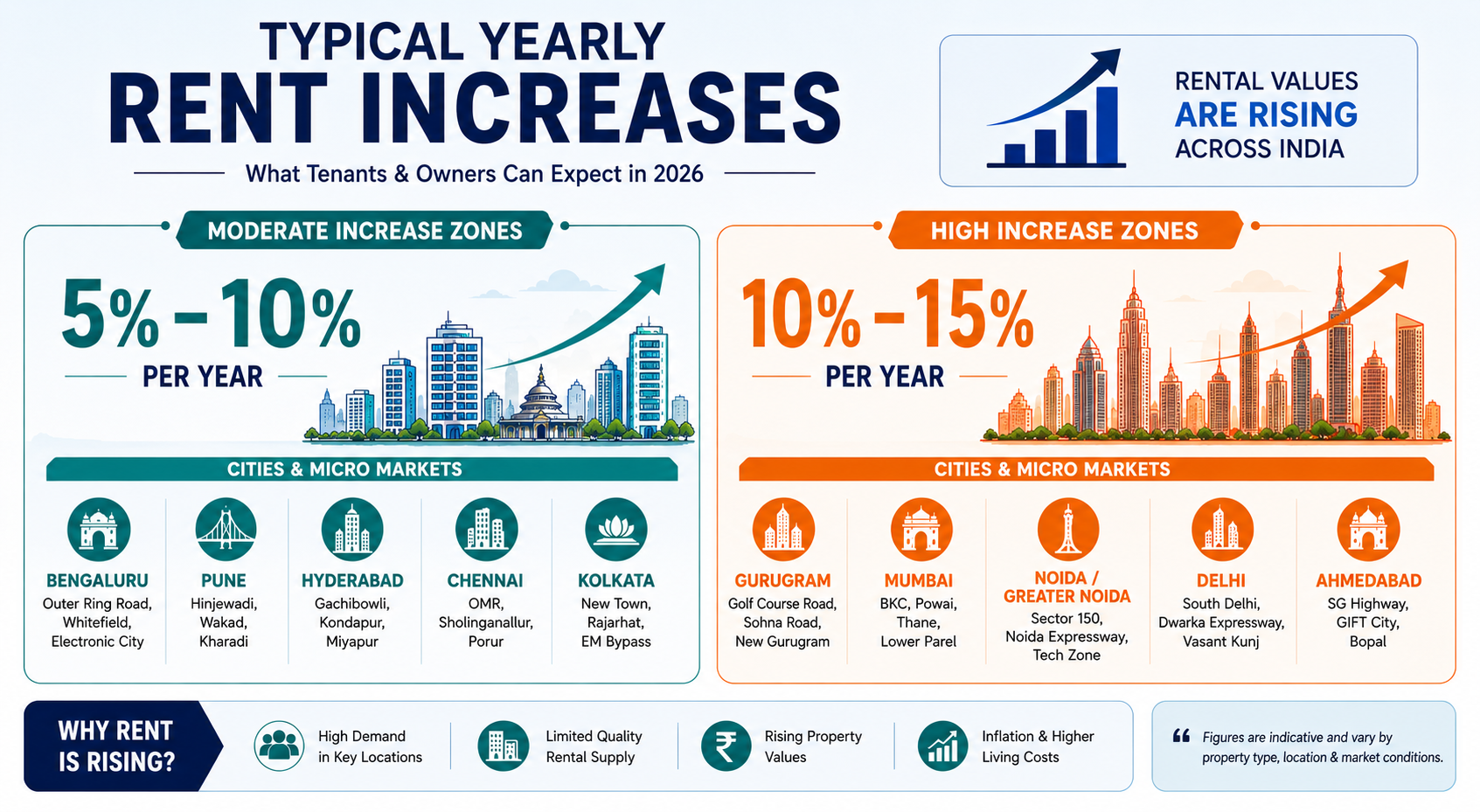
No single central law fixes a nationwide cap on annual rent increases. What actually governs the increase is a combination of your signed rent agreement and the applicable state law.
What Happens in Practice Today
Across most Indian cities, landlords and tenants privately agree on an annual escalation clause within the rent agreement itself. Based on prevailing market patterns:
- Typical annual increases range from 5% to 10% at the time of renewal.
- High-demand metro and IT corridors – parts of Bengaluru, Pune, and Gurugram – sometimes see hikes of 10% to 15%.
- The increase cannot be imposed mid-agreement. It applies only when the lease comes up for renewal, unless the signed agreement explicitly states otherwise.
- Landlords must typically provide advance written notice – commonly one to three months, and 90 days under Model Tenancy Act-style state laws – before any revised rent takes effect.
What Happens for Legacy Standard-Rent Properties
For the shrinking category of properties still governed by classic standard rent provisions, the increase is far more restricted and follows the specific state act:
- Under the Delhi Rent Control Act, 1958, a landlord can increase standard rent by roughly 10% every three years under the Act’s enhancement provisions – not annually – and can also seek a separate increase (capped at a percentage of expenditure) after genuine structural improvements.
- Under Maharashtra’s rent control framework, older standard-rent buildings reference a modest periodic “permitted increase,” a legacy figure far below current market escalation rates.
- Under the Himachal Pradesh Urban Rent Control Act, 1987, landlords cannot charge beyond the fixed standard rent except through specifically authorized increases, and any premium or extra charge beyond standard rent is void.
Always check what your written agreement says first, and confirm whether your specific property falls under a legacy standard-rent provision or a modern market-rate tenancy. The rules differ substantially between the two.

Rent Control Act Rules Across Major States
Because housing law sits with individual states, the Rent Control Act that governs you changes as you cross a state border. Here is what applies in the states most frequently searched.
Maharashtra Rent Control Act (Mumbai, Pune, Nagpur)
Maharashtra’s rental relationships were historically governed by the Bombay Rents, Hotel and Lodging House Rates Control Act, 1947 – commonly called the Bombay Rent Act. This was repealed and replaced by the Maharashtra Rent Control Act, 1999, which came into force on 31 March 2000 and now applies uniformly across the state.
Key provisions:
- The Act defines and fixes standard rent for older, legacy-controlled premises.
- Section 24 empowers a landlord to recover possession from a licensee (a common Mumbai-style “leave and license” arrangement) who fails to vacate once the license period expires, by approaching the Competent Authority.
- Section 55 makes a written and registered leave-and-license or rent agreement mandatory. The landlord bears primary responsibility for registration, and failing to register carries penalties, including fines or imprisonment.
For most Mumbai and Pune residents today, actual rent revision follows whatever the Leave & License agreement specifies – typically 5% to 10% at renewal – rather than the older standard-rent formula, which now applies mainly to legacy tenancies.
Delhi Rent Control Act (National Capital Territory)
The Delhi Rent Control Act, 1958 governs rental premises across the NCT of Delhi, with a few important exemptions:
- Government-owned premises fall outside the Act entirely.
- Premises with monthly rent exceeding Rs 3,500 have been exempt since a 1988 amendment.
- Premises constructed after the 1988 amendment enjoy a 10-year exemption window from the date of completion.
Parliament passed a replacement law – the Delhi Rent Control Act, 1995 – but it was never notified into force, so the original 1958 Act continues to govern Delhi even today. Because of the Rs 3,500 exemption threshold (set decades ago and never revised for inflation), the vast majority of Delhi’s current rental market operates outside the Act’s standard-rent provisions and relies on the terms of the signed agreement.
Uttar Pradesh Tenancy Law (Noida, Greater Noida, Ghaziabad, Lucknow)
This section is especially relevant if you rent or invest in Noida and the wider NCR. The old UP Urban Buildings (Regulation of Letting, Rent and Eviction) Act, 1972 has been repealed and replaced by the Uttar Pradesh Regulation of Urban Premises Tenancy Act, 2021, modelled on the central Model Tenancy Act.
Under the new UP tenancy law:
- A written tenancy agreement is mandatory and must be notified to a designated Rent Authority.
- Both parties must mutually agree on any rent revision as per the terms of the tenancy agreement.
- The landlord must give three months’ written notice before a revised rent becomes due.
- A dedicated Rent Authority and Rent Tribunal handle disputes, aiming for faster resolution than ordinary civil courts.
For Noida and Greater Noida residents, this means your rental relationship today runs on a contract-based tenancy model rather than the older standard-rent system. Rent moves according to what you and your landlord agree upon in writing, within the procedural safeguards the 2021 Act provides.
Karnataka Rent Control Act (Bengaluru)
Karnataka’s current law, formally the Karnataka Rent Act, 1999 (notified in 2001 and often called the Karnataka Rent Control Act, 2001), exempts:
- Residential buildings with standard rent above Rs 3,500 per month within Municipal Corporation areas
- Residential buildings above Rs 2,000 per month in other areas
- Commercial premises above a specified plinth area
Given Bengaluru’s high market rents, most current tenancies fall outside these exemption thresholds and are governed primarily by the signed rental agreement rather than court-fixed standard rent.
Rajasthan Rent Control Act (Jaipur, Jodhpur, Udaipur)
The Rajasthan Rent Control Act, 2001 created a structured dispute-resolution system with a Rent Tribunal and an Appellate Rent Tribunal, along with a Rent Authority – typically an officer not below the rank of Sub-Divisional Officer – who handles applications and petitions related to tenancy disputes. The Act has been amended multiple times since its enactment to refine procedural timelines and appeal periods.
Tamil Nadu Tenancy Law (Chennai)
Tamil Nadu offers a clear before-and-after example of India’s shift from rent control to tenancy law. The original Tamil Nadu Buildings (Lease and Rent Control) Act, 1960 set annual residential rent at 6% to 9% of the building’s construction cost (9% to 12% for non-residential premises), capped maintenance charges at 10% of rent, and permitted a 15% premium for furnished properties.
This Act was repealed by the Tamil Nadu Regulation of Rights and Responsibilities of Landlords and Tenants Act, 2017 – enacted on the lines of the Model Tenancy Act. Under the newer law, tenancy agreements must be written and registered with a Rent Authority, rent increases follow the terms of the registered agreement, and dedicated Rent Courts and Rent Tribunals resolve disputes.
Kerala Rent Control Act (Kochi, Thiruvananthapuram)
The Kerala Buildings (Lease and Rent Control) Act, 1965 continues to govern rental premises across the state through a dedicated Rent Control Court. Reform proposals, including a more comprehensive lease and fair-rent bill, have been discussed by Kerala’s law reform bodies over the years, but the 1965 Act remains the operative law today. Always confirm the current status with a local advocate before relying on any proposed reform as settled law.
Other States at a Glance
| State | Governing Act | Key Feature |
|---|---|---|
| Telangana | Telangana Buildings (Lease, Rent and Eviction) Control Act, 1960 | Legacy standard-rent framework inherited from combined Andhra Pradesh |
| West Bengal | West Bengal Premises Tenancy Act, 1997 | Eviction is restricted to specific grounds, including unauthorised subletting, rent default of three months within a year, or bona fide landlord requirement |
| Madhya Pradesh | Madhya Pradesh Accommodation Control Act, 1961 | Standard rent is fixed under Sections 7–8, with disputes handled by a designated Rent Controlling Authority |
| Haryana | Haryana Urban (Control of Rent and Eviction) Act, 1973 | Regulates rent and eviction across designated urban areas of the state |
| Himachal Pradesh | Himachal Pradesh Urban Rent Control Act, 1987 | Security deposit is capped at three months’ rent; premium or “pugree” charges are void |
| Chhattisgarh | Chhattisgarh Rent Control Act, 2011 | Provides for a dedicated Rent Control Tribunal and defines a “habitual defaulter” as a tenant who misses rent three or more times within 12 months |
| Gujarat | Framework rooted in the historical Bombay Rent Act | Continues a similar standard-rent approach to Maharashtra |
Is a Rent Agreement Mandatory?

Yes, in practice and, increasingly, in law. A written rent agreement is essential, though the legal mandate varies by state and lease duration:
- Registration Act, 1908: Any lease exceeding 11 months (or one year, per specific state rules) legally requires registration, regardless of which Rent Control Act applies. This is why so many Indian rental agreements are deliberately drafted for an 11-month term.
- Maharashtra’s Section 55: Makes a written, registered leave-and-license agreement compulsory for every tenancy, with penalties for landlords who skip registration.
- Tamil Nadu and Uttar Pradesh’s newer tenancy laws: Require every tenancy agreement to be written and formally registered or notified to a Rent Authority.
- Older, legacy rent control acts: Do not always explicitly mandate a written agreement, but strongly recommend one, because disputes without a written record are far harder to resolve.
Even where the law is silent, a written agreement remains your strongest protection for setting rent terms, defining the security deposit, and avoiding disputes later.
Who Pays for the Rent Agreement?
There is no single, uniform national rule. In practice:
- Tenants commonly pay the stamp duty and documentation charges as a matter of prevailing custom in most Indian cities.
- Under Maharashtra’s Section 55, the landlord holds the legal responsibility to ensure the agreement gets registered – though the actual cost is frequently negotiated and split between both parties.
- This remains fully negotiable. Nothing in most state rent laws forces either party to bear the full cost. Record the arrangement clearly in the agreement itself to avoid confusion later.
Your Rights as a Renter Under the Rent Control Act
Regardless of which specific act applies to your property, most Indian tenancy frameworks – old and new – extend a broadly similar set of protections:
- The right to a written agreement that clearly states the rent, deposit, and duration of tenancy.
- The right to advance notice before any rent revision takes effect – commonly one to three months, or 90 days under Model Tenancy Act-based state laws.
- The right to protection from arbitrary eviction. A landlord can only remove a tenant on specific, legally recognised grounds and must follow due process through a Rent Controller, Rent Court, or civil court.
- The right to a capped, transparent security deposit – increasingly limited to two or three months’ rent under the newer tenancy laws.
- The right to essential services. Landlords cannot arbitrarily cut off water or electricity to force a tenant out.
- The right to receive rent receipts on request, which serve as important proof of tenancy and payment history.
- The right to privacy. Under Model Tenancy Act-based laws, landlords must give advance notice (commonly 24 hours) before entering the rented premises.
Rent Control Act vs Tenancy Act: Key Differences
These terms often get used interchangeably, but they describe two distinct generations of Indian housing law.
Rent Control Act refers to the older generation of laws – enacted mostly in the 1940s through the 1960s – built around the concept of standard or fair rent. These laws were designed to protect economically vulnerable tenants during severe post-war housing shortages. Delhi’s 1958 Act, Kerala’s 1965 Act, and Madhya Pradesh’s 1961 Act are classic examples still in force today.
Tenancy Act refers to the newer generation of laws inspired by the Model Tenancy Act, 2021. These laws shift the emphasis from rigid rent control toward a balanced, contract-based landlord-tenant relationship. They mandate written, registered agreements, establish dedicated Rent Authorities for registration, and create Rent Courts and Rent Tribunals for faster dispute resolution. Tamil Nadu’s 2017 Act and Uttar Pradesh’s 2021 Act both belong to this newer category.
Where neither a specific rent control act nor a modern tenancy act fully applies, the Transfer of Property Act, 1882 – a colonial-era statute still very much in force – supplies the general legal principles governing leases and licenses across India.
Together, these three layers form what most people casually refer to as “landlord-tenant law” in India.
The Bottom Line
The Rent Control Act that governs your property depends entirely on your state, your building’s age, and whether that state has moved to a newer, Model Tenancy Act-inspired framework. Most modern tenancies – especially across Noida, Greater Noida, and the wider NCR – run on contract-based rent revision rather than the rigid standard-rent system many people still associate with “rent control.”
Understanding which rules actually apply protects you from unfair hikes, sudden eviction threats, or agreements that do not hold up when a dispute arises.
If navigating annual rent hikes, notice periods, and uncertain tenancy terms feels like a moving target year after year, you are not alone. That frustration is exactly what pushes many long-term renters toward buying instead. Owning your home means the “landlord” question disappears entirely, your monthly outgo builds equity instead of someone else’s asset, and no Rent Authority notice period stands between you and long-term stability.
If you are ready to explore what owning a home in Noida, Greater Noida, or Ghaziabad could look like, Express Builders is here to help. Our team can walk you through ready-to-move and upcoming residential projects across Noida’s and Greater Noida’s most connected sectors, as well as in Ghaziabad, with complete transparency on pricing, documentation, and possession timelines – no pressure, just honest answers to your questions.
Frequently Asked Questions
Is the rent fixed under the Rent Control Act?
Rent is genuinely fixed only for a shrinking category of older properties governed by legacy standard-rent provisions, where a Rent Controller or court has determined a formula-based rent that the landlord cannot exceed except through specific, sanctioned increases. For the vast majority of modern rentals – including most properties across Noida, Gurugram, and other newer developments – rent is not court-fixed. It is freely negotiated, recorded in the written rental agreement, and revised according to whatever that agreement specifies.
How much can a landlord increase rent per year in India?
No single national law fixes a maximum annual increase. Market practice typically sees rent hikes of 5% to 10% at renewal, sometimes reaching 10-15% in high-demand metro and IT corridors, based entirely on what the signed rent agreement specifies. For legacy standard-rent properties still governed by an older Rent Control Act, increases are far more restricted. For example, Delhi’s provisions allow roughly a 10% enhancement every three years for such premises, not annually.
Is a rent agreement mandatory in India?
For any tenancy exceeding 11 months, registration is legally required under the Registration Act, 1908, regardless of which state you are in. Several states go further: Maharashtra’s Section 55 mandates a written, registered agreement for every tenancy, and newer tenancy laws in states like Tamil Nadu and Uttar Pradesh require formal registration or notification to a Rent Authority. Even where not strictly mandatory, a written agreement remains essential – it protects both landlord and tenant and is often needed for KYC, address proof, and dispute resolution.
What is “standard rent” under the Rent Control Act?
Standard rent (also called fair rent) is a rent amount fixed through a formula defined in the applicable state’s Rent Control Act – often tied to the property’s construction cost, its rent as of a historical reference date, or a figure determined by a Rent Controller or court. Once fixed, a landlord cannot legally charge more than the standard rent except through specific, sanctioned increases such as those for structural improvements or added amenities. Most modern, market-rate rentals fall outside standard-rent provisions entirely.
Who pays for the rent agreement – landlord or tenant?
There is no single national rule. By common practice in most Indian cities, tenants typically bear the stamp duty and documentation costs, though this remains fully negotiable between both parties. In Maharashtra, the landlord carries the legal responsibility to ensure the agreement gets registered under Section 55, even though the actual cost is often split by mutual agreement. Always confirm and record this arrangement clearly in the agreement itself.
