
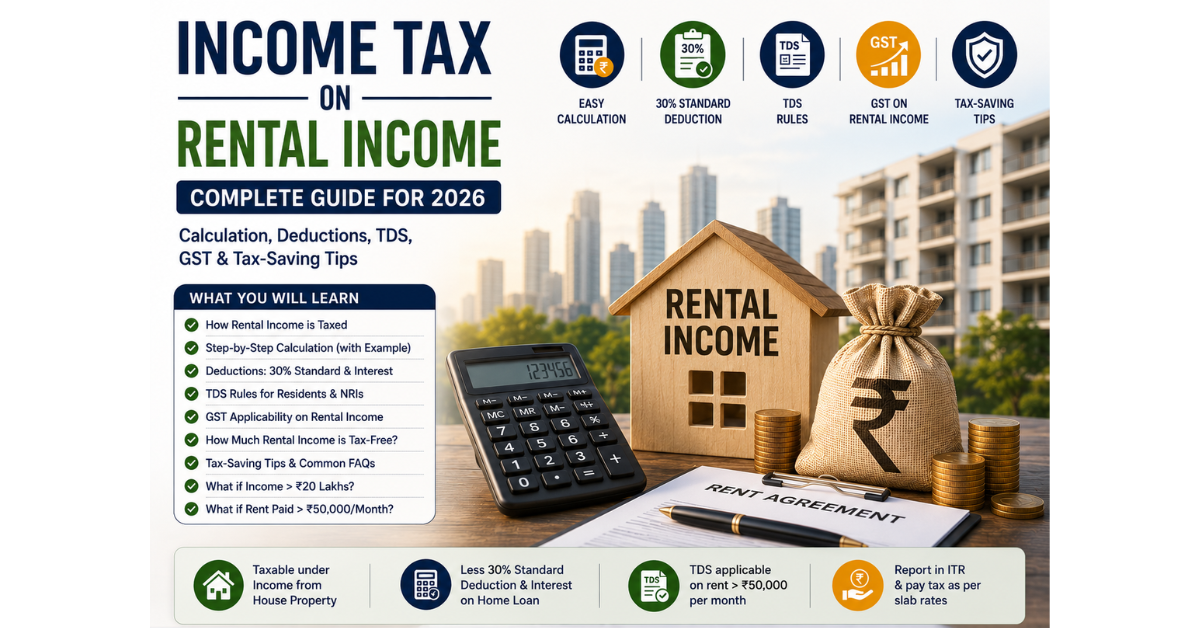
Rental income is a popular passive income source for property owners in India, especially with growing demand for residential spaces. However, it is fully taxable under the head “Income from House Property” as per the Income Tax Act. Understanding the rules helps you comply, minimize your tax liability legally, and maximize returns on your investment properties.
Know how rental income is taxed, step-by-step calculations, deductions (including the popular 30% standard deduction), TDS, GST implications, and answers to common questions like how much rental income is tax-free.
Is Rental Income Taxable in India?
Yes, rental income is taxable. It does not matter whether the property is residential or commercial. The key exceptions are:
- Self-occupied properties (up to two houses can be treated as self-occupied with nil annual value).
- Properties used for your own business/profession (taxed under business income instead).
Rental income is computed on an accrual basis (due or received, whichever applies).
How to Calculate Tax on Rental Income (Step-by-Step)
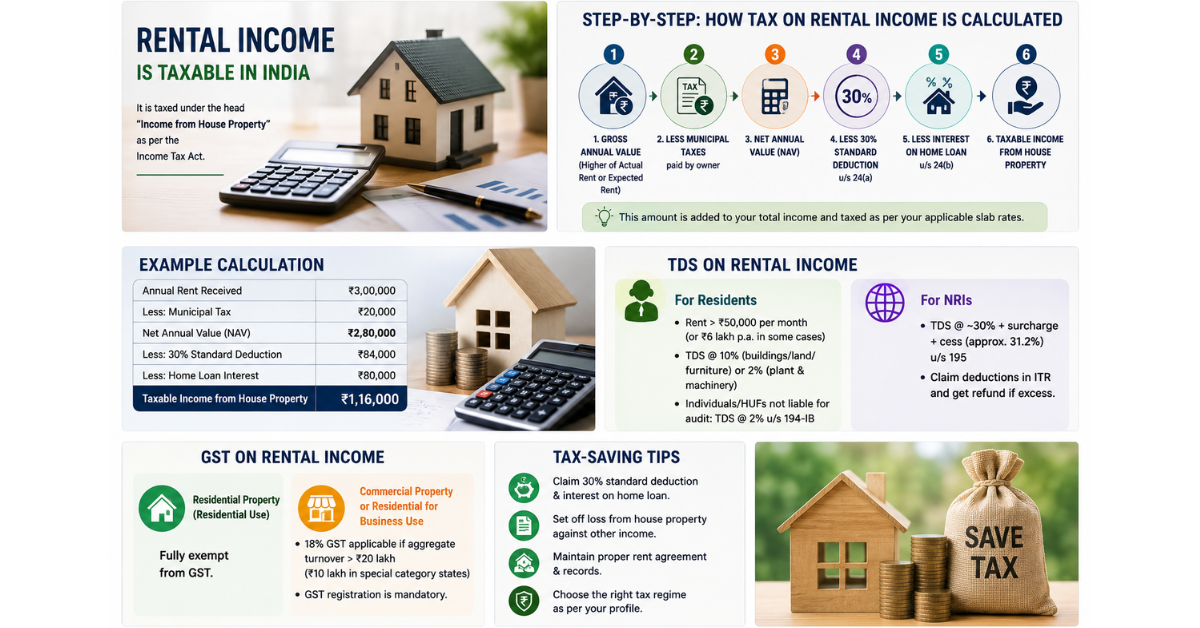
Follow this standard process for let-out properties:
- Determine Gross Annual Value (GAV): Higher of —
- Actual rent received/receivable, or
- Expected rent (higher of municipal value or fair rent, but not exceeding standard rent under Rent Control Act).
- Subtract Municipal Taxes/Property Tax paid by the owner during the year → Net Annual Value (NAV).
- Standard Deduction u/s 24(a): 30% of NAV (flat deduction for repairs, maintenance, etc., even if actual expenses are lower). This is the “30% deduction” many refer to.
- Deduct Interest on Home Loan u/s 24(b): Full interest for let-out properties (no ₹2 lakh cap like self-occupied). Pre-construction interest is allowed in 5 equal installments.
- Taxable Income from House Property = NAV – 30% std. deduction – Interest.
This amount is added to your total income and taxed at your slab rates (old or new regime).
Example (Annual rent ₹3,00,000 / ₹25,000 per month):
- GAV: ₹3,00,000
- Less: Municipal tax ₹20,000 → NAV ₹2,80,000
- Less: 30% std. deduction ₹84,000
- Less: Home loan interest ₹80,000
- Taxable Income: ₹1,16,000 (added to your other income and taxed per slab).
Loss from house property (common due to high interest) can be set off against other income (up to ₹2 lakh limit in some cases) and carried forward.
How Much Rental Income is Tax-Free in India?
There is no specific exemption for rental income alone. Taxability depends on your total income after deductions.
- Basic exemption limit: Up to ₹2.5 lakh (old regime) or higher effective threshold in new regime (with rebate u/s 87A).
- With only rental income + 30% standard deduction, you can often have zero tax on rental income up to ~₹12–17 lakh (depending on regime and other factors) due to slabs and rebates. For instance, after 30% deduction, effective taxable portion may fall within rebate limits in the new regime.
Tip: Use the new tax regime for simplicity if you have minimal other deductions.
TDS on Rental Income
- For residents (u/s 194-I / 194-IB): Tenant deducts TDS if rent > ₹50,000 per month (or ₹6 lakh p.a. in some cases). Rate: 10% (buildings/land/furniture) or 2% (plant/machinery). Individuals/HUFs not liable for audit deduct at 2% under 194-IB.
- For NRIs: Tenant deducts ~30% + surcharge + cess (often 31.2%) u/s 195, regardless of amount in many cases. NRIs can claim deductions via ITR and get refund if excess.
How to avoid/reduce TDS on rental income?
- File Form 13 for lower/nil TDS certificate with the tax department if your total tax liability is low.
- Claim credit for TDS in your ITR using Form 26AS.
GST on Rental Income
- Residential property rented for residential use: Fully exempt from GST.
- Commercial property or residential rented for business use: 18% GST applies if the landlord’s aggregate turnover exceeds ₹20 lakh (₹10 lakh in special category states). The landlord must register and charge GST.
If your annual rental income from commercial properties exceeds ₹20 lakh, GST registration is mandatory.
What if Rental Income is More Than ₹20 Lakhs?
- Income tax applies as usual (slab rates on taxable portion).
- GST may apply (for commercial) if threshold crossed.
- Higher TDS implications and possible advance tax liability. File ITR-1 or ITR-2/3 as applicable and pay advance tax if liability > ₹10,000.
What if Rent Paid is More Than ₹50,000 per Month?
This triggers TDS deduction by the tenant (payer). As a landlord (payee), you get credit for it in your ITR. It does not increase your tax but ensures compliance.
Other Key Points & Tax-Saving Tips
- Vacancy allowance: Deductible if property was vacant for part of the year.
- Unrealized rent: Deductible under conditions.
- Deemed let-out: Extra properties beyond 2 self-occupied are deemed let-out with notional rent.
- Joint ownership: Co-owners can claim deductions proportionately.
- Choose tax regime wisely: Old for more deductions (e.g., 80C); new for higher rebates and simplicity.
- Report accurately to avoid notices/penalties.
FAQs on Income Tax on Rental Income
How much rental income is tax-free in India?
No fixed amount, but if your total income (after 30% deduction etc.) stays below the basic exemption limit (₹2.5 lakh+), it is effectively tax-free. With optimal planning in the new regime, significant rental income (₹12–17 lakh range) can result in zero tax.
How can I avoid TDS on rental income?
Apply for a lower/nil TDS certificate via Form 13 if your expected tax liability is low. Otherwise, claim full credit while filing ITR.
What if rental income is more than 20 lakhs?
Pay income tax on the taxable portion + consider GST registration (for commercial). Ensure advance tax compliance.
What if rent paid is more than 50000 per month?
Tenant must deduct TDS (2–10% typically). You claim credit in your return.
What is the 60% trap?
This term is not standard in Indian rental income taxation (it often refers to UK personal allowance taper creating ~60% effective rates). In India, watch for effective high marginal rates due to slab transitions, loss of exemptions, or surcharge (e.g., above ₹50 lakh/₹1 crore). Proper regime choice and deductions help avoid high effective taxation. Consult a tax advisor for personalized planning.
Final Tips for Property Owners
Investing in quality rental properties maximizes net yields after tax. Focus on locations with high demand, good rental appreciation, and easy tenant compliance. Maintain proper rent agreements, PAN details, and records for municipal taxes and loan interest.
Always consult a Chartered Accountant for your specific situation, as rules can have nuances (e.g., new tax regime updates). File your ITR on time to claim refunds for excess TDS.
This article is for informational purposes based on current tax provisions (as of 2026). Tax laws change; verify with official sources or professionals.
Optimize your rental portfolio with Express Builders’ premium projects designed for high rental demand and long-term value. Contact us for investment opportunities!
