

Real estate builds more wealth for ordinary Indians than almost any other asset class and the numbers keep proving it. Residential prices in Greater Noida West, Pune’s ring road zone, and Hyderabad’s ORR belt surged 50–65% in four years. Yet most first-time investors enter the market without understanding the basics: what real estate investment in India actually means, which type suits their goal, and where the real risks sit.
Whether you are a salaried professional planning your first investment, an NRI deploying capital from abroad, or someone holding ₹10–20 lakhs looking for growth this guide gives you everything you need to invest with confidence. We cover meaning, types, benefits, risks, and a practical starting plan for the Indian market in 2026.
What Is Real Estate Investment?
Real estate investment means acquiring property, a flat, land, a commercial unit, or a share in a property fund with the primary goal of generating returns through rental income, capital appreciation, or both.
This differs from buying a home to live in. When you invest in real estate, the property functions as an income-producing asset that works for you over time through a tenant paying rent, through rising market values, or both simultaneously.
In India, real estate investment takes two core forms:
- Direct investment you purchase physical property (apartment, plot, commercial space) registered in your name
- Indirect investment you invest through REITs (Real Estate Investment Trusts), fractional ownership platforms, or real estate funds
India’s real estate market crossed ₹24 lakh crore in 2024 and continues to attract domestic and NRI capital at record levels, driven by rapid urbanization, large-scale infrastructure expansion, and rising household incomes.
Why Indians Are Choosing Real Estate in 2026
Three forces are driving real estate investment in India right now:
Consistent Capital Appreciation
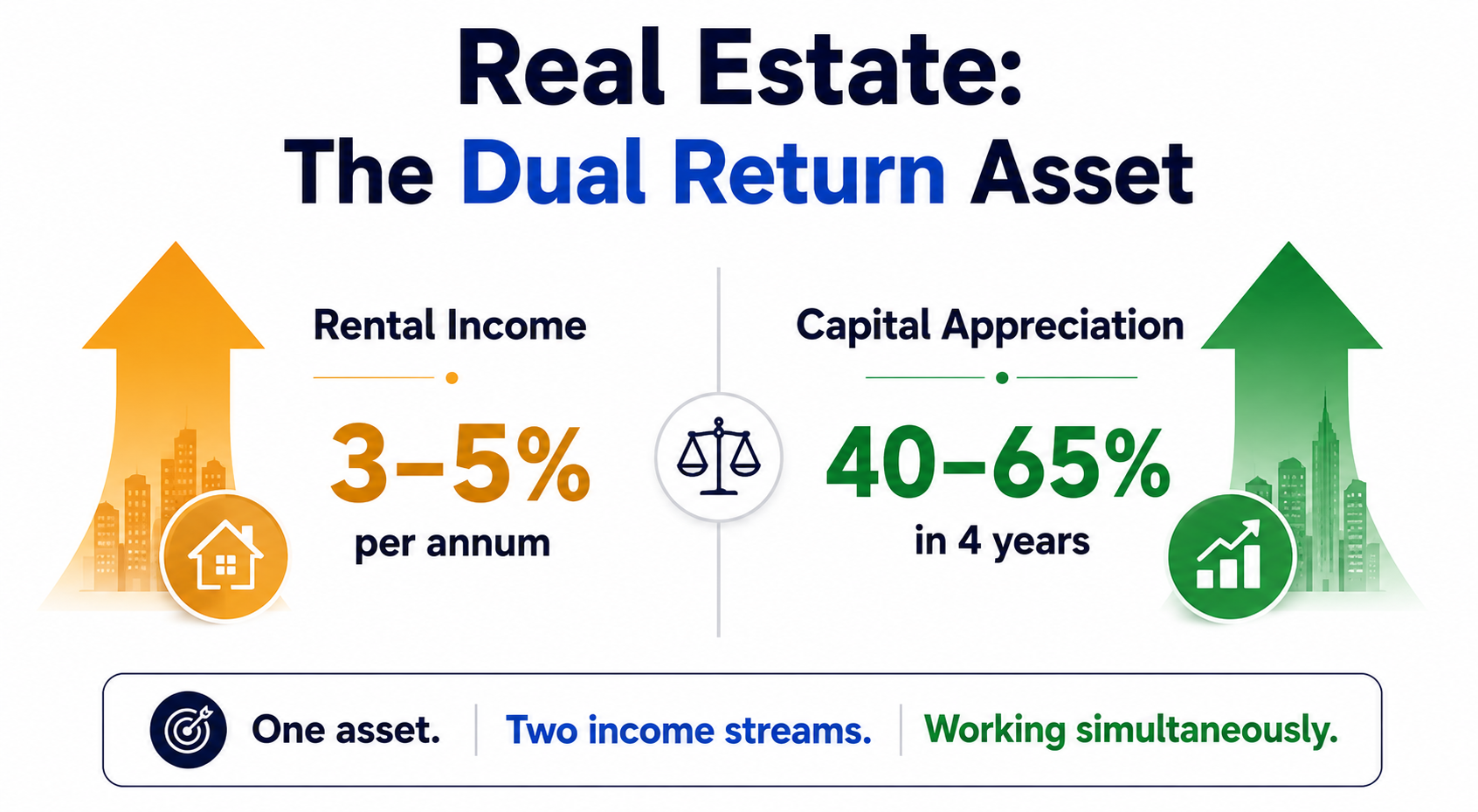
Well-located properties in India’s growth corridors delivered 40–65% appreciation over the last four years. Buyers who entered Greater Noida West in 2020–21 at ₹3,500 per sq ft now hold assets valued at ₹7,500 to ₹10,700+ per sq. ft . The upcoming Jewar International Airport and metro expansions across NCR continue to push this trajectory forward.
Reliable Passive Income
Rental yields in tier-1 and adjacent cities average 3–5% per annum. Combined with capital appreciation, total real estate returns consistently outpace fixed deposits and most debt fund categories over a 5–7 year hold period.
Natural Inflation Hedge
When the cost of living rises, property values and rents move in the same direction. Real estate is one of the few assets that preserves and often grows purchasing power over time. That quality makes it especially powerful for long-term wealth planning in India’s inflationary environment.
What Are the 4 Types of Real Estate Investments in India?
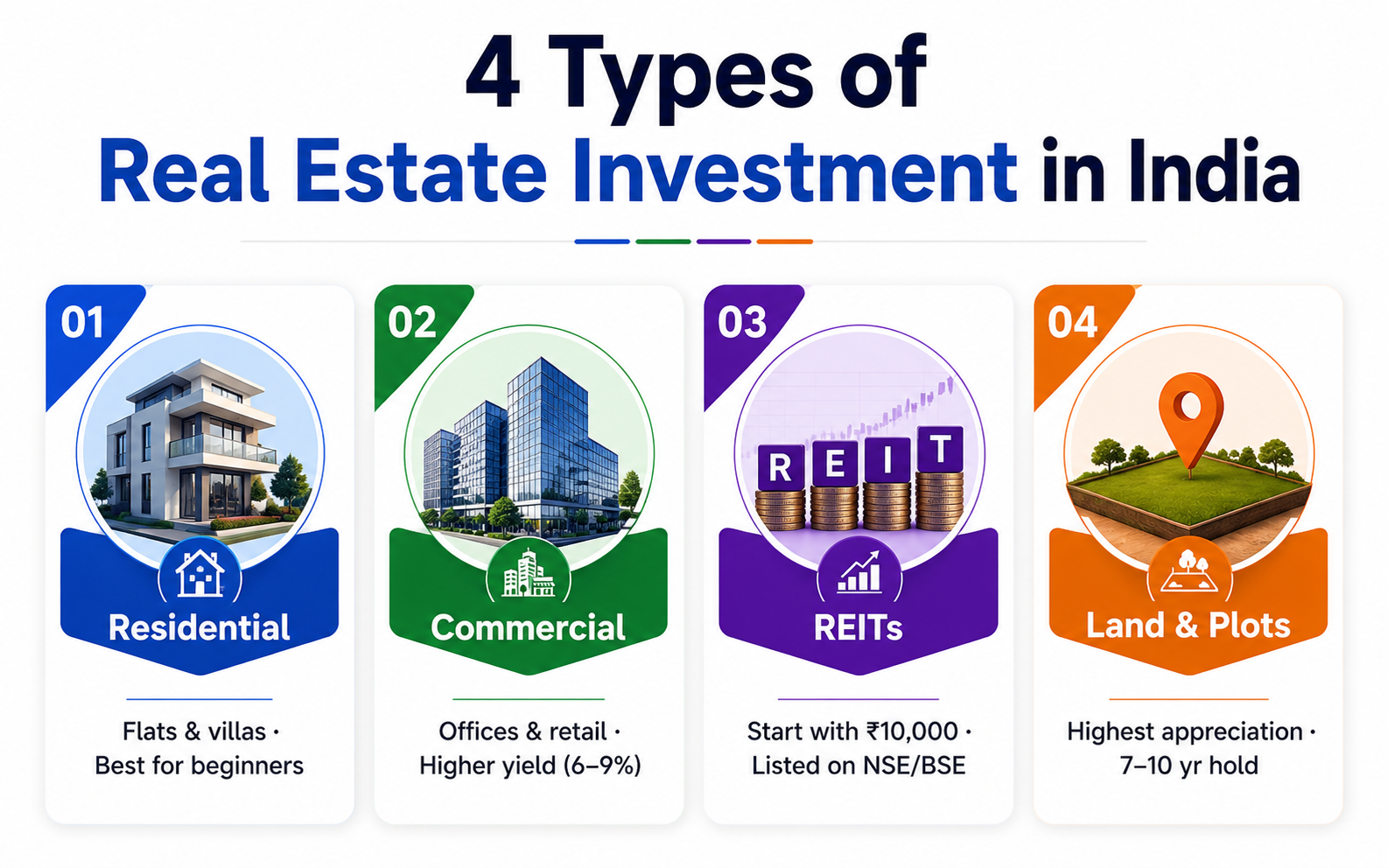
1. Residential Real Estate
The most accessible entry point for Indian investors. Buying a 2 BHK or 3 BHK apartment in a high-growth corridor then renting it out or holding for appreciation creates a dual-return asset with predictable demand. Growth markets like Greater Noida West, Navi Mumbai, and Whitefield Bengaluru offer premium apartments under ₹1.5–2 crore with strong rental demand from working professionals.
2. Commercial Real Estate
Office spaces, retail shops, and co-working units deliver higher rental yields (6–9%) than residential property but require a larger upfront investment. This category suits buyers deploying ₹50 lakh and above who priorities income yield over ease of entry.
3. Real Estate Investment Trusts (REITs)
REITs let you participate in income-generating real estate without owning property. SEBI-regulated Indian REITs listed on NSE and BSE distribute 90% of income as dividends. You start investing with ₹10,000–15,000, making this the most accessible entry point for beginners.
4. Land and Plots
Buying land near high-growth corridors such as Jewar Airport, Yamuna Expressway, or emerging tier-2 cities offers the highest potential appreciation. However, land generates zero rental income and remains highly illiquid. Treat it as a 7–10 year hold, not a short-term strategy.
What Are the 7 Types of Real Estate?
Beyond investment categories, the real estate sector classifies into seven broad types:
- Residential flats, villas, row houses, builder floors
- Commercial offices, business parks, co-working hubs
- Industrial warehouses, factories, logistics parks
- Retail malls, high-street shops, neighbourhood retail
- Mixed-use combined residential, retail, and office developments
- Land agricultural land, residential plots, commercial land banks
- Special purpose hotels, hospitals, data centres, educational campuses
For most Indian retail investors, residential property and REITs remain the most practical, low-complexity starting points.
Key Benefits of Real Estate Investment in India
Real estate investment delivers across multiple dimensions that other asset classes struggle to match:
- Dual income stream rental yield and capital appreciation work simultaneously, compounding your effective return year on year
- Leverage amplifies returns banks finance 75–80% of property value. A 10% price rise on a ₹1 crore property means ₹10 lakh gain on your ₹20 lakh equity a 50% return on capital deployed
- Significant tax advantages home loan interest earns up to ₹2 lakh deduction under Section 24b; principal repayment counts under Section 80C; first-time buyers access additional benefits under PMAY
- RERA-backed legal protection the Real Estate (Regulation and Development) Act mandates escrow accounts for buyer funds, project registration, and delivery timelines with legal penalties for non-compliance
- Tangible and improvable you can renovate, lease, subdivide, or redevelop property to actively increase its value something shares and fixed deposits never allow
Risks You Must Understand Before Investing
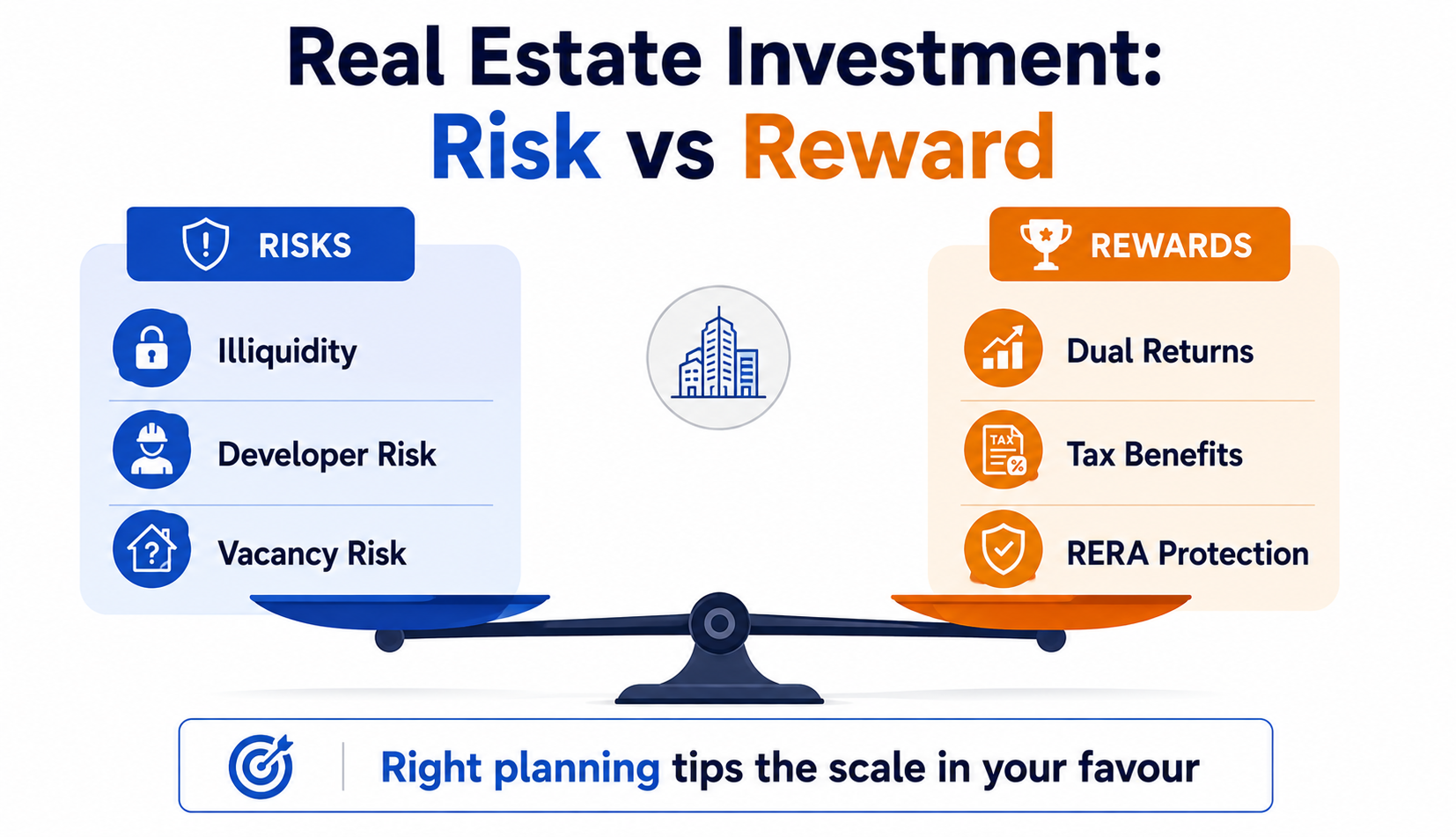
Every investment carries risk. Real estate investment in India brings specific challenges that every buyer must plan around before committing capital:
Illiquidity You cannot exit a property in 24 hours the way you sell shares. Rushed exits consistently produce prices 10–20% below market value. Define your exit horizon before you enter.
High entry and exit costs Stamp duty (5–7%), registration (1%), GST on under-construction property (5%), and brokerage add 25–30% over the sticker price. Factor these into your return calculations.
Developer risk Project delays and insolvencies remain real in the under-construction segment. Always verify RERA registration on your state’s portal before signing anything.
Vacancy risk Rental income assumes an occupied unit. Oversupplied micro-markets or poor location choices leave properties vacant for extended periods and erode returns.
Concentration risk Putting all savings into one property in one location creates dangerous single-asset exposure. Combine direct property with REIT investment to diversify.
How to Start Your Real Estate Investment Journey in India
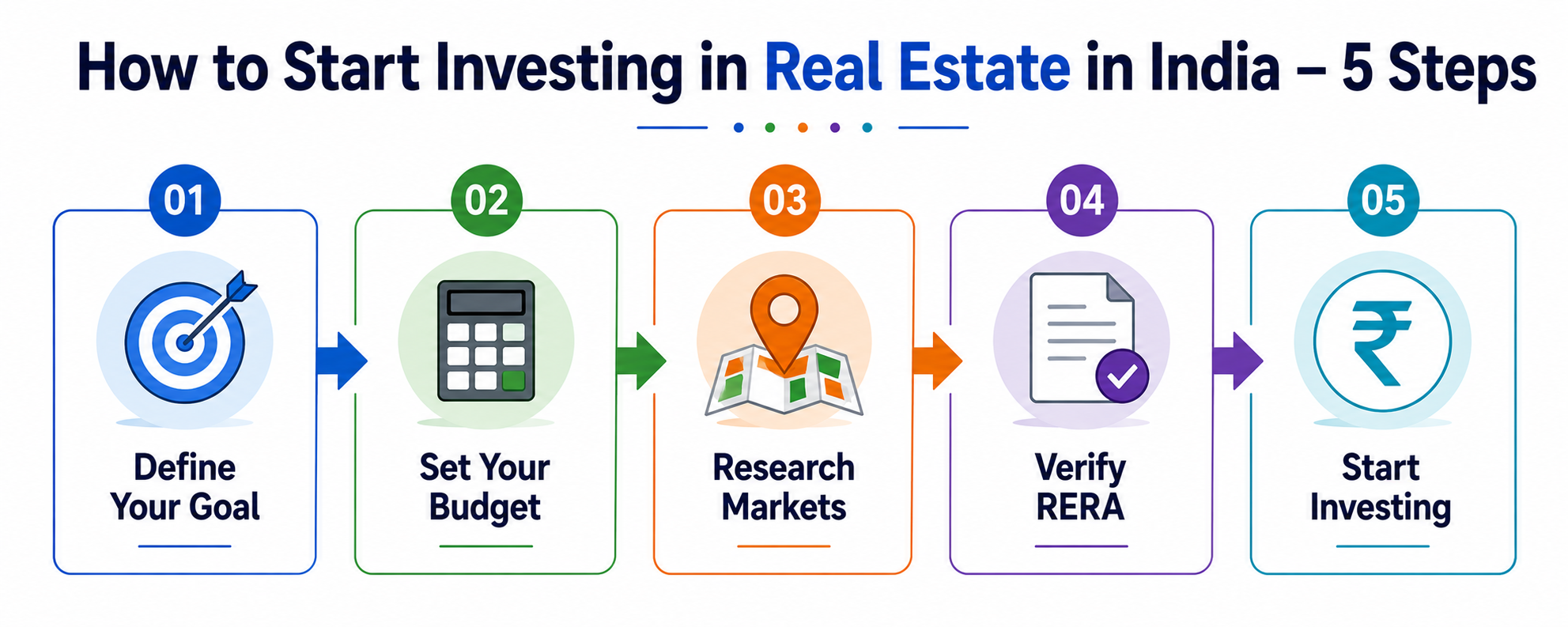
Follow this step-by-step approach regardless of your budget:
Step 1: Define your goal Decide upfront: rental income, capital appreciation, or long-term wealth transfer? Your goal determines the right property type and holding period.
Step 2 Set a realistic all-in budget Go beyond the sticker price. Add stamp duty, registration, GST, maintenance deposit, parking, and a 15% buffer. A ₹1 crore apartment realistically costs ₹1.20–1.25 crore all-in.
Step 3 Research micro-markets Target locations with concrete demand drivers: an upcoming metro line, a new airport, proximity to job zones, or a university catchment. Study resale volume and rental occupancy data, not just developer marketing.
Step 4 Verify RERA first Search the project on your state’s RERA portal before any conversation about booking. Check the registered completion date, escrow account status, and the developer’s prior delivery record.
Step 5 Start small if needed REITs let you enter with ₹10,000–20,000. Build a corpus through regular REIT investments, then use accumulated capital as a down payment when you move into direct property ownership.
The Bottom Line
Real estate investment in India rewards patience, research, and clear financial intent. The market has delivered consistent returns across economic cycles and with infrastructure expanding in corridors like Greater Noida West, Pune’s eastern belt, and Hyderabad’s ORR zone, 2026 remains a compelling window for buyers across every budget level.
Whether you start with a REIT at ₹10,000 or a premium 2 BHK at ₹1.5 crore, the principle stays constant: choose the right location, verify every document, and hold with a defined horizon. Real estate investment in India has built generational wealth for those who plan and it will continue to do so for those who enter with clarity.
If you are looking for better investment in Delhi NCR including Noida, Greater Noida West, Ghaziabad. Please fill the form to book your call with our sale team
Frequently Asked Questions
Q1. Which investment is best in real estate?
For most Indian investors, residential property in a high-growth corridor delivers the best balance of appreciation, rental income, and financing access. REITs suit smaller budgets (₹10,000+) and deliver passive income without management responsibility. Commercial real estate targets yield-focused investors with ₹50 lakh+. Most advisors recommend combining residential ownership with REIT positions for a balanced portfolio.
Q2. Is it a good idea to invest in real estate in India?
Yes for investors with a 5+ year horizon and clear financial goals. Real estate in India provides dual returns, leverage benefits, tax advantages, and RERA-backed legal protection. The key is choosing the right location and doing thorough due diligence before committing.
Q3. Can I invest ₹10,000 in real estate?
Yes. SEBI-regulated REITs listed on NSE and BSE accept investments starting at ₹10,000–15,000. They distribute regular dividends from premium commercial real estate and trade like stocks. You scale up as your corpus grows.
Q4. What are the 4 types of real estate investments?
The four main types are: (1) Residential real estate apartments and villas; (2) Commercial real estate offices and retail; (3) REITs listed real estate funds; and (4) Land and plots in growth corridors. Each carries a different risk, return, and liquidity profile.
Q5. How can I double ₹10 lakhs in 5 years through real estate?
Combine ₹3–4 lakhs in REITs (for compounding dividend income) with ₹6–7 lakhs as a down payment on a plot or apartment in a verified high-growth micro-market targeting 12–15% CAGR. Markets like Greater Noida West have delivered near-doubling returns in four years. Location and entry timing are the primary variables no outcome is guaranteed, but the right corridor significantly improves the probability.
Q6. What is the Rule of 7 in real estate?
The Rule of 7 states that property values in well-located, growing markets tend to double approximately every 7 years equivalent to roughly 10% compounded annual growth. India’s fastest-growing corridors have beaten this rule significantly. Use it as a benchmark to evaluate whether a market’s growth potential justifies your investment.
Q7. How can I make ₹1 crore in 3 years through real estate?
This requires a high-conviction, leveraged strategy: buy under-construction property at pre-launch pricing in a high-demand micro-market and sell near possession. Pre-launch bookings in growth corridors can yield 30–50% appreciation by handover. Starting with ₹25–30 lakhs as equity and funding the rest through a home loan, ₹1 crore in 3 years is achievable but demands precise timing, strong developer credibility, and acceptance of higher risk.
Q8. How should I invest ₹20 lakhs in real estate?
Option A: Use it as a 20% down payment on a ₹1 crore RERA-registered apartment in a growth corridor, fund the balance with a home loan, and hold 5–7 years.
Option B: Allocate ₹12–14 lakhs to a residential plot in an emerging micro-market and ₹6–8 lakhs to REITs for liquidity and income diversification. Option A builds leverage-amplified wealth; Option B balances appreciation with income access.
Q9. What are the 7 types of real estate?
The seven types are: Residential (flats, villas), Commercial (offices, retail), Industrial (warehouses, logistics), Retail (malls, high-street), Mixed-use (combined developments), Land (agricultural, plots), and Special purpose (hotels, hospitals, data centres). Most retail investors focus on residential and REITs as starting points.
Q10. Which real estate company is best to invest with?
The best developer shares four qualities: RERA registration across all active projects, a verified track record of on-time delivery, RERA-mandated escrow accounts for buyer funds, and projects in proven high-demand locations. Always check delivery history on your state’s RERA portal. A developer’s past performance is the strongest signal available. Never rely solely on marketing material.
