
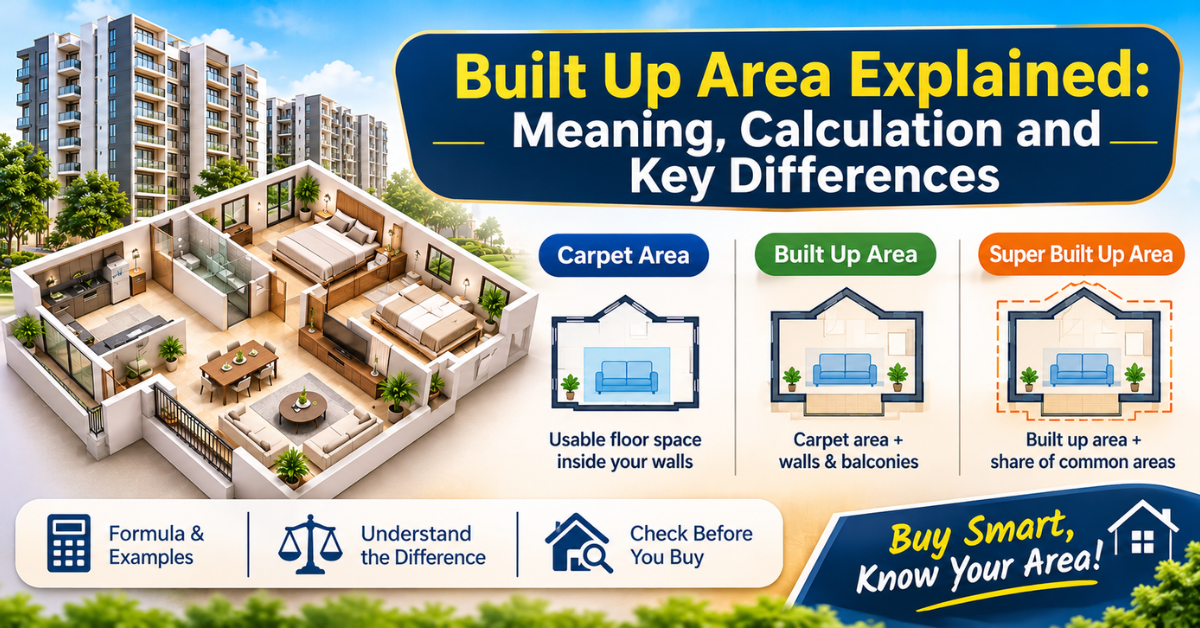
Built up area is the most misunderstood figure in a property brochure. Every home buyer sees area numbers, yet few know what they really mean. A flat advertised at 1,300 square feet may offer far less usable space. Understanding built up area helps you compare homes fairly and avoid overpaying. This guide explains the term in simple language. You will learn the meaning, the formula, and the differences between the main area types. You will also see worked examples, practical tips, and answers to common questions.
What Is Built Up Area?
Built up area is the total constructed space of your flat. Builders measure it from the outer edge of the walls. It includes the usable floor space, the thickness of all walls, and the attached balconies. Many developers also add private utility areas and service shafts.
The figure always stays larger than the carpet area. It also stays smaller than the super built up area. Think of it as the physical footprint of your own unit. It covers everything inside your unit boundary, including the structure itself.
It does not cover shared spaces such as lobbies, staircases, or the clubhouse. Those spaces belong to every resident in the project. Developers usually quote measurements in square feet or square meters. One square meter equals about 10.764 square feet.
What Does Built Up Area Include and Exclude?
Built up area covers the private, constructed parts of your apartment. Review the lists below to see what counts.
Included in built up area:
- Carpet area, which is the usable floor space inside the walls
- Thickness of internal and external walls
- Balconies and attached verandas
- Utility areas and service shafts inside the unit
- Columns and other structural elements inside the flat
- Private terrace attached to the unit, in some projects
Excluded from builtup area:
- Lobbies, corridors, and common staircases
- Lift shafts and lift lobbies
- Clubhouse, gym, and swimming pool
- Basement or podium parking
- Gardens, driveways, and security rooms
Some developers count balconies at partial value. Always ask for a clear area breakup in writing.
What Is Super Built Up Area?
Super built up area adds your share of common spaces to the built up area. Developers use this figure to set the selling area of a flat. Common spaces include lobbies, stairs, lift cores, and corridors. Amenities such as the clubhouse, gym, and security room also enter the calculation.
The builder divides these shared areas among all flats in the project. Your flat receives a proportionate share. The extra percentage is called the loading factor. In high-rise societies, loading often ranges between 25 and 40 percent over carpet area. It depends on the project design and the number of amenities.
A project with large amenities usually shows higher loading. Two projects with equal carpet areas can therefore show different super builtup areas. Compare the loading before you compare prices.
What Is Carpet Area?
Carpet area is the net usable floor space inside your flat. You could spread a carpet across it from wall to wall, hence the name. It excludes external walls, balconies, open terraces, and common spaces.
The RERA Act, 2016 defines carpet area clearly. It includes the area covered by internal partition walls. It excludes external walls, service shafts, exclusive balconies, and exclusive open terraces.
Carpet area reflects the space you actually live in. Furniture, movement, and daily comfort all depend on this figure. Smart buyers therefore ask for the carpet area first.
What Is the Difference Between Built Up Area and Carpet Area?
Carpet area measures the space inside your walls. Builtup area measures the entire constructed unit, including the walls and balconies. Super builtup area goes one step further and adds common areas. The table below places all three side by side.
| Parameter | Carpet Area | Built Up Area | Super Built Up Area |
|---|---|---|---|
| Meaning | Net usable floor space | Carpet area plus walls and balconies | Built up area plus share of common areas |
| Wall thickness | Internal partitions only | All walls included | All walls included |
| Balcony | Excluded | Included | Included |
| Common areas | Excluded | Excluded | Included |
| Typical size over carpet area | Base figure | 10 to 20 percent more | 30 to 40 percent more |
| Best use | Judging livable space | Judging constructed size | Understanding the advertised sale area |
Thick walls and large balconies widen the gap between carpet and built up area. A compact, efficient layout keeps the gap small. Therefore, always check the carpet to builtup ratio. A ratio above 80 percent suggests an efficient floor plan.
How to Calculate Built Up Area?
You can calculate builtup area with a simple formula. Use the floor plan from your developer to collect the measurements.
Formula: Built up area = Carpet area + Wall area + Balcony area + Other private areas
Follow these steps to get an accurate figure:
- Measure the carpet area of each room, including the kitchen and bathrooms.
- Add the passages and foyers to the room totals.
- Measure the thickness and length of every wall in the unit.
- Multiply thickness by length to find the wall area.
- Measure the balcony, utility area, and service shafts.
- Add all these values to reach the built up area.
You can also use a quick estimate. Add 10 to 20 percent to the carpet area. This method works for rough planning only. Use exact measurements for any purchase decision.
Worked example for a 2 BHK flat:
| Component | Area (sq ft) |
|---|---|
| Living and dining room | 270 |
| Bedroom 1 | 150 |
| Bedroom 2 | 130 |
| Kitchen | 90 |
| Two bathrooms | 70 |
| Passage and foyer | 40 |
| Carpet area | 750 |
| Wall area | 75 |
| Balcony | 45 |
| Utility and service shaft | 15 |
| Built up area | 885 |
The built up area here is 18 percent larger than the carpet area. That figure falls within the normal range.
How Do You Calculate Super Built Up Area and Loading Factor?
Super built up area follows a second formula. You add your share of common areas to the built up area.
Formula: Super built up area = Built up area + Proportionate common area
Developers calculate your share of common area with this method:
- Add the built up areas of all flats in the project.
- Measure the total common area, including lobbies, stairs, and amenities.
- Divide your flat’s built up area by the total built up area of all flats.
- Multiply the result by the total common area.
Suppose your share of common area equals 135 square feet. Your super builtup area then reaches 885 plus 135, which equals 1,020 square feet.
The loading factor shows how much extra area the builder adds. Use this formula: (Super built up area minus built up area) divided by builtup area, times 100. In our example, the loading equals 15.25 percent over built up area. Many buyers measure loading against carpet area instead. That method gives 36 percent in this example.
How Does Area Type Change Your Price Per Square Foot?
The same flat price produces very different rates under each area type. Consider a 2 BHK flat priced at Rs. 1.02 crore. This price reflects a super built up rate of Rs. 10,000 per square foot, which suits many mid-segment high-rise projects in the NCR belt.
| Area Type | Area (sq ft) | Effective Rate per sq ft |
|---|---|---|
| Super built up area | 1,020 | Rs. 10,000 |
| Built up area | 885 | Rs. 11,525 |
| Carpet area | 750 | Rs. 13,600 |
The advertised rate looks attractive at Rs. 10,000. Yet you pay Rs. 13,600 for every square foot you can actually use. That is a 36 percent difference. Always calculate the carpet area rate before you compare two projects.
Market rates in this region vary by location and project stage. Use the following ranges as a rough guide:
- Ready-to-move projects in established sectors: Rs. 9,000 to 12,000 per sq ft
- Newer projects along expressway corridors: Rs. 7,500 to 10,000 per sq ft
- Premium projects with large amenity clusters: Rs. 12,000 to 16,000 per sq ft
Why Does Built Up Area Matter for Home Buyers?
Built up area affects several decisions in your buying journey. It influences more than the headline price.
- Fair comparison: It shows the true constructed size of competing flats.
- Price check: It helps you test whether the quoted rate is reasonable.
- Property tax: Many local bodies use built up area to assess annual tax.
- Loan valuation: Banks may consider built up area when they value a property.
- Resale value: Future buyers also compare area figures, so clear records help.
What Does RERA Say About Area Measurement?
The Real Estate (Regulation and Development) Act, 2016 brought clarity to area disclosure. It requires developers to sell apartments on a carpet area basis. This rule ended the confusion caused by varying super builtup area claims.
Developers must now state the carpet area in the agreement for sale. They must also register their projects with the state regulator. If the final carpet area differs from the agreement, the price adjustment follows the agreement terms.
Buyers still see built up and super builtup figures in marketing material. Those figures help you understand the project, but the carpet area drives your legal rights.
How Can You Verify Area Claims Before You Buy?
A few simple checks protect you from misleading numbers. Apply them to every project you shortlist.
- Ask for a dimensioned floor plan of your exact unit.
- Request a written breakup of carpet, built up, and super built up areas.
- Check the project registration on the state RERA website.
- Compare the loading factor across at least three projects.
- Measure key rooms during your site visit.
- Read the sale agreement carefully before you sign.
- Confirm how the developer treats balconies and terraces.
These steps take little time. They can save you lakhs of rupees and years of regret.
Ready to Invest in Your Dream Home?
Now that you understand builtup area, you can judge any floor plan with confidence. The next step is to find a home that offers honest measurements and strong value. Express Builder projects are designed to deliver the perfect blend of lifestyle, comfort, and investment value.
Experience world-class amenities, prime locations, and homes built for the future. Every floor plan carries a clear area breakup, so you always know what you pay for. Do not miss this opportunity to secure a high-ROI property in one of NCR’s most in-demand corridors. Our expert sales team is ready to guide you at every step of your journey.
The team will explain carpet, builtup, and super built up areas in plain terms. They will also share payment plans, possession timelines, and project approvals. You can compare layouts, ask questions, and decide with complete clarity.
Book a Site Visit Today, Walk through your future home and experience the difference in person. Contact Express Builder now and take the first step toward a smarter, more rewarding investment.
What Are the Most Common Questions About Built Up Area?
How much larger is builtup area than carpet area?
Built up area usually exceeds carpet area by 10 to 20 percent. The exact gap depends on wall thickness and balcony size. In our 2 BHK example, the gap is 18 percent.
Is super built up area the same as built up area?
No. Super built up area adds your share of common spaces to the built up area. Built up area covers only your private unit.
Which area should I use to compare flat prices?
Use the carpet area rate. It shows what you pay for every usable square foot. Ask each developer for all three area figures in writing.
Do I pay for the balcony under builtup area?
Yes, builtup area includes the balcony. Some developers charge balconies at a lower rate. Check the payment schedule and agreement for the exact treatment.
What is a good carpet to builtup area ratio?
A ratio above 80 percent signals an efficient layout. In our example, 750 divided by 885 gives about 84.7 percent. Lower ratios mean thicker walls or larger balconies.
How do I convert square meters to square feet?
Multiply the square meter value by 10.764. A 70 square meter flat, for example, measures about 753 square feet.
Disclaimer: All area figures mentioned in this guide are indicative and based on general market standards as of Q3 2026. Actual builtup area varies by project, unit, and floor. Always verify the RERA-registered builtup area for your specific unit on up-rera.in or directly with the developer before booking.
Express Builders Ltd is registered with UP RERA. Registration No: UP RERAPRJ3393 and UPRERAPRJ980703 (04/2024). Verify at: up-rera.in
