
Buying a flat in Noida is a major milestone for professionals, NRIs, and end-users looking to invest or settle in the National Capital Region. One of the first practical questions that comes up is how much down payment for flat in Noida you actually need. The answer depends on the property value, RBI guidelines on loan-to-value ratios, the lender you choose, and additional costs such as stamp duty and registration that sit outside the bank’s financing.
Let’s break down the numbers clearly so you can plan with confidence and move forward on the right flat.
Understanding Down Payment and Loan-to-Value Rules in India
Banks and housing finance companies never fund 100% of a property’s cost. The Reserve Bank of India sets maximum Loan-to-Value (LTV) ratios that determine the minimum down payment for home loan in India. These rules form the foundation for every home loan application across the country, including Noida, Noida Extension and Greater Noida.
Minimum Down Payment by Property Bracket (RBI Mandate)
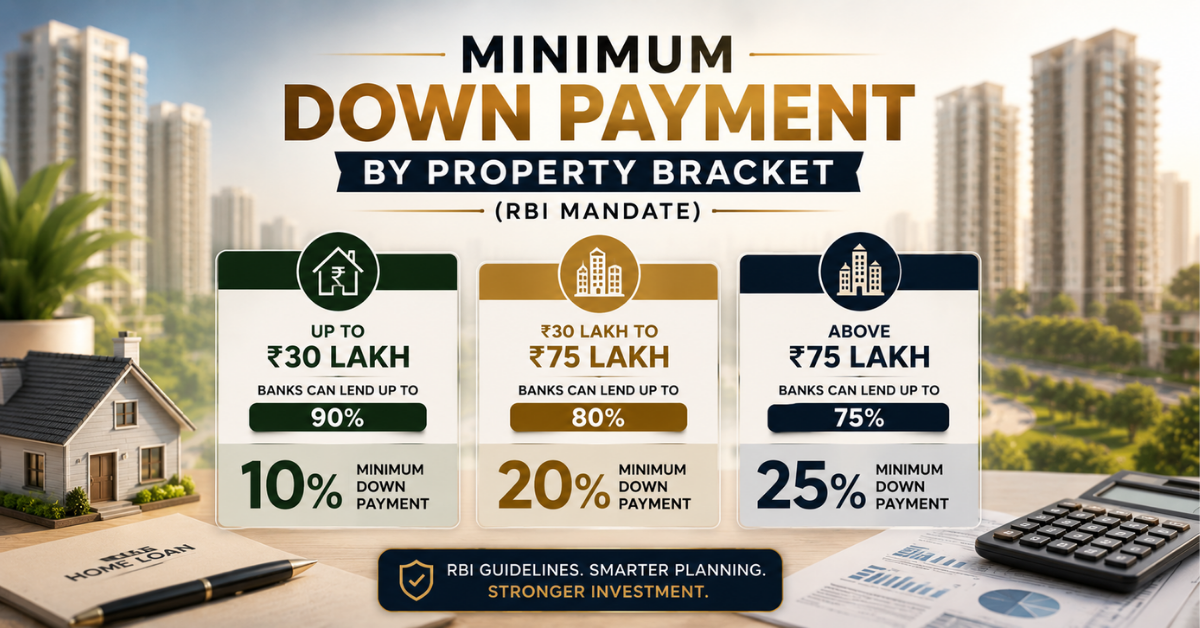
The RBI’s current LTV framework is straightforward and applies uniformly:
- Properties up to ₹30 lakh: Banks can lend up to 90%. Minimum down payment required is 10%.
- Properties between ₹30 lakh and ₹75 lakh: Banks can lend up to 80%. Minimum down payment required is 20%.
- Properties above ₹75 lakh: Banks can lend up to 75%. Minimum down payment required is 25%.
These percentages are calculated on the bank’s assessed value of the property, not necessarily the agreement price you negotiate with the developer. Individual lenders such as SBI, HDFC and ICICI may apply slightly stricter internal norms for certain projects or borrower profiles, but they cannot exceed the RBI ceilings.
For most flats currently available in central Noida, Noida Extension and Greater Noida, buyers fall into the 20% or 25% bracket. Understanding these exact brackets helps you set a realistic savings target from day one.
Minimum Down Payment for Home Loan SBI, HDFC and ICICI
Major lenders follow the RBI framework while adding their own risk filters.
Minimum down payment for home loan SBI
SBI generally sticks close to the RBI LTV caps. For eligible salaried applicants with strong CIBIL scores, you can often secure the maximum permissible funding. Processing fees are relatively low, and festive offers sometimes reduce or waive them.
Minimum down payment for home loan HDFC
HDFC Bank also adheres to RBI norms. Approval is often faster for customers who already hold accounts or credit cards with the bank. Higher down payments frequently translate into better interest rate offers.
Minimum down payment for Home Loan ICICI
ICICI follows the same LTV structure. Digital processes and relationship-based pricing can improve terms if you maintain a good banking relationship.
In practice, the minimum down payment for home loan in India remains 10–25% depending on property value, but lenders prefer borrowers who bring more equity because it lowers their risk.
The Real Cost: Mandatory “Out-of-Pocket” Expenses
The down payment is only the beginning. Several mandatory costs cannot be financed by the home loan and must be paid from your own funds. These out-of-pocket expenses significantly increase the total cash you need at the time of booking and registration.
Key items include:
- Stamp duty: 7% for male buyers, 6% for female buyers, and 6.5% for joint ownership in Noida and Greater Noida (charged on the higher of circle rate or transaction value).
- Registration charges: Approximately 1%.
- GST: 5% on under-construction properties (1% for affordable housing; nil for ready-to-move).
- Preferential Location Charges (PLC), floor-rise charges and parking: Often ₹2–8 lakh depending on the unit.
- Interest-Free Maintenance Security (IFMS) and advance maintenance: Usually ₹25–50 per sq ft plus 1–2 years of maintenance collected upfront.
- Legal fees, loan processing fees and documentation charges: Typically 0.5–1% of the loan amount plus fixed costs.
Together, these can add 10–22% to the base price of the flat. Buyers who plan only for the RBI minimum down payment often face a shortfall when these charges become due.
Simulated Upfront Cash Breakdown
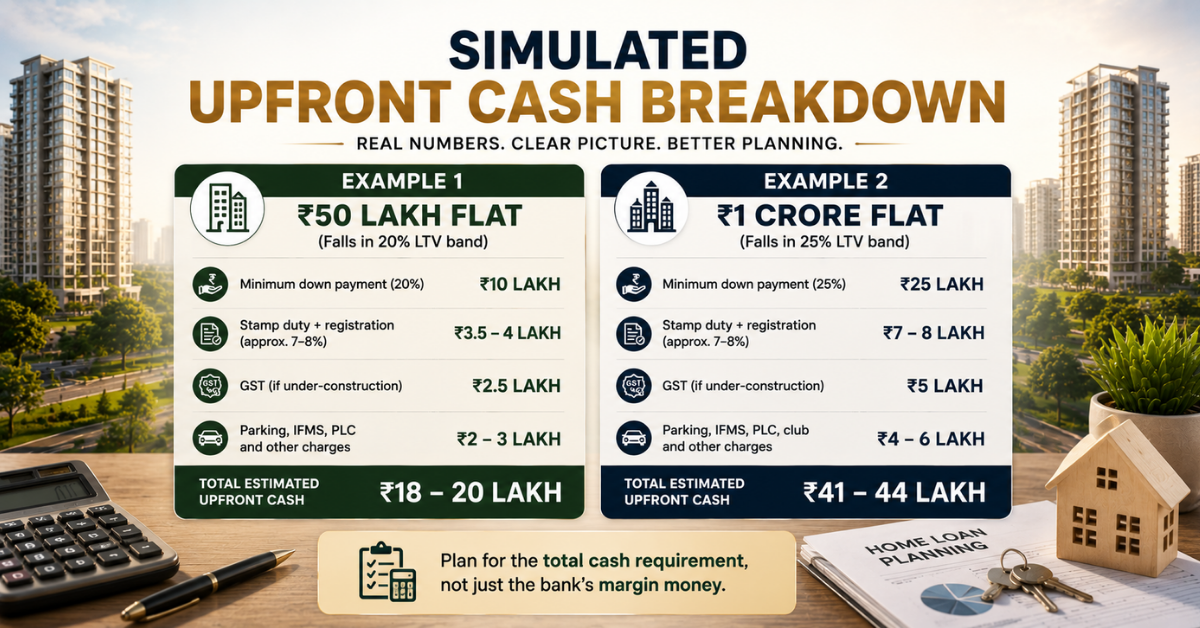
Here are realistic illustrations for two common price points in the Noida region. Figures are approximate and based on current norms; actual amounts vary by project, buyer gender and exact valuation.
Example 1: ₹50 lakh flat (falls in 20% LTV band)
- Minimum down payment (20%): ₹10 lakh
- Stamp duty + registration (approx. 7–8%): ₹3.5–4 lakh
- GST (if under-construction): ₹2.5 lakh
- Parking, IFMS, PLC and other charges: ₹2–3 lakh
- Total estimated upfront cash: ₹18–20 lakh
Example 2: ₹1 crore flat (falls in 25% LTV band)
- Minimum down payment (25%): ₹25 lakh
- Stamp duty + registration (approx. 7–8%): ₹7–8 lakh
- GST (if under-construction): ₹5 lakh
- Parking, IFMS, PLC, club and other charges: ₹4–6 lakh
- Total estimated upfront cash: ₹41–44 lakh
These simulations show why the question “how much down payment for flat in Noida” must always be answered with the full cash requirement in mind, not just the bank’s margin money.
How Much Down Payment for 50 Lakh Home Loan and for a 1 Crore House
The examples above directly address the practical numbers most buyers search for. For a 50 lakh home loan scenario the equity component starts at ₹10 lakh plus extras. For a 1 crore house the equity jumps to ₹25 lakh plus the same additional layer of statutory and project charges. Running these figures through a home loan calculator or down payment for home loan calculator before shortlisting projects prevents unpleasant surprises later.
RERA Down Payment Rules Noida and What Buyers Must Know
Under the Real Estate (Regulation and Development) Act, a promoter cannot accept more than 10% of the cost of the apartment as an advance payment without first entering into a written, registered agreement for sale. In Noida and Greater Noida, authorities have strengthened this protection by requiring a tripartite agreement involving the buyer, the developer and the authority once the 10% is paid.
This rule protects you. Never pay more than 10% before the registered agreement is in place. The remaining payments follow the construction-linked or down-payment plan mentioned in the agreement. Always verify that the project is registered with UP RERA and that the specific tower or phase appears on the approved list of your chosen bank.
Using a Home Loan Calculator and Down Payment for Home Loan Calculator
A home loan calculator or down payment for home loan calculator helps you test different scenarios quickly. Input the property value, expected interest rate (currently starting in the mid-to-high 7% range for strong profiles), tenure (up to 30 years), and existing obligations. The tool shows the EMI and the approximate down payment required under RBI LTV rules.
Run the numbers for different property prices so you know exactly how much liquidity you need before you shortlist projects. Keep a buffer for stamp duty, registration, and initial maintenance because banks do not finance these costs.
Can I Get a Home Loan for a Salary of 60,000 Rupees?
Yes. Many lenders approve home loans for applicants earning ₹60,000 per month provided the Fixed Obligation to Income Ratio (FOIR) stays within limits (typically 40–55% of net income depending on the bank and salary slab).
Assuming no existing EMIs and a good CIBIL score, eligibility often falls in the ₹35–45 lakh range for a 20–25 year tenure at current rates. The exact amount depends on age, employer stability, co-applicant income, and credit history. Adding a co-applicant with stable income can increase eligibility significantly.
What Is the EMI for a 20 Lakh Home Loan?
At an illustrative rate of around 8% for 20 years, the EMI for a ₹20 lakh loan is roughly ₹16,700–17,000 per month. At 25 years the EMI drops closer to ₹15,400. Actual figures vary with the precise rate offered by the bank and any processing-fee adjustments. Use a home loan calculator with your exact rate and tenure for precision.
The 20-30-40 Rule for Buying a House
Financial planners often recommend a practical affordability framework known as the 20-30-40 rule (sometimes expanded to 3/20/30/40):
- Aim for at least 20% down payment from your own funds.
- Keep the housing EMI (including maintenance) at or below 30% of monthly income.
- Ensure total debt EMIs stay under 40% of income.
Some versions also suggest the property price should not exceed three times annual household income. These guidelines are not regulatory rules; they are safety buffers that help you absorb rate changes and life events without stress.
Strategy Checklist to Reduce Upfront Burden
You can lower the immediate cash pressure with deliberate planning:
- Choose a construction-linked payment plan instead of a full down-payment plan so equity is spread over construction milestones.
- Opt for a longer loan tenure (within the 20-30-40 comfort zone) to reduce EMI and free up monthly savings for the down payment.
- Add a co-applicant with stable income to increase loan eligibility and reduce the equity percentage you need to bring.
- Target ready-to-move properties to avoid GST, or look for affordable-housing units that qualify for lower GST.
- Utilise EPF partial withdrawal (permitted for home purchase) and redeem low-risk investments systematically.
- Negotiate processing-fee waivers and relationship discounts with SBI, HDFC or ICICI.
- Maintain a CIBIL score above 750 to maximise LTV approval and secure better rates.
- Build a dedicated down-payment corpus 12–18 months in advance through SIPs and fixed deposits rather than last-minute borrowing.
- Verify that the project is on the preferred lender list so valuation and disbursement proceed smoothly.
Following this checklist turns the minimum down payment for flat in Noida into a manageable, phased commitment rather than a single large outflow.
Putting It All Together for Noida Buyers
The minimum down payment for flat in Noida typically ranges from 10% for lower-value units to 25% for higher-value ones, with most mid-segment buyers arranging 20%. When you add stamp duty, registration and other charges, the total cash requirement is higher. Use a home loan calculator, keep FOIR comfortable, and never pay more than 10% before a registered agreement under RERA down payment rules Noida.
Whether you are looking at central Noida, Noida Extension or Greater Noida, accurate planning of the down payment is the foundation of a stress-free purchase.
If you are ready to explore carefully selected projects that align with these financial realities, consider Express Astra in Noida Extension, and Express Zenith in Noida Sector 77. These developments cater to professionals and end-users seeking quality homes in well-connected locations. Fill in the enquiry form on our website to receive detailed payment plans, current offers and eligibility guidance tailored to your budget. Our team will help you understand the exact down payment required for the unit that fits your needs and walk you through the next steps toward owning your flat.
Expres Zenith
Location
Sneak Peek
View this post on Instagram
Express Astra
Location
Sneak Peek
View this post on Instagram
FAQs
How much downpayment is required to buy a flat?
As per RBI norms it ranges from 10% (properties up to ₹30 lakh) to 25% (properties above ₹75 lakh). Additional costs such as stamp duty and registration are paid separately.
What is the minimum down payment for home loan in India?
It follows the RBI LTV structure: 10%, 20% or 25% depending on the property value band.
Can I get a home loan for a salary of 60,000 rupees?
Yes, subject to FOIR limits, credit score and other eligibility criteria. Many applicants in this salary range secure loans of ₹35–45 lakh or more with a co-applicant.
What is the EMI for a 20 lakh home?
At current rates around 8% for 20 years it is approximately ₹16,700–17,000 per month. Use a precise calculator for your exact rate and tenure.
Is 10% down payment flat Noida possible?
Yes for properties valued up to ₹30 lakh under RBI rules, provided the lender approves the full 90% LTV and the project meets its criteria. For higher-value flats the minimum rises.
