

Buying a home is one of the biggest financial decisions you will ever make. For most Indians, a home loan for buying property in India is what makes it possible. Whether you are buying your first home, upgrading to a bigger apartment, investing from abroad as an NRI, or running your own business, understanding how home loans work can save you lakhs of rupees over the years.
This blog covers everything you need before you apply. You will learn how to compare banks, understand interest rates, pick the right payment plan for an under-construction property, gather the right documents, calculate your EMI, and claim your tax benefits.
We wrote this guide to help you no matter which builder, bank, or city you choose. Express Builders, a Noida-based developer working across Noida, Greater Noida, and Delhi-NCR, put this guide together to help buyers make informed, confident financing decisions.
Why Home Loans Matter in India
A home loan lets you buy a house with a small down payment. You then repay the rest through monthly instalments (EMIs) over 10 to 30 years. This turns one huge, one-time cost into a manageable long-term plan, and it can also unlock tax benefits under the Income Tax Act.
Property prices in most Indian cities run into tens of lakhs or even crores of rupees. Very few buyers can pay the full amount from their own savings. A home loan closes this gap in three practical ways:
- Affordability: You pay only 10–25% of the property value as a down payment. The exact share depends on your loan amount and the Loan-to-Value (LTV) ratio, which we will explain later.
- Financial discipline: EMIs build a steady repayment habit instead of leaving you with an open-ended savings goal.
- Tax efficiency: Under the old tax regime, you can reduce your taxable income by claiming both your principal and interest repayments. This lowers your real cost of borrowing.
The Reserve Bank of India (RBI) regulates home loans that banks give out. The National Housing Bank (NHB) framework regulates housing finance companies (HFCs). This oversight is why home loans count among the safer, more transparent forms of secured credit in the country.
Expert Tip: Check your home loan eligibility before you shortlist properties it stops you from falling in love with a home you cannot finance.
Common Mistake: Don’t assume your salary alone decides your loan amount. Lenders also look at your existing EMIs, credit score, age, and the property type.
Types of Home Loans
One home loan does not fit every need. Lenders in India offer different products for buying a home, building one, renovating, buying a plot, transferring a loan, or borrowing extra funds. Each product carries its own eligibility rules, LTV limits, and payout pattern.
Here are the main types you will come across:
- Home Purchase Loan The standard loan for buying a ready-to-move or under-construction apartment, builder-floor, or independent house.
- Home Construction Loan For buyers who already own a plot and want to fund construction. The lender pays out the loan in stages as construction progresses.
- Plot / Land Purchase Loan For buying residential land, usually with a shorter tenure and lower LTV than a home purchase loan.
- Home Improvement / Renovation Loan For renovating, repairing, or extending an existing home.
- Home Extension Loan For adding rooms or floors to an existing structure.
- Balance Transfer Loan Lets you move an existing home loan to a new lender offering a lower interest rate or better terms.
- Top-Up Loan An extra loan on top of an existing, well-serviced home loan; you can use it for any purpose.
- NRI Home Loan A purchase loan built for Non-Resident Indians, with adjusted documentation and repayment rules.
- Affordable Housing Loan Loans for properties within specific price and carpet-area limits, sometimes linked to government schemes such as PMAY.
Most first-time buyers of apartments in Noida, Greater Noida, or Delhi-NCR compare home purchase loans for under-construction or ready-to-move property. So the rest of this guide focuses mainly on that.
India offers nine common home loan types. When you buy a flat, you almost always compare purchase loans for under-construction or ready-to-move property. Expert Tip: If you already have a home loan with a good repayment record, ask your lender about a top-up loan instead of a fresh unsecured loan top-up rates are usually far lower. Common Mistake: Don’t confuse a plot loan with a construction loan. A plot loan alone will not fund building a house on that plot; you need a separate or combined construction loan.
Best Banks Offering Home Loans in India
Public sector banks like SBI, Bank of Baroda, PNB, and Canara Bank typically offer the lowest starting interest rates. Private banks like HDFC Bank, ICICI Bank, Axis Bank, and Kotak Mahindra Bank offer faster digital processing and more flexible product structures. Housing finance companies like LIC Housing Finance are also strong options.
No single bank works best for everyone. The right choice depends on your credit score, income type (salaried or self-employed), loan amount, and whether you value speed or the lowest price more. Here is a practical look at major lenders in the Indian home loan market:
State Bank of India (SBI) India’s largest home loan lender. It offers competitive repo-linked rates, a wide branch network, and special schemes for women borrowers and government employees.
HDFC Bank Leads the private-sector home loan market after its merger with HDFC Ltd. It offers both floating and fixed-for-a-period (TruFixed) rate options, plus strong digital application tools.
ICICI Bank Offers quick digital approval, doorstep service, and pricing tiers based on your credit score and loan amount.
Axis Bank Gives you flexible tenure options and both fixed and floating rate structures, and sets rate slabs based on your risk profile and property type.
Bank of Baroda A major public sector lender with simple eligibility rules and competitive processing fees. Buyers of affordable and mid-segment housing often choose it.
Punjab National Bank (PNB) Offers reliable, simple, and transparent pricing. Government employees and cautious borrowers often prefer it.
Canara Bank Focuses on value and reaches wide, especially in tier-2 and tier-3 cities.
LIC Housing Finance One of India’s largest housing finance companies. It often quotes some of the lowest starting rates in the market.
Union Bank of India Offers repo-linked pricing with competitive entry-level rates for salaried borrowers.
Kotak Mahindra Bank Gives personalized service and flexible eligibility checks for high-income and self-employed applicants.
Interest rates and offers change often, based on RBI’s monetary policy stance. Always confirm current rates directly with the bank before you apply.
Bank Comparison Table
We compiled the interest rates below from official bank sources and financial data platforms as of July 2026. They are indicative starting rates only. Your actual rate depends on Key Eligibility Factors credit score, income type, loan amount, and property, and it changes with RBI’s Monetary Policy Committee (MPC) decisions. Always confirm the current rate on the lender’s official website before you apply.
| Bank / Lender | Indicative Interest Rate (p.a.)* | Max LTV | Processing Fee (Indicative) | Max Tenure | Best Suited For |
|---|---|---|---|---|---|
| State Bank of India (SBI) | 7.25% – 9.05% | Up to 90%** | Nominal, scheme-dependent | Up to 30 years | Salaried & government employees, women borrowers |
| HDFC Bank | 7.75% onwards | Up to 90%** | Up to ~0.5% of loan amount | Up to 30 years | Buyers wanting fixed-for-period options |
| ICICI Bank | 8.50% onwards | Up to 90%** | ~0.5% of loan amount + taxes | Up to 30 years | Fast digital processing |
| Axis Bank | 8.00% onwards | Up to 90%** | Up to 1% or ₹10,000, whichever higher | Up to 30 years | Salaried professionals in metros |
| Bank of Baroda | 7.20% onwards | Up to 90%** | Low, scheme-dependent | Up to 30 years | Affordable & mid-segment housing |
| Punjab National Bank (PNB) | 7.20% onwards | Up to 90%** | Low, scheme-dependent | Up to 30 years | Government employees, conservative borrowers |
| Canara Bank | 7.15% onwards | Up to 90%** | Applicable, scheme-dependent | Up to 30 years | Tier-2/Tier-3 city buyers |
| LIC Housing Finance | 7.15% onwards | Up to 90%** | Low relative to peers | Up to 30 years | Buyers seeking the lowest entry rate |
| Union Bank of India | 7.15% onwards | Up to 90%** | Low, scheme-dependent | Up to 30 years | Salaried buyers & affordable housing |
| Kotak Mahindra Bank | 7.70% onwards | Up to 90%** | Applicable, scheme-dependent | Up to 30 years | Self-employed & high-income applicants |
Rates are illustrative starting points, not a quote. Your final rate depends on the lender’s risk assessment. Subject to RBI’s LTV slabs, see the Eligibility section below.
Which Home Loan Is Right for You?
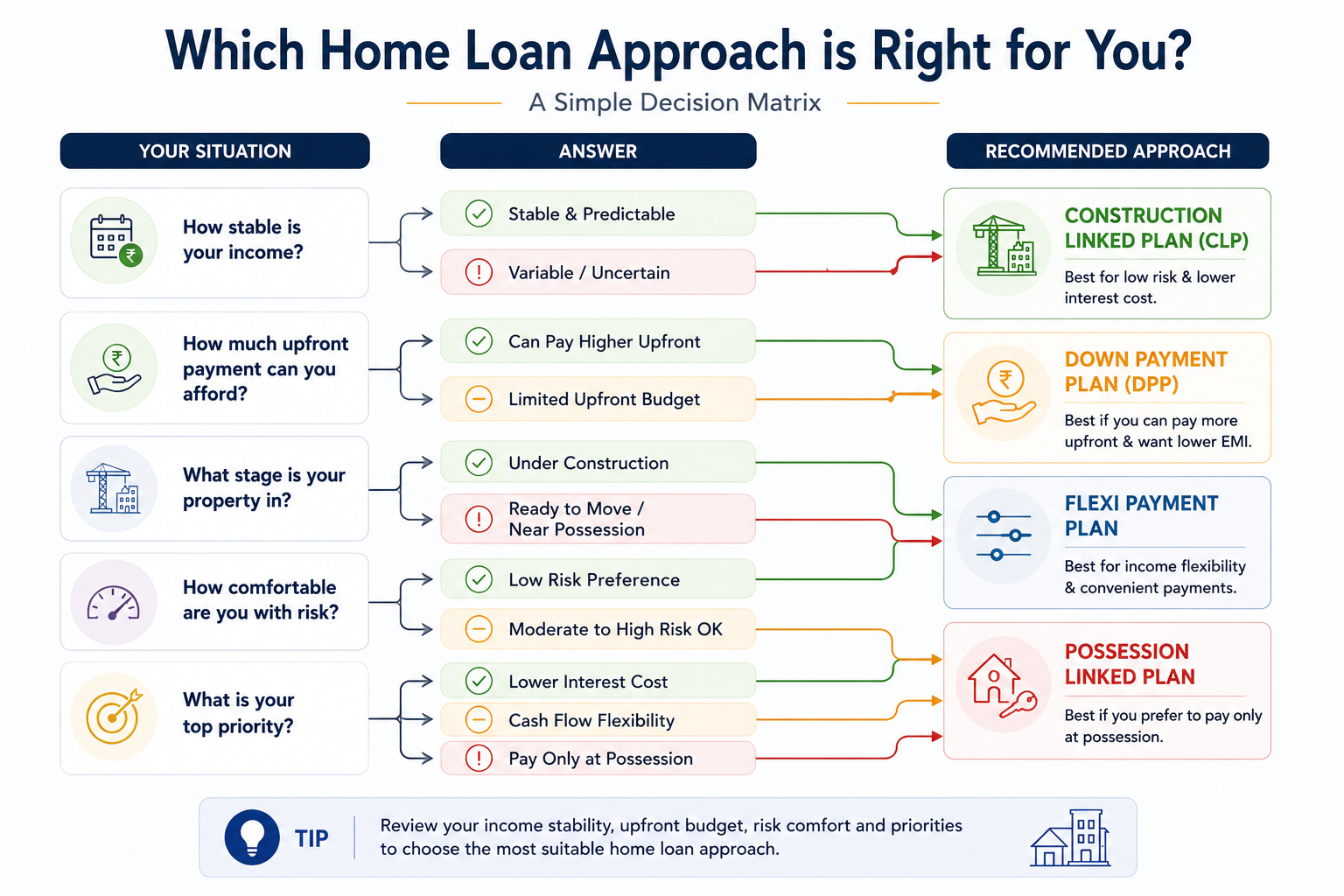
The right lender and loan structure depend on your income type, credit score, how much you value a low rate versus fast processing, and whether you are buying under-construction or ready-to-move property. Use this decision matrix to quickly narrow your options.
| Your Situation | Recommended Approach |
|---|---|
| Salaried employee with a strong CIBIL score (750+) | Compare public sector banks like SBI, Bank of Baroda, PNB, Canara Bank, and top HFCs like LIC Housing Finance for the lowest interest rates. |
| Salaried buyer seeking fast digital loan approval | Consider ICICI Bank, HDFC Bank, or Axis Bank for quicker online processing and doorstep service. |
| Self-employed professional or business owner | Choose Kotak Mahindra Bank or a flexible Housing Finance Company (HFC). Keep your ITRs, financial statements, and bank statements ready. |
| First-time homebuyer with limited down payment | Look for higher LTV eligibility (up to 90% on eligible loans) and check if you qualify for any affordable housing schemes. |
| NRI planning to buy property in India | Select banks with dedicated NRI home loan services and verify NRE/NRO account requirements and repayment rules. |
| Buying an under-construction property | Choose a Construction Linked Payment Plan (CLP) and verify the project’s RERA registration before applying. |
| Buying a ready-to-move property | A Down Payment Plan (DPP) is generally simpler because the bank disburses the loan against a completed property. |
| Already have a home loan and want lower interest rates | Consider a Home Loan Balance Transfer after comparing the savings against processing fees and transfer costs. |
Quick Summary: Match the lender to your income type and priorities (rate vs. speed vs. flexibility), and match the payment plan to how far along the property’s construction is. Expert Tip: Run the same loan amount and tenure through two or three lenders’ EMI calculators before you finalize a choice a 0.25% rate difference on a ₹50 lakh, 20-year loan can change your total interest by well over ₹1.5 lakh. Common Mistake: Don’t pick a lender based only on a lower advertised rate. Check processing fees, prepayment terms, and how quickly the rate slab climbs if your credit profile changes.
Home Loan Eligibility
Home loan eligibility in India depends on your age, income, employment type, credit score (CIBIL), existing financial obligations (FOIR), and the property’s value. Most lenders require you to be salaried or self-employed, aged between 21 and 65 when the loan ends, with a CIBIL score of 700 or higher to get the best rates.
Key Eligibility Factors
- Age: Typically 21–65 years at the end of the loan tenure. Younger applicants generally qualify for longer tenures.
- Employment & Income Stability: Salaried applicants usually need at least 2–3 years of work experience. Self-employed applicants need stable business income, and they usually prove this with 2–3 years of Income Tax Returns (ITRs).
- Credit Score (CIBIL Score): A score of 750 and above typically gets you the best available rate slab. Scores between 700–749 may still qualify, but at a slightly higher rate. Scores below 650 often lead to rejection or much higher pricing.
- FOIR (Fixed Obligation to Income Ratio): Lenders check what percentage of your monthly income already goes toward existing EMIs and other debts. Most banks prefer this figure to stay within roughly 40–50% of your net income, including the new home loan EMI.
- Co-applicant: Adding a co-applicant (spouse, parent, or sibling with income) can meaningfully increase your eligible loan amount. If they are also a co-owner, both of you can separately claim tax benefits.
- Loan-to-Value (LTV) Ratio: Under RBI norms, lenders can fund up to 90% of the property value for loans up to ₹30 lakh, up to 80% for loans between ₹30 lakh and ₹75 lakh, and up to 75% for loans above ₹75 lakh. You must fund the rest from your own money as a down payment.
Illustrative Eligibility Snapshot
| Eligibility Factor | Typical Requirement |
|---|---|
| Minimum Age | 21 years |
| Maximum Age at Loan Maturity | 60–70 years (varies by lender) |
| Recommended CIBIL Score | 750+ for the best interest rates |
| Preferred FOIR (Fixed Obligation to Income Ratio) | Up to 40–50% of net monthly income |
| Minimum Work Experience (Salaried) | 2–3 years of continuous employment |
| Minimum Business Vintage (Self-employed) | 2–3 years with supporting Income Tax Returns (ITRs) |
| Maximum Loan-to-Value (LTV) – Loans up to ₹30 lakh | Up to 90% |
| Maximum Loan-to-Value (LTV) – Loans from ₹30 lakh to ₹75 lakh | Up to 80% |
| Maximum Loan-to-Value (LTV) – Loans above ₹75 lakh | Up to 75% |
Your age, stable income, strong CIBIL score, manageable existing debts, and the RBI-mandated LTV cap for your loan slab all decide your eligibility. Expert Tip: Check your CIBIL score at least three months before you apply. If it sits below 750, focus on clearing overdue payments and lowering your credit card usage before you submit your application. Common Mistake: Don’t apply to multiple lenders at once “just to compare.” Each hard credit check can temporarily lower your CIBIL score, which can work against you.
Documents Required for a Home Loan
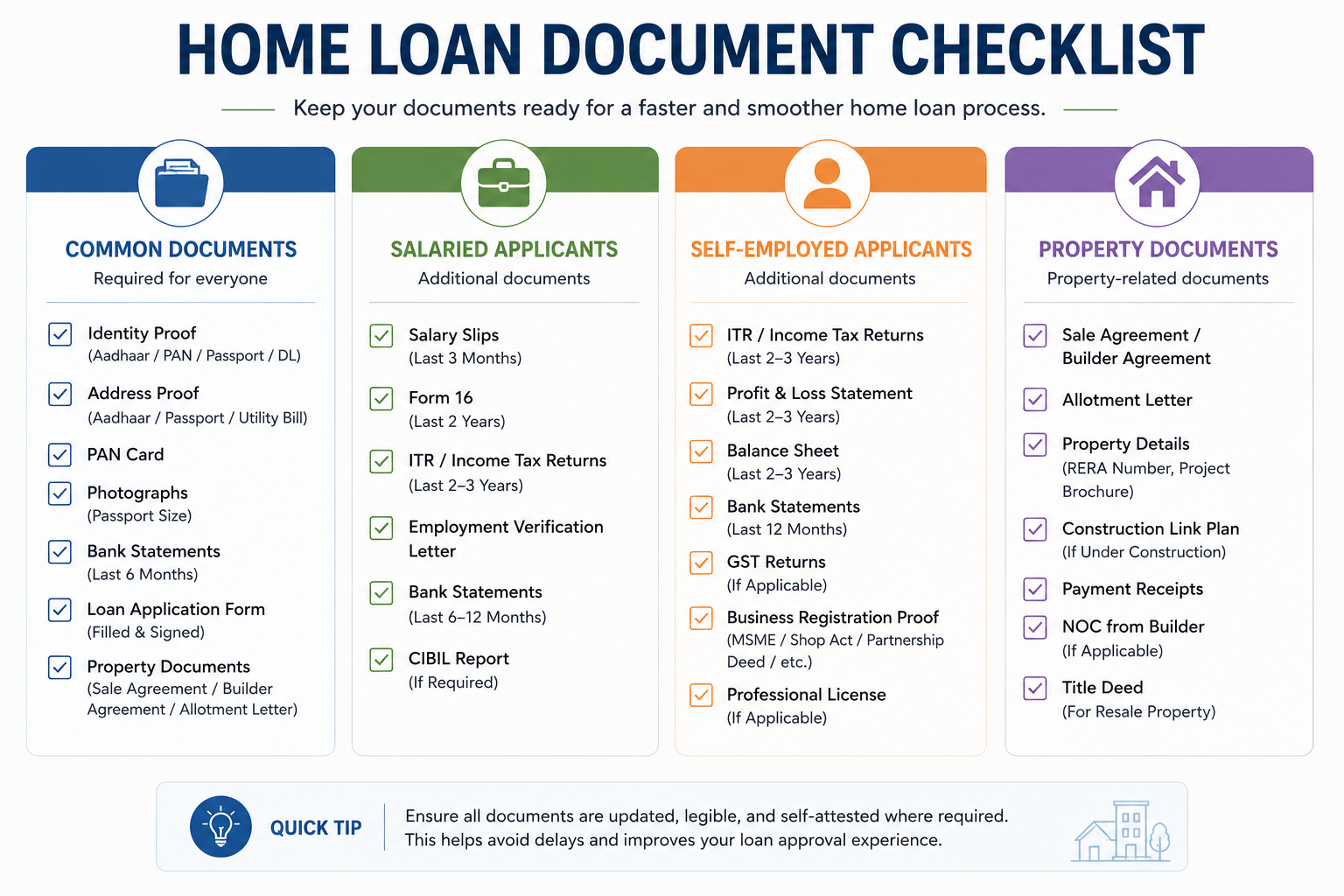
Home loan documents in India fall into four groups: identity and address proof, income proof, property documents, and bank statements. Salaried and self-employed applicants submit slightly different income documents, and NRIs need extra overseas employment and account paperwork.
Common Documents (All Applicants)
- Duly filled and signed loan application form with photographs
- Identity proof: PAN card, Aadhaar card, passport, or voter ID
- Address proof: Aadhaar card, utility bill, passport, or rent agreement
- Bank statements for the last 6 months
- Passport-size photographs
For Salaried Applicants
- Last 3 months’ salary slips
- Form 16 or Income Tax Returns (ITR) for the last 2–3 years
- Employment continuity proof or an employer certificate
For Self-Employed Applicants
- ITRs for the last 2–3 years, with computation of income
- Business proof: GST registration, shop establishment licence, or partnership deed
- Profit & Loss statement and balance sheet, usually CA-certified
- Business bank account statements for 6–12 months
Property Documents
- Copy of the Builder-Buyer Agreement or Agreement to Sell
- Title documents / Sale Deed or Allotment Letter
- Approved building plan and layout
- RERA registration certificate of the project
- Occupancy Certificate or Completion Certificate (for ready-to-move properties)
- No Objection Certificate (NOC) from the builder or housing society, where applicable
- Encumbrance Certificate confirming the property carries no legal or financial liabilities
For NRI Applicants
- Valid passport and visa/work permit copy
- Overseas employment contract or employer certificate
- NRE/NRO bank account statements
- Power of Attorney (POA) in favour of a representative in India, if the lender requires it
Organizing your identity, income, bank, and property documents in advance incomplete paperwork causes most home loan processing delays. Expert Tip: Ask your developer for a document checklist specific to the project. Established developers keep RERA certificates, approved plans, and title documents ready in a single file for buyers and lenders. Common Mistake: Don’t submit ITRs that don’t match the income you wrote in the loan application. Mismatches are one of the most common reasons lenders delay or reject self-employed applications.
Home Loan Interest Rates Explained
Home loan interest rates in India come in three types: fixed, floating, or hybrid. Floating rates track external benchmarks such as the RBI repo rate, so they change whenever RBI’s Monetary Policy Committee revises the repo rate. At the June 2026 MPC meeting, RBI set the repo rate at 5.25%, and most bank home loan rates now start somewhere between 7.15% and 8.45%, depending on the lender and your profile.
How Floating Rates Work
Most home loans in India today carry a floating rate. Banks link this rate to an External Benchmark Lending Rate (EBLR), which in turn tracks the RBI repo rate. When RBI changes the repo rate at its bi-monthly MPC meetings, your EMI (or your loan tenure, depending on the bank’s policy) adjusts accordingly.
- Repo rate cut – Bank’s EBLR falls – your effective home loan rate falls
- Repo rate hike – Bank’s EBLR rises – your effective home loan rate rises
RBI set the repo rate at 5.25% at the June 2026 MPC meeting, and the next policy review happens in early August 2026. Because this rate can change every two months, treat any interest rate you see online as indicative, and reconfirm it directly with the lender when you apply.
What Determines Your Final Rate
- CIBIL/credit score: Higher scores (750+) usually unlock the lowest slab in a bank’s rate card.
- Loan amount: Some banks price larger loans slightly differently from smaller ones.
- Income type: Salaried applicants sometimes get marginally better pricing than self-employed applicants.
- Gender: Several public sector banks offer a small rate concession (often around 0.05%) to women borrowers or co-borrowers.
- Property type and location: Lenders view approved, RERA-registered projects in well-established micro-markets more favorably than unapproved or disputed properties.
Floating rates move with the RBI repo rate through your bank’s EBLR. As of mid-2026 the repo rate sits at 5.25%, and home loan rates broadly range from about 7.15% to 8.45% for well-qualified borrowers though this changes with each MPC cycle. Expert Tip: If you hold a floating-rate loan and RBI cuts the repo rate, call your bank yourself. Some lenders wait for you to request a rate reset rather than applying it automatically to your EMI. Common Mistake: Don’t compare only the lowest advertised “starting from” rate across banks. Check which credit score and loan slab that rate actually applies to.
Fixed vs. Floating vs. Hybrid Home Loan Interest Rates Comparison
A fixed rate stays the same for the loan tenure (or a set period). A floating rate moves with the RBI repo rate through the bank’s benchmark. A hybrid rate stays fixed for an initial period, then switches to floating. Most Indian borrowers choose floating rates today because they usually cost less over the long run.
| Feature | Fixed Rate | Floating Rate | Hybrid Rate |
|---|---|---|---|
| Interest Rate Stability | Remains unchanged throughout the tenure or fixed period. | Changes based on RBI repo rate movements. | Fixed initially, then switches to a floating rate. |
| Starting Interest Rate | Usually higher than floating-rate loans. | Generally lower at the beginning. | Typically falls between fixed and floating rates. |
| Best Suited For | Borrowers who prefer predictable monthly EMIs. | Borrowers comfortable with changing interest rates. | Borrowers seeking short-term stability with long-term flexibility. |
| Prepayment Charges | May apply, especially on true fixed-rate home loans. | Generally not applicable for individual borrowers, as per RBI guidelines. | May apply during the fixed-rate period. |
| Interest Rate Risk | Lender bears the interest rate risk during the fixed period. | Borrower bears the risk of rate fluctuations. | Risk is shared depending on the loan structure. |
Floating rates dominate the Indian market because RBI rules generally waive prepayment charges on individual floating-rate home loans, and they tend to average out cheaper over a long tenure. Expert Tip: If you expect rates to fall over the next few years, floating usually costs less; if you value predictable budgeting above all, ask about hybrid options with a 2–3 year fixed period. Common Mistake: Don’t pick a fixed-rate loan for the whole term without checking the fine print. Most “fixed” home loan products in India only stay fixed for an initial window, then switch to floating.
Home Loan Payment Plans Explained
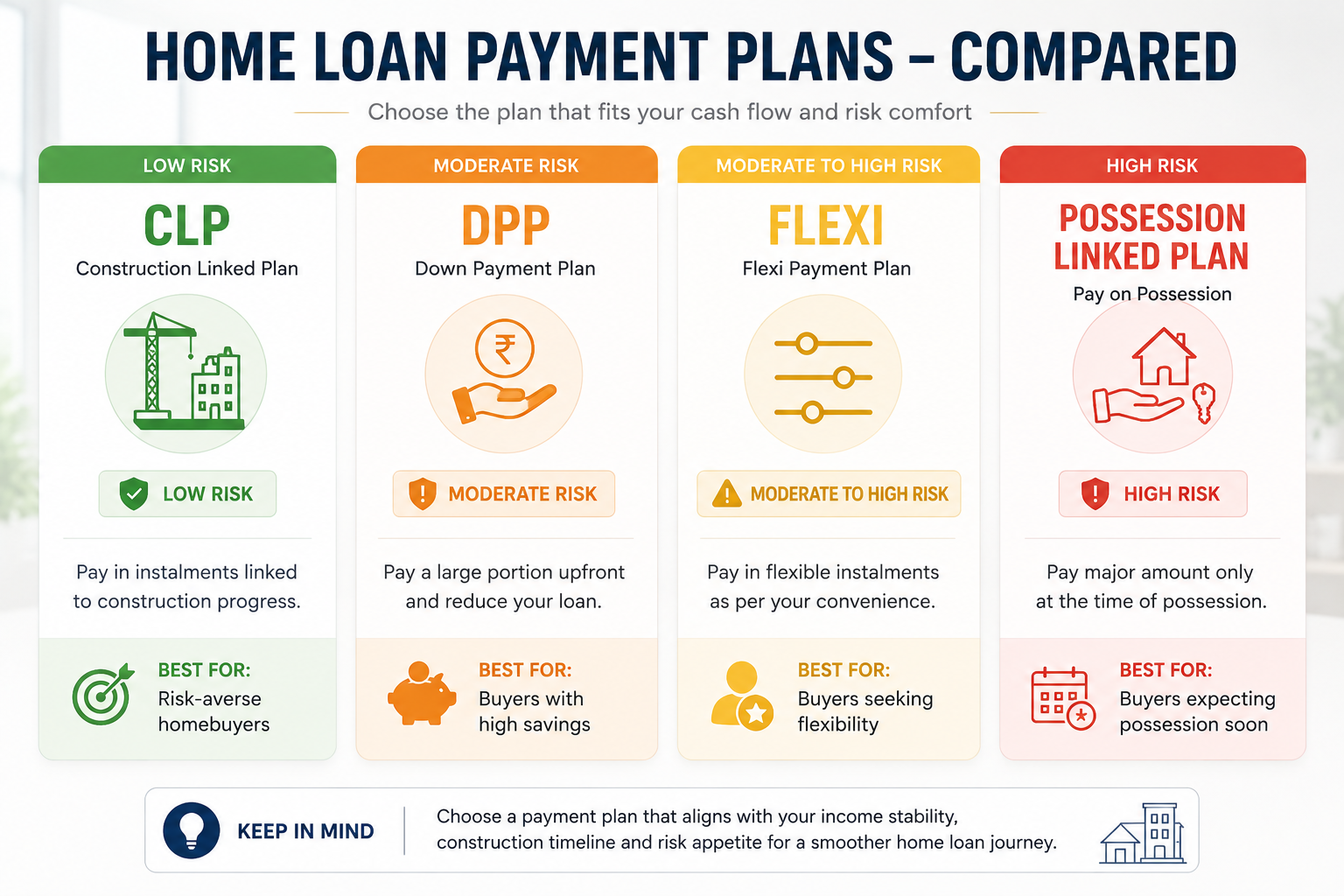
When you buy an under-construction property, your payment plan decides when you pay the builder and when your bank releases the loan. India has four common payment plans: the Construction Linked Plan, Down Payment Plan, Flexi Payment Plan, and Possession Linked Plan. Each carries a different mix of risk and cost.
Choosing the right payment plan matters as much as choosing the right bank, especially when you buy an apartment before it is complete.
Construction Linked Plan (CLP)
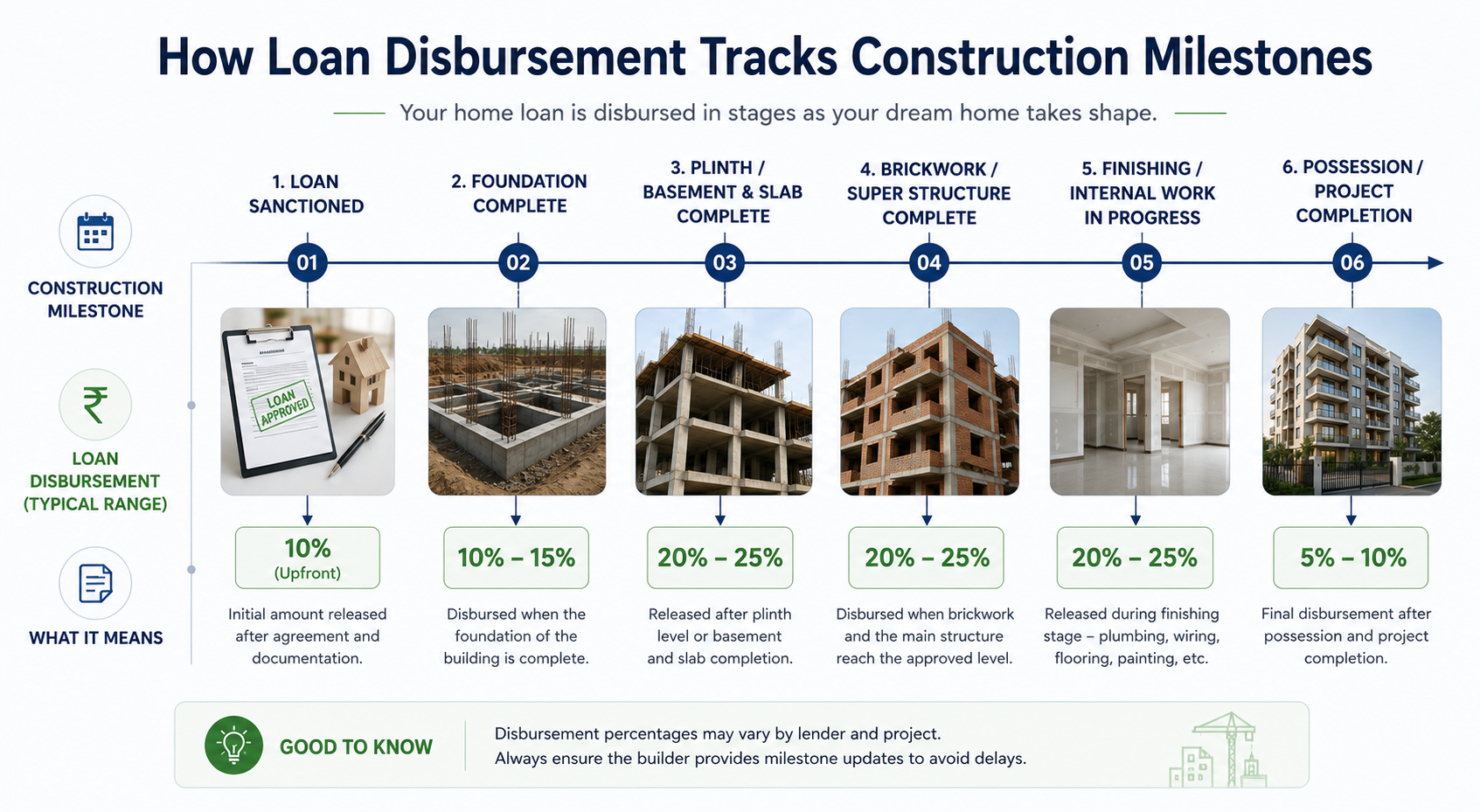
Under a Construction Linked Plan, you (and your bank) release payments in installments tied to construction milestones, foundation, slab casting, brickwork, finishing, and so on. Lenders prefer this structure the most, because it matches your payment to actual construction progress. This lowers your risk if the project runs late.
Down Payment Plan (DPP)
In a Down Payment Plan, you pay a large upfront portion (commonly 10–20%) directly to the builder, and the bank disburses the remaining loan amount in a lump sum shortly after. Builders often offer a price discount for Down Payment Plans since they receive funds faster. This plan carries more risk for you if the project runs late, since you pay most of the money early.
Flexi Payment Plan
A Flexi Payment Plan is a hybrid structure. It often combines an upfront payment with a mix of milestone-linked and time-linked instalments. It gives you slightly more flexibility than a strict CLP while offering more protection than a pure DPP.
Possession Linked Plan / No EMI Till Possession
Under a Possession Linked Plan, you defer a large part of the payment (and loan disbursement) until you take possession of the property. Some developers market a version of this as “No EMI Till Possession,” where the builder subsidises interest during construction. Read the fine print carefully builders often build this subvention cost into the property price.
Subvention Plan / 10:90 and 20:80 Plans
A Subvention Plan often marketed as a 10:90 or 20:80 plan asks you to pay only 10% or 20% upfront. The bank disburses the rest to the builder, and the developer pays the pre-EMI interest until possession or a set date. RBI has flagged concerns about developer-funded subvention structures in the past, so make sure the Builder-Buyer Agreement clearly documents the builder’s obligations don’t rely on marketing material alone.
CLP offers the most balanced and widely available option. DPP suits you if you trust the builder’s delivery track record and want a price discount. Subvention and possession-linked plans need a careful read of who really bears the pre-EMI interest cost. Expert Tip: Whichever plan you choose, ask the builder for the RERA-registered project timeline and cross-check the payment schedule against it payment milestones should logically follow actual construction stages. Common Mistake: Don’t assume “No EMI Till Possession” means free money. In most cases, the builder quietly builds the subvention or discount cost into the base property price.
Payment Plan Comparison Table
| Payment Plan | How Payments Are Made | Buyer Risk | Best Suited For |
|---|---|---|---|
| Construction Linked Plan (CLP) | Payments are released in stages based on construction milestones. | Low – Payments follow actual construction progress. | Most buyers purchasing under-construction properties. |
| Down Payment Plan (DPP) | Buyer pays 10–20% upfront, while the bank disburses the remaining loan amount early. | High – Most funds are paid before project completion. | Buyers who trust the builder and have sufficient cash flow. |
| Flexi Payment Plan | A combination of upfront payment and milestone-based instalments. | Moderate – Balances flexibility with financial protection. | Buyers seeking a mix of convenience and lower risk. |
| Possession Linked Plan (PLP) | Most payments are made when possession is offered. | Low – Lower financial burden during construction, though the cost may be built into the property price. | Buyers wanting minimal financial outflow until possession. |
| Subvention Plan (10:90 / 20:80) | Buyer pays 10–20% upfront, while the builder covers pre-EMI interest until possession. | Depends on the Builder – Success depends on the developer’s financial strength and project execution. | Buyers looking for lower upfront investment with a financially stable developer. |
EMI Calculation Guide
You calculate your home loan EMI (Equated Monthly Instalment) from three things: the loan amount, the interest rate, and the tenure. The formula is EMI = P × r × (1+r)^n ÷ [(1+r)^n − 1], where P is the principal, r is the monthly interest rate, and n is the number of monthly installments.
The EMI Formula
- P = Loan principal (the amount you borrow)
- r = Monthly interest rate (annual rate ÷ 12 ÷ 100)
- n = Loan tenure in months
Worked Example
Assume a loan amount of ₹50,00,000, an interest rate of 8.5% per annum, and a tenure of 20 years (240 months).
- Monthly interest rate (r) = 8.5 ÷ 12 ÷ 100 = 0.007083
- Your EMI works out to approximately ₹43,400 per month
- You pay approximately ₹1.04 crore in total over 20 years
- You pay approximately ₹54 lakh in total interest over 20 years
This example shows why the interest rate and tenure matter as much as the loan amount itself. Over a long tenure, the total interest you pay can approach or even exceed the amount you borrowed.
How Tenure Affects Your EMI and Total Cost
| Loan Tenure | Approx. Monthly EMI (₹50 Lakh Loan @ 8.5% p.a.) |
Approx. Total Interest Paid |
|---|---|---|
| 10 Years | ~₹61,990 | ~₹24.4 Lakh |
| 15 Years | ~₹49,240 | ~₹38.6 Lakh |
| 20 Years | ~₹43,400 | ~₹54.2 Lakh |
| 25 Years | ~₹40,280 | ~₹70.8 Lakh |
These figures are illustrative. We calculated them using the standard EMI formula and rounded them for readability. Use an online EMI calculator or your bank’s tool for a precise, personalized estimate.
A longer tenure lowers your monthly EMI but sharply increases the total interest you pay over the life of the loan. Expert Tip: If your income allows it, choose the shortest tenure with a comfortable EMI rather than automatically picking the maximum tenure on offer. Even a few extra thousand rupees a month can cut years off your repayment and lakhs off your total interest. Common Mistake: Don’t focus only on the EMI amount and ignore the total interest cost over the full tenure.
Step-by-Step Home Loan Process in India
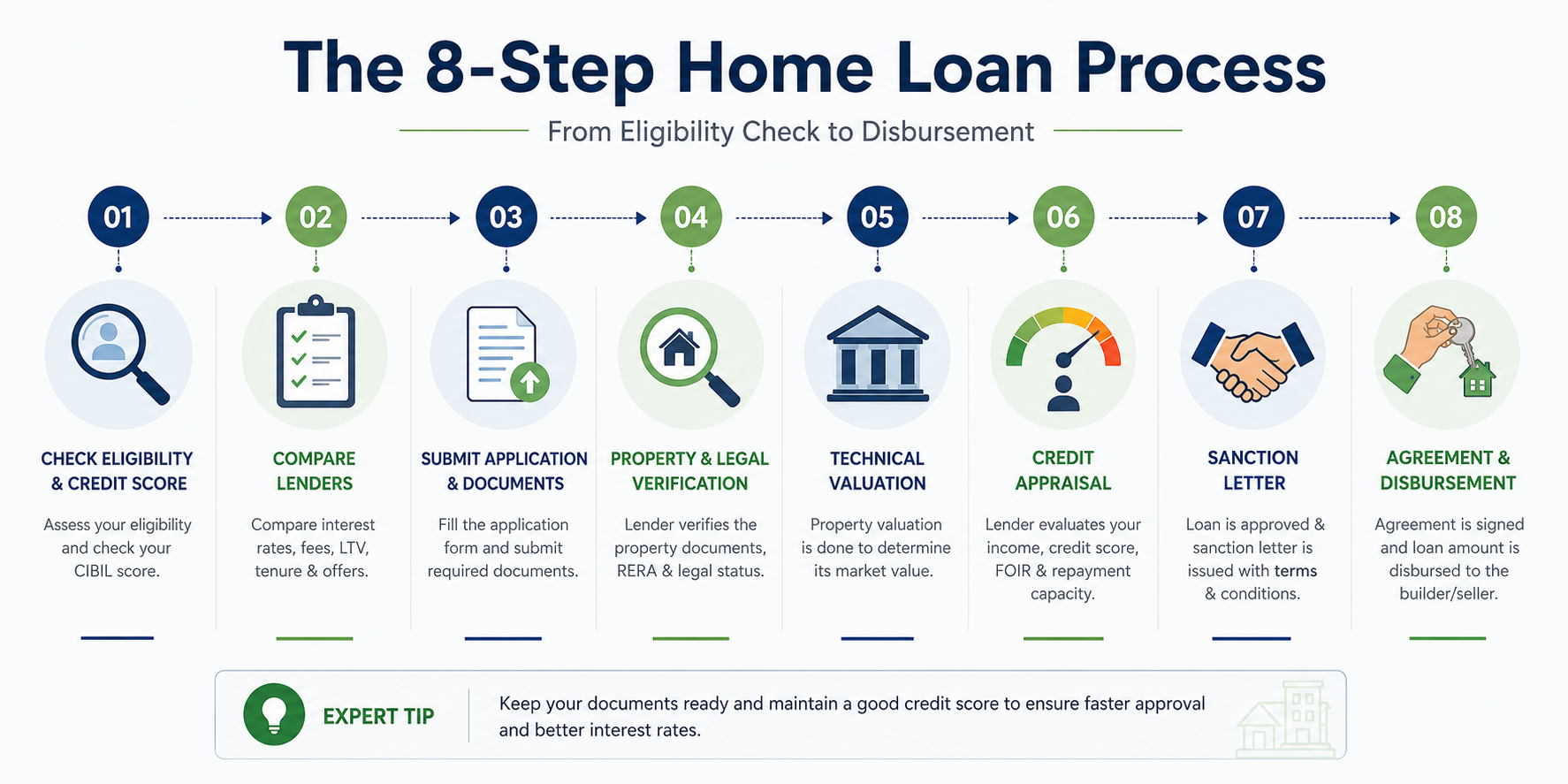
The home loan process in India typically involves eight steps: checking eligibility, comparing lenders, submitting your application with documents, property and legal verification, credit appraisal, sanction, agreement signing, and disbursement. This usually takes anywhere from a few days to a few weeks, depending on the property and lender.
- Check Your Eligibility and Credit Score: Use online eligibility calculators and check your CIBIL score before you approach lenders.
- Compare Lenders: Shortlist 3–4 banks or HFCs based on interest rate, processing fee, LTV, and reputation for service.
- Submit Application and Documents: Fill in the loan application form and submit your identity, income, and property documents.
- Property and Legal Verification: The lender’s legal team checks the Sale Deed, Builder-Buyer Agreement, RERA registration, Encumbrance Certificate, and approved building plan.
- Technical Valuation: A lender-appointed valuer assesses the property’s market value, which directly affects your eligible LTV and loan amount.
- Credit Appraisal: The lender evaluates your income, existing debts (FOIR), credit history, and repayment capacity.
- Sanction Letter: On approval, the lender issues a Home Loan Sanction Letter stating your approved amount, interest rate, and tenure. This is not the same as disbursement, it is an offer.
- Loan Agreement and Disbursement: You sign the loan agreement, submit post-dated cheques or set up an ECS/NACH mandate, and the lender releases the funds either in full (ready-to-move property) or in stages as per your Construction Linked Plan.
For under-construction property, the bank releases the loan in tranches that match construction milestones. You pay pre-EMI (interest only) on the amount released so far, until the bank pays out the full loan. After that, your regular EMIs begin.
From application to disbursement, expect the lender to verify both your finances and the property’s legal status. Keeping your documents ready at each stage speeds up the process considerably. Expert Tip: Ask for a copy of the technical valuation report. If the valuer’s assessed value comes in lower than the agreement value, your effective LTV and hence your loan amount could shrink. Common Mistake: Don’t sign the Builder-Buyer Agreement before you confirm that the bank’s legal team has cleared the project’s title and RERA status.
Tax Benefits on Home Loans
If you choose the old tax regime, you can claim up to ₹1.5 lakh a year on principal repayment under Section 80C, and up to ₹2 lakh a year on interest under Section 24(b). Sections 80EE and 80EEA offer extra interest deductions, but only if you took your loan within specific windows that have now closed. The new tax regime does not offer most of these deductions on a self-occupied home.
Section 80C Principal Repayment
Under Section 80C of the Income Tax Act, you can claim up to ₹1.5 lakh per financial year on the principal portion of your EMI, along with stamp duty and registration charges (claimable in the year you pay them) but only under the old tax regime. This limit is shared with other 80C investments like PPF and ELSS.
Section 24(b) Interest Repayment
Under Section 24(b), you can claim up to ₹2 lakh per financial year on interest you pay for a self-occupied property, also only under the old tax regime. For a rented-out property, you can deduct the full interest amount against your rental income this applies even under some new-regime scenarios, though loss set-off rules limit it.
Section 80EE and Section 80EEA Additional Interest Deduction
- Section 80EE gives you an extra deduction of up to ₹50,000, but only if you took the loan within a specific earlier window the government set. It does not apply to loans you take today.
- Section 80EEA gives you a bigger extra deduction of up to ₹1.5 lakh. It applies only if you took the loan between 1 April 2019 and 31 March 2022, for a property with a stamp duty value up to ₹45 lakh, and only if you did not own another residential property when you took the loan.
Both windows have closed for new loans as of 2026. If you take a fresh home loan today, you cannot claim 80EE or 80EEA. Only borrowers who are still repaying a loan taken within those earlier windows can keep claiming them.
Old Regime vs. New Regime
As of 2026, the new tax regime is the default option for taxpayers in India. Under the new regime, you cannot claim Section 80C or Section 24(b) deductions on a self-occupied property. This means the old tax regime is the only way to unlock most home loan tax benefits, so run the numbers for your income and deductions before you choose a regime each year.
| Deduction | Income Tax Section | Maximum Limit | Applicable Regime |
|---|---|---|---|
| Principal Repayment | Section 80C | ₹1.5 lakh/year | Old Tax Regime |
| Interest on Self-Occupied Property | Section 24(b) | ₹2 lakh/year | Old Tax Regime |
| Additional Interest (Eligible Older Loans) | Section 80EE | ₹50,000/year | Old Tax Regime (Closed for New Loans) |
| Additional Interest (Loans Sanctioned Apr 2019–Mar 2022) | Section 80EEA | ₹1.5 lakh/year | Old Tax Regime (Closed for New Loans) |
Tax rules can change with each Union Budget. This section gives general information only and is not tax advice please consult a qualified chartered accountant or tax advisor for guidance specific to your situation.
Under the old tax regime, a home loan can meaningfully cut your taxable income through Sections 80C and 24(b). Under the new regime (the current default), most of these benefits disappear for a self-occupied home. Expert Tip: If you and your spouse are joint applicants and co-owners, you can each separately claim the Section 80C and 24(b) limits, effectively doubling your household’s total deduction.
Common Mistake: Don’t assume you automatically qualify for Section 80EEA just because you’re a first-time buyer. The sanction-date and property-value rules are strict, and most loans you take today do not qualify.
Common Home Loan Mistakes to Avoid
The most frequent home loan mistakes include skipping your CIBIL score check, borrowing the maximum eligible amount instead of a comfortable one, ignoring processing and hidden charges, skipping legal verification of the property, and not comparing prepayment or foreclosure terms across lenders.
- Skipping an early credit score check Finding out about a low CIBIL score at the application stage wastes time and may lead to rejection or a higher rate.
- Borrowing the maximum eligible amount A bank approving a certain amount doesn’t mean it fits comfortably within your monthly budget alongside other expenses.
- Ignoring the FOIR impact of existing loans Car loans, personal loans, or high credit card balances can sharply cut your eligible home loan amount.
- Skipping legal and RERA verification Always confirm the project’s RERA registration number and check it on the state RERA portal before you sign any agreement.
- Overlooking processing fees and hidden charges Compare the total cost, including processing fees, legal/technical charges, and insurance bundling, not just the headline interest rate.
- Not reading prepayment and foreclosure terms RBI bans prepayment penalties on individual floating-rate loans, but terms can still differ for fixed-rate loans or business borrowers.
- Delaying EMI payments Even one missed EMI can hurt your CIBIL score for years and complicate future borrowing.
- Skipping a financial buffer If you’re on a Construction Linked Plan, budget for both pre-EMI interest and rent (if you’re currently renting) during the construction period.
Expert Tips Before Applying for a Home Loan
Before you apply, check and improve your CIBIL score, compare at least three lenders, calculate your true affordability (not just your eligibility), keep all documents ready in advance, and verify the project’s RERA and legal status yourself rather than relying only on the builder’s word.
- Improve your CIBIL score first. Pay down credit card balances and clear any overdue EMIs at least 3–6 months before you apply.
- Get a pre-approved loan (in-principle sanction). This tells you your realistic budget before you start shortlisting properties, and it strengthens your negotiating position with builders.
- Add a co-applicant strategically. A working spouse or family member as a co-applicant can boost your eligibility and, if they’re also a co-owner, unlock extra tax benefits.
- Negotiate the processing fee, not just the rate. Many lenders can waive or reduce processing fees, especially during festive offers.
- Match the payment plan to the builder’s track record. A well-established developer with a strong delivery history may justify a Down Payment Plan discount; for newer projects, a Construction Linked Plan is generally safer.
- Keep a contingency fund. Registration charges, stamp duty, interior costs, and moving expenses typically add 8–12% on top of the property price plan for this separately from your down payment.
- Reassess your loan periodically. Once or twice a year, compare your current rate against new offers in the market. A balance transfer can pay off if the gap is meaningful after you account for transfer costs.
Preparation checking your credit score, getting pre-approval, keeping documents ready, and verifying legal status yourself does more to secure a good home loan deal than negotiating tactics alone. Expert Tip: Ask for the loan sanction letter in writing before you make any non-refundable payment to the builder or seller. Common Mistake: Don’t rely only on the builder’s in-house loan desk. Independently compare rates from at least one or two other lenders.
People Also Ask
How much home loan can I get on my salary?
Most lenders use your net monthly income and existing debts (FOIR) to estimate your eligibility. They commonly want your total EMIs including the new home loan to stay within about 40–50% of your take-home income. Use a bank’s eligibility calculator with your actual salary slips for an accurate figure.
What is the minimum CIBIL score needed for a home loan?
Most banks prefer a CIBIL score of 700 or above, and a score of 750+ typically unlocks the best interest rate slabs. Scores below 650 may lead to rejection or much higher pricing.
Can I get a home loan without ITR if I am self-employed?
Getting one is hard but not impossible. Some lenders accept bank statements and business proof instead of ITRs. But if you submit proper ITRs for 2–3 years, your chances and your rate improve significantly.
Is a floating rate or fixed rate better for a home loan?
Floating rates usually cost less over the long term, and banks don’t charge individual borrowers a prepayment penalty on them that’s why most Indian home loans today are floating. Fixed rates suit you if you want predictable EMIs more than the lowest total cost.
What happens if I miss an EMI payment?
If you miss an EMI, the lender usually charges a late payment fee and reports it to credit bureaus, which can lower your CIBIL score. If you keep missing payments, the lender can classify your loan as a Non-Performing Asset (NPA) and start recovery action.
Can NRIs get a home loan for property in India?
Yes, most major banks and HFCs offer dedicated NRI home loan products, though documentation (overseas employment proof, NRE/NRO account details) and repayment rules differ slightly from resident applications.
Do I need to pay tax on a home loan if I choose the new tax regime?
Under the new tax regime, you generally cannot claim Section 80C or Section 24(b) deductions on a self-occupied property. So the home loan itself does not directly reduce your taxable income under this regime.
Key Takeaways
- A home loan for buying property in India typically covers 75–90% of the property value, depending on the RBI’s LTV slabs for your loan amount.
- Compare at least three to four lenders on interest rate, processing fees, and service quality not just the headline rate.
- Floating rates track the RBI repo rate (5.25% as of the June 2026 MPC review). They’re the most common structure in India, and banks generally charge individual borrowers no prepayment penalty on them.
- For under-construction property, a Construction Linked Plan is usually the safest payment structure; Down Payment and subvention plans carry different risk-reward trade-offs.
- A strong CIBIL score (750+), a manageable FOIR, and complete documentation give you the best chance of quick approval at a good rate.
- You get tax benefits under Sections 80C and 24(b) only in the old tax regime. Sections 80EE and 80EEA apply only to loans you took within specific windows that have now closed.
- Always verify a project’s RERA registration and legal documents yourself before you make any payment.
The Bottom Line is..
Getting a home loan for buying property in India does not have to feel overwhelming once you understand how eligibility, interest rates, payment plans, and tax benefits fit together. The core principles stay the same whether you buy in Noida, Delhi-NCR, or any other Indian city: check your credit profile early, compare lenders honestly, match your payment plan to the property’s construction stage, and borrow an amount that fits comfortably within your monthly budget not just the maximum you’re eligible for.
If you’re exploring residential options in Noida, Greater Noida, or Delhi-NCR, Express Builders structures its projects with RERA-registered documentation and payment schedules that work smoothly with major banks’ home loan processes. Please contact our team can help you understand which payment plan and financing path suits your specific property choice without any obligation to proceed.
