
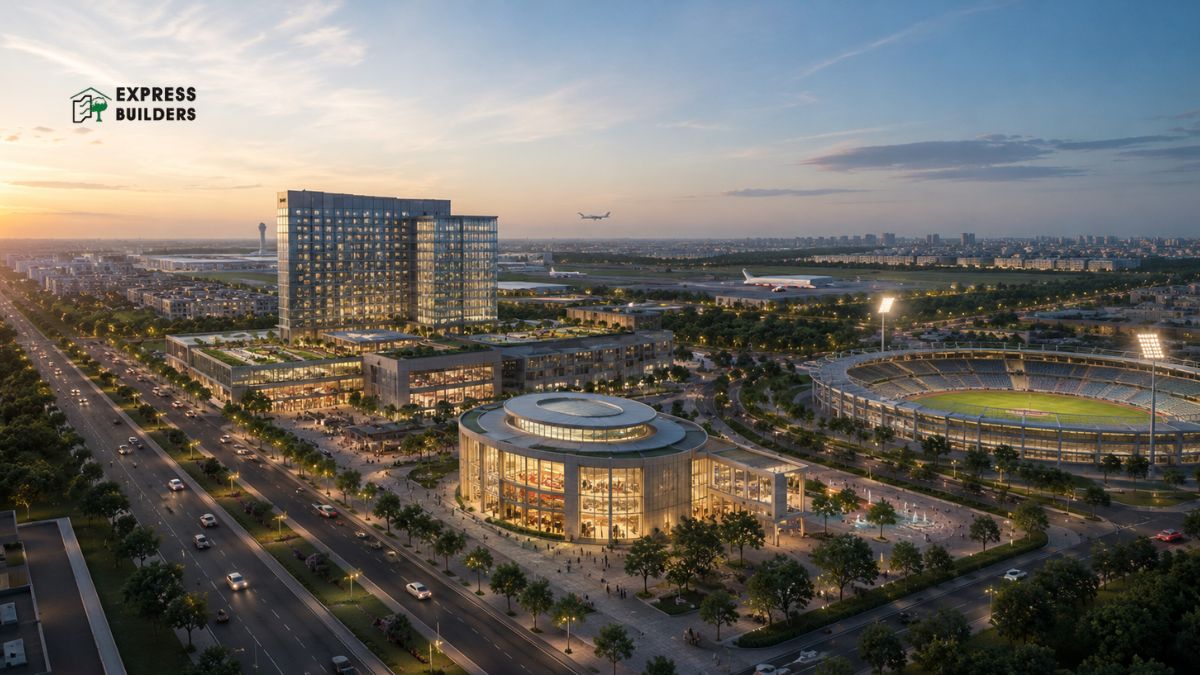
Ghaziabad has always been more than a stopover city on the Delhi-Meerut highway. Over the last decade, it has grown into a genuine real estate destination within the NCR. Better roads, metro lines, and industrial activity raised its profile among homebuyers and investors. Now, a far bigger shift is underway. The Ghaziabad Aerocity Project is set to redefine the city’s urban identity completely.
This is not a single housing complex or a small commercial park. It is a 380-acre integrated urban township backed by the Ghaziabad Development Authority. It brings aviation infrastructure, commercial real estate, hospitality, sports, and residential planning together under one bold vision. Understanding this project and its real estate implications helps you make smarter property decisions in the region today.
What Is the Ghaziabad Aerocity Project?
The Ghaziabad Development Authority (GDA) first outlined this project in 2014-15. After years of delayed progress, it gained significant momentum under the current state government. The Yogi Adityanath government has prioritized its completion. The goal is to transform Ghaziabad into a globally competitive urban hub.
The Ghaziabad Aerocity Project is located in the Raj Nagar Extension area, specifically in the Morti zone. It covers 380 acres and forms part of a larger Rs 2,200 crore investment initiative. This investment also includes the construction of an international cricket stadium at an estimated cost of Rs 400 crore.
The Aerocity township is envisioned as an Integrated Urban Hub drawing inspiration from global standards. The planned facilities include luxury resorts, five-star hotels, high-end shopping malls, and a state-of-the-art business hub. An international convention center, a sports academy, and smart residential complexes complete the vision.
Adjacent to the Aerocity, the international cricket stadium will occupy 37 acres and hold more than 30,000 spectators. High-tech lighting systems and a modern media center will support international-level matches. It will be the first international cricket venue in Western Uttar Pradesh.
GDA Vice-Chairman Nand Kishore Kalal has emphasized that the Aerocity model will catalyze significant economic growth. He highlighted that the project will benefit the retail and service sectors particularly. By merging sports, commerce, and tourism, the development aims to generate large-scale employment.
The Scale and Vision Behind This Development
Uttar Pradesh's Ghaziabad is set to emerge as a next-gen integrated urban hub with a ₹2200 crore project featuring an international cricket stadium, aerocity, business districts, and smart residential zones.
India’s urban growth is clearly moving multi-nodal. pic.twitter.com/6wz6ccnhcs
— India First Post (@ifpost47) April 11, 2026
The sheer scale of the Ghaziabad Aerocity Project sets it apart from previous development plans in this city. Most earlier projects in Ghaziabad focused on standalone residential colonies or small commercial strips. This project brings something genuinely different to the table.
It combines the pulling power of an airport-adjacent township with the energy of a sports and entertainment district. These combinations are rare in Tier-2 NCR cities. When they do emerge, they create lasting and measurable uplift for surrounding real estate markets.
The convention center component deserves special attention. Convention centers attract corporate events, trade exhibitions, and government summits. Each event brings in delegates, visitors, and businesses that need hotel rooms, dining facilities, and transportation. This consistent footfall directly supports commercial and hospitality real estate around the Aerocity zone.
The sports academy adds another interesting layer to this development. A well-run sports academy attracts students, coaches, and sports organizations on a year-round basis. This creates sustained demand for housing and services in the immediate catchment area. Unlike event-based facilities, training academies generate predictable, daily footfall.
Hindon Airport: The Aviation Backbone of the Project
Every aerocity project draws its core energy from the airport it surrounds. For the Ghaziabad Aerocity Project, that airport is the Hindon Civil Terminal at Sikanderpur, Sahibabad.
Hindon Airport sits roughly 12 km from the heart of Ghaziabad city and approximately 30 km from Connaught Place in Delhi. This location makes it highly practical for travelers from East Delhi, Indirapuram, Vasundhara, and Vaishali. The airport operates under the Government of India’s UDAN (Ude Desh ka Aam Nagrik) scheme, which aims to make air travel affordable and accessible to a wider population.
Hindon Airport currently handles an average of 25 daily departures and 25 daily arrivals. Air India Express commenced operations in March 2025 connecting to nine destinations including Bengaluru, Mumbai, Chennai, Goa, Varanasi, Bhubaneswar, Patna, Jaipur, and Kolkata. IndiGo launched its operations in July 2025 linking to nine cities with around 40 weekly flights.
The passenger growth at Hindon has been exceptional and very recent. In November 2025, Hindon Airport recorded a 2,998 percent year-on-year surge in passenger traffic. It handled 1,22,381 passengers compared to just 3,950 in the same month a year earlier. This kind of growth rate is rare for any regional airport anywhere in India.
The Ghaziabad district administration has approved a Rs 63 crore expansion plan for the Hindon civil terminal to ease congestion and upgrade passenger infrastructure. The Airports Authority of India has requested additional land for this expansion. Land acquisition is already in progress and expansion work is expected to begin in 2026.
A proposed 16-km metro corridor will connect Vaishali on the Blue Line to Gokulpuri in northeast Delhi via the Hindon Civil Terminal. The alignment passes through Sahibabad, Mohan Nagar, and Pasonda. This direct metro link will reduce first-mile and last-mile travel challenges for thousands of daily airport users.
When a regional airport grows this fast and gains metro connectivity, nearby real estate responds. The airport expansion creates direct employment and draws hospitality, logistics, and retail investment to the surrounding zone. The Ghaziabad Aerocity Project benefits from every milestone of this airport growth story.
The Aerocity Concept: A Proven Urban Growth Engine
Airport-adjacent integrated townships have a strong track record in India. They consistently deliver superior real estate outcomes compared to conventional residential or commercial developments.
The core logic is simple. Airports generate sustained economic activity. They attract businesses, logistics companies, hospitality chains, and corporate offices to their vicinity. When a planned township sits next to an airport, it captures this economic activity within a master-planned environment. The result is a dense, multi-functional urban cluster that creates its own momentum.
Employment in aerocity zones tends to be diverse and resilient. A hotel manager, a logistics coordinator, a retail supervisor, and a convention services professional might all work within the same aerocity. This diversity of employment creates stable housing demand. A slowdown in one sector does not collapse the overall property market because multiple sectors support demand simultaneously.
Aerocity developments also benefit from a genuine address premium. Properties carrying an aerocity-adjacent address typically trade higher than comparable non-aerocity properties nearby. Buyers assign aspirational value to airport-proximity locations. This premium is consistent and well-documented in the Indian real estate market.
The Ghaziabad Aerocity Project will bring all these benefits to one of NCR’s most strategically located cities. Raj Nagar Extension, Sahibabad, and the broader Ghaziabad market stand to gain from this aerocity premium as the project moves through its development phases.
How the Project Impacts Real Estate Values
The Ghaziabad Aerocity Project is already creating overlapping waves of demand in the local property market. Each component of the project activates a different category of real estate activity.
The hotel and hospitality infrastructure first invites branded operators to establish properties in the zone. This commercial investment typically precedes and then sustains residential demand. As professionals and employees start moving closer to their workplaces, they drive up demand for apartments, plots, and rental housing in the vicinity.
The Raj Nagar Extension micro-market is already responding to this developing narrative. Historically a mid-segment market, it now draws interest from premium-category buyers as well. The proximity of world-class facilities changes the lifestyle perception of the locality. This shifts the buyer profile and supports higher price points over time.
Industry analysts have observed that emerging areas like Sahibabad and Raj Nagar Extension could witness stronger real estate momentum than already-established NCR hubs. While established areas may see steady gains, these emerging micro-markets carry more upside potential for buyers entering today.
Airport-adjacent properties across India have historically delivered strong capital appreciation. Areas near major airport developments have seen sustained price growth once infrastructure becomes operational. Ghaziabad follows this well-established and repeatable pattern.
Employment Generation and Its Effect on Housing Demand
Large urban projects generate employment in distinct, sequential waves. The Ghaziabad Aerocity Project will follow this pattern closely.
The first wave arrives during construction itself. Building a 380-acre township and a 30,000-seat stadium creates thousands of direct construction jobs. Workers on these projects require affordable housing within a reasonable commute distance. Localities like Loni, Raj Nagar Extension, and Mohan Nagar will absorb this initial surge.
The second wave arrives during the operational phase of the project. Hotel staff, retail workers, event management teams, convention center personnel, and sports facility operators all need homes within a short commute. This generates a sustained, year-round housing demand that keeps vacancy rates low and rents firm.
The third wave is the most valuable for long-term real estate investors. When an aerocity generates enough employment and economic activity, it attracts other businesses to locate nearby. Companies look for office space, warehousing, and commercial premises near well-connected urban hubs. This secondary commercial investment reinforces housing demand further and creates a self-strengthening cycle.
The GDA has acknowledged this employment multiplier effect in its public statements. The project’s deliberate design combines tourism, retail, and sports to maximize the diversity of employment it creates. A diverse employment base means more stable real estate demand across all property segments from affordable to premium.
The Infrastructure Network That Amplifies This Impact
The Ghaziabad Aerocity Project does not operate in infrastructure isolation. It sits within a broader transport development story that makes its real estate impact far larger.
The Delhi-Meerut RRTS (Rapid Rail Transit System) is the most significant surrounding infrastructure investment. This rapid rail system covers 92 km and reduces the Delhi-to-Meerut journey to under 50 minutes. Ghaziabad sits directly on this corridor. The RRTS has already shifted homebuyer sentiment toward Ghaziabad. Shorter and more predictable travel times make the city significantly more attractive to Delhi-based buyers.
The proposed metro corridor connecting Vaishali to Gokulpuri through Hindon Airport adds yet another layer of transit access. Properties within 1-2 km of metro stations historically command a premium of 10 to 20 percent over comparable non-metro properties. As this corridor takes shape, micro-markets along its alignment will see measurable price appreciation.
Road infrastructure continues to improve alongside these transit projects. The Hindon Elevated Road, the Delhi-Meerut Expressway, NH-58, and proximity to the Eastern Peripheral Expressway provide strong multi-directional road connectivity to the Aerocity zone. Together, these corridors ensure that the Aerocity site will not face connectivity bottlenecks as it scales up.
Good infrastructure is the most reliable predictor of sustained property appreciation. When multiple infrastructure streams converge in one zone, the combined effect is far greater than each project delivers individually. The Ghaziabad Aerocity Project sits precisely at this kind of infrastructure confluence.
What Buyers and Investors Should Consider
The Ghaziabad Aerocity Project creates a compelling investment narrative for multiple buyer profiles. Infrastructure-driven real estate cycles reward buyers who recognize the right opportunity at the right phase of development.
Properties in Raj Nagar Extension, Sahibabad, and Vasundhara are currently priced at levels that do not fully reflect the arriving infrastructure. As construction milestones for the Aerocity become visible, buyer confidence will grow quickly. This accelerates demand and closes the pricing gap these areas currently carry relative to more established NCR markets.
Residential apartments in mid-to-premium segments will benefit most directly from the Aerocity’s arrival. Homebuyers seeking quality housing with strong future capital value now find Ghaziabad’s combination of airport proximity, metro access, RRTS connectivity, and large-scale urban development genuinely attractive.
Commercial property buyers and shop owners also have good reason to pay attention. The mall, convention center, and hotel clusters within the Aerocity will anchor footfall that spills naturally into surrounding commercial zones. Properties within this catchment will see rising rental demand from businesses and service providers who want proximity to this footfall.
Buyers should verify RERA registration and project delivery timelines on any property they consider. Infrastructure timelines in India can shift, and building in a reasonable margin for delivery variation is always prudent. Despite this caution, the fundamental case for investing near the Ghaziabad Aerocity Project corridor remains structurally sound.
Ghaziabad’s Broader Real Estate Trajectory
The Ghaziabad Aerocity Project adds significant momentum to a city already moving forward on multiple fronts. The GDA approved the Ghaziabad Master Plan 2031 in April 2022 for zones including Loni and Muradnagar, using a geographic information system (GIS) for comprehensive urban planning.
This master plan addresses housing, commercial zones, transport corridors, and green zones together. The Aerocity development aligns strongly with these broader planning goals. It delivers an internationally positioned mixed-use development to a city that has historically underperformed its location advantages.
As Ghaziabad’s infrastructure improves and urban quality rises, its pricing gap with Noida will narrow over time. Historically, Ghaziabad offered comparable connectivity at lower property prices than Noida. As this discount closes, early investors in well-chosen Ghaziabad properties will enjoy strong appreciation on their capital. The Ghaziabad Aerocity Project is the single most powerful catalyst accelerating this convergence today.
Express Builder has been creating quality homes across the Delhi-NCR region since 1980. Explore our thoughtfully designed residential projects in Ghaziabad, Noida, and Greater Noida West. Whether you are a homebuyer or an investor, we are here to help. Book a site visit today and find your perfect home in this high-growth corridor.
FAQs
Q1. What is the Ghaziabad Aerocity Project?
The Ghaziabad Aerocity Project is a 380-acre integrated urban township planned by the Ghaziabad Development Authority in the Raj Nagar Extension (Morti area) of Ghaziabad. It includes luxury resorts, five-star hotels, a state-of-the-art business hub, shopping malls, an international convention center, a sports academy, and smart residential complexes. It forms part of a larger Rs 2,200 crore initiative that includes a 30,000-plus seat international cricket stadium.
Q2. How does the Ghaziabad Aerocity Project affect real estate prices?
The project is driving residential and commercial property demand in nearby micro-markets like Raj Nagar Extension, Sahibabad, and Vasundhara. Airport-adjacent integrated developments attract employment, hospitality investment, and commercial activity. These overlapping demand drivers consistently push property values higher in surrounding areas over the medium and long term.
Q3. What is the role of Hindon Airport in this development?
Hindon Airport provides the aviation foundation for the Ghaziabad Aerocity Project. The airport recorded a 2,998 percent year-on-year surge in passenger volumes in November 2025. A Rs 63 crore expansion and a proposed 16-km metro corridor connecting Hindon to the Blue Line metro network will further strengthen its importance as a regional aviation hub.
Q4. Is Ghaziabad a good real estate investment market in 2025-26?
Yes, Ghaziabad presents a strong investment case in 2025-26. The Ghaziabad Aerocity Project, the Hindon Airport expansion, the Delhi-Meerut RRTS, and the proposed metro corridor are converging to create a high-growth infrastructure environment. Emerging micro-markets like Raj Nagar Extension and Sahibabad show early and consistent signs of strong demand momentum.
