
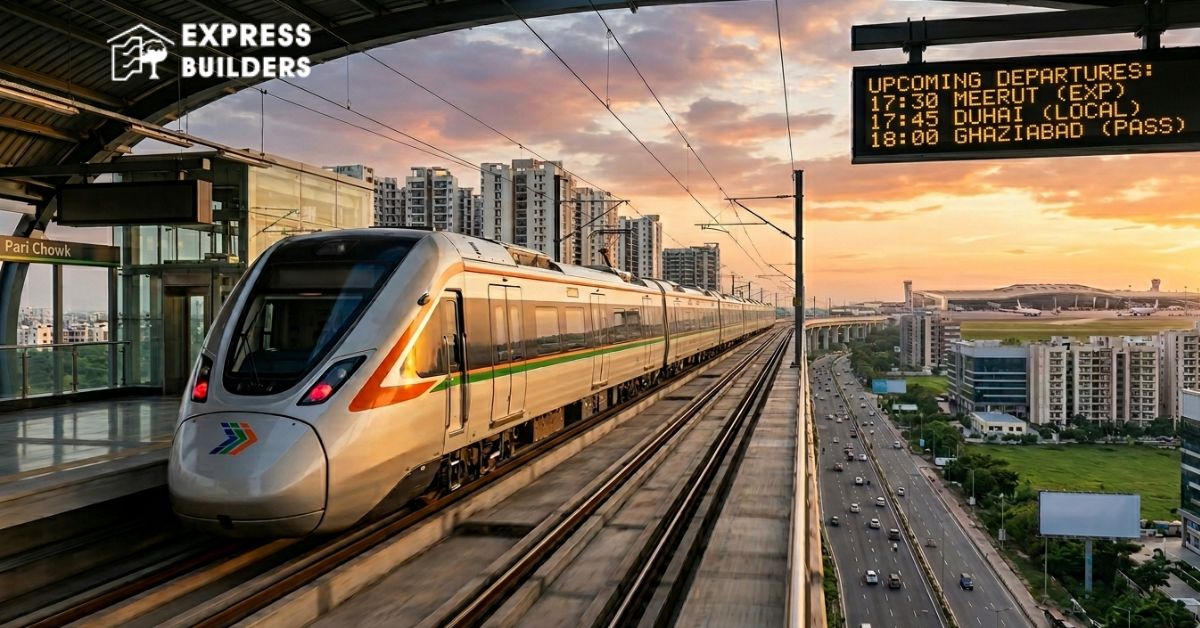
The National Capital Region is transforming at a breathtaking pace. One project is driving this change more than any other. The RRTS Metro corridor from Ghaziabad to Jewar International Airport is redefining regional travel across NCR. It connects cities, airports, and economic zones in ways no previous transit project has achieved.
Whether you are a daily commuter, a real estate investor, or simply a curious resident, this project changes life across the region. Let’s understand exactly what it means, station by station, fact by fact.
What Is the RRTS Metro?
RRTS stands for Regional Rapid Transit System. The RRTS Metro is a semi-high-speed rail network designed for intercity commuting. It covers longer distances at much higher speeds than a regular city metro. The National Capital Region Transport Corporation (NCRTC) builds and manages this entire network. Trains operate under the Namo Bharat brand and reach a top speed of 180 km/h.
The RRTS Metro Project sets an entirely new benchmark for public transit in India. It does not replace the existing metro system it upgrades how regions connect and communicate.
The Proposed RRTS Metro Route: Ghaziabad to Jewar
The proposed RRTS Metro Route stretches approximately 72.44 km end to end. It starts at Ghaziabad and terminates at the Ground Transportation Centre at Jewar Airport Terminal 1. The alignment cuts through some of NCR’s fastest-growing corridors, Greater Noida West, Surajpur, Pari Chowk, and the developing YEIDA City.
NCRTC submitted the Detailed Project Report (DPR) to YEIDA in April 2024. The Uttar Pradesh Government had already granted in-principle approval in December 2023. This makes it the fourth corridor under Phase 1 of the RapidX program. Together with the Delhi-Meerut and Delhi-Alwar lines, it builds NCR’s most ambitious transit backbone.
Stations on the Ghaziabad-Jewar RRTS Metro Route
The RRTS Metro Route rolls out in two distinct phases. Each phase targets a specific stretch of the corridor.
Phase 1-Ghaziabad to Kasna (approx. 39 km). Phase 1 targets completion by 2027 and includes these stations:
- Ghaziabad South-interchange with the Delhi-Meerut RRTS
- Greater Noida West, Sector 4
- Noida, Sector 2
- Greater Noida, Sector 12
- Surajpur
- Pari Chowk
- Ecotech VI/Kasna
Phase 2- Kasna to Jewar Airport (approx. 33 km). Phase 2 targets completion by 2030 and covers these stations:
- Dankaur
- YEIDA North, Sector 18
- YEIDA Central, Sectors 21 and 35
- Ground Transportation Centre, Jewar Airport Terminal 1
All stations will be elevated except the final stop at Jewar Airport.
Why the RRTS Metro Project Is a Real Game-Changer
Speed, scale, and smart design define the RRTS Metro Project from start to finish. Here is what makes this corridor truly exceptional:
- Top Speed: Trains operate at 140 km/h with a maximum of 180 km/h.
- Travel Time: Ghaziabad reaches Jewar Airport in under 40-50 minutes.
- Airport Link: Jewar Airport connects to IGI Airport Delhi in just 80 minutes.
- Dual Mode: The corridor runs 11 RRTS stations and 11 dedicated metro stations. RapidX trains carry 8 coaches. Metro trains use 3 coaches.
- Project Budget: Total estimated cost stands at ₹20,640 crore, roughly $2.5 billion.
This dual-mode setup makes the RRTS Metro uniquely flexible. Passengers pick a fast regional express or a short local hop, both of which run on the same corridor. No other NCR transit system offers this kind of versatility today.
Also Read: RRTS (Rapid Rail): Which NCR Towns Will See the Biggest Real Estate Boom?
Rapid Metro Meerut: The Northern Connection
This Jewar corridor does not stand in isolation. It links directly to the Delhi-Meerut RRTS at Ghaziabad. Rapid Metro Meerut is already integrated into this 82.15-km backbone that runs from Sarai Kale Khan in Delhi to Modipuram in Meerut. The Rapid Metro Meerut section covers 37 km and spans 25 stations across two phases.
Trial runs on the Rapid Metro Meerut section started in January 2025. Full commercial operations are expected by early 2026. The Delhi-Meerut RRTS priority corridor was launched in October 2023. Since then, it has served more than 10 million passenger journeys.
Now, the Ghaziabad-Jewar corridor extends this network southward. Together with Rapid Metro Meerut, it creates a continuous high-speed spine from Modipuram all the way to Jewar Airport. That is a region-wide transit link unlike anything NCR has ever seen.
Real Estate Impact Along the Corridor
Transit projects always reshape property demand. The RRTS Metro Route is already generating strong interest among developers and buyers. Areas like Greater Noida West, Pari Chowk, and the YEIDA sectors have emerged as new investment hotspots.
Jewar Airport amplifies this demand even further. Tata Projects Ltd builds the airport, while Flughafen Zürich AG manages its development. Once operations begin, the airport will attract commercial hubs, retail zones, and residential clusters along the entire corridor. Properties near proposed RRTS stations carry exceptional long-term investment value.
Investors who move early on plots and apartments near these stations typically gain the most. This window does not stay open forever.
Current Status of the RRTS Metro Project
The RRTS Metro Project currently awaits final Central and State Government approvals. NCRTC submitted the DPR to YEIDA in April 2024. YEIDA reviews it before forwarding it to the UP Government and the Union Government for final clearances.
Civil construction begins as soon as all approvals arrive. Phase 1 targets 2027 and Phase 2 targets 2030. The full corridor carries a completion deadline of 2041. Given the impressive pace of the Delhi-Meerut RRTS, this is an achievable and realistic timeline.
A Connected Future for All of NCR
The Ghaziabad-Jewar RRTS Metro is far more than a commuter rail project. It is a catalyst for economic growth, urban planning, and regional quality of life. NCRTC is building a network that stitches NCR together from Meerut in the north to Jewar Airport in the south.
This corridor will not just move people faster. It will move opportunities closer. Shorter commutes mean more productive cities. Better connectivity drives more investment and generates more jobs across every station on the route.
Frequently Asked Questions (FAQs)
1. What is the status of Delhi-Meerut RRTS?
3. Is RRTS faster than the metro?
Explore Properties Along the RRTS Metro Route
The Ghaziabad-Jewar RRTS corridor is one of the most exciting real estate stories in NCR right now. Prices near upcoming station areas are moving fast. Acting early puts you ahead of the curve.
Visit our site today to explore top residential properties. Experience the future of fast connectivity with homes near the RRTS corridor. Express Builders offers premium, well-connected societies in Noida, Greater Noida, and Vasundhara, Ghaziabad, perfect for modern commuters. Invest today in a location that keeps you closer to everything that matters.
