
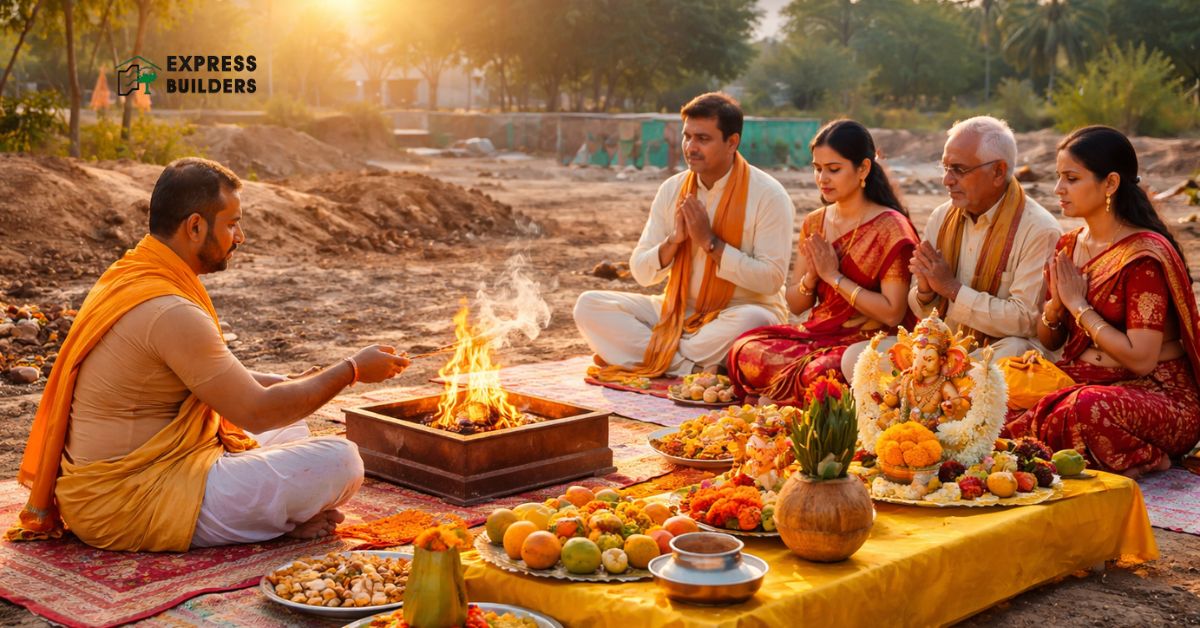
Bhumi Pujan is one of the most important rituals in Hindu tradition. Families perform it before beginning any construction activity on a plot of land. The word Bhumi means earth, and Pujan means worship. Together, they represent a heartfelt prayer to Mother Earth before breaking ground.
This ritual honours Bhoomi Devi, the goddess of earth, and Vastu Purush, the deity of architecture and space. Priests chant sacred mantras, perform a havan (fire ritual), and offer flowers, rice, turmeric, coconut, and fruits to the earth. Families invite relatives and well-wishers to witness this auspicious beginning.
The ceremony carries deep cultural significance. It marks the moment when a family’s dream of building a home officially begins. People believe that starting construction without Bhumi Pujan can invite obstacles, financial difficulties, or structural problems.
Why Does Choosing the Right Bhumi Pujan Muhurat Matter?
In Hindu tradition, time itself carries energy. The right moment for beginning an important task can shape the outcome significantly. A Muhurat is a precisely chosen time window that aligns cosmic energies in your favour.
Astrologers and priests study the Hindu Panchang carefully before recommending a Bhumi Pujan Muhurat. The Panchang is a traditional almanack that tracks tithi (lunar day), nakshatra (star constellation), yoga, karana, and planetary positions.
A well-chosen Bhumi Pujan Muhurat 2026 is believed to:
- Remove Vastu doshas from the land before construction begins
- Protect the project from unexpected delays, legal hurdles, and cost overruns
- Bring prosperity and positive energy to the future residents
- Align the home with favourable cosmic vibrations for long-term happiness
- Create a spiritually and emotionally strong start for the family
Even from a practical standpoint, Bhumi Pujan encourages families to plan well. It forces them to finalise designs, confirm their builder, and align with all stakeholders before breaking ground.
Read More: Griha Pravesh Muhurat
How Is a Bhumi Pujan Muhurat Determined?

Vedic astrology uses multiple factors to identify auspicious muhurats. Priests and astrologers examine each of these carefully:
1. Tithi (Lunar Day)
The Hindu lunar calendar divides each month into 30 tithis. Certain tithis carry auspicious energy for starting new work. The following tithis are considered favourable for Bhumi Pujan:
- Dwitiya (2nd lunar day): Symbolises growth and steady progress
- Tritiya (3rd lunar day): Represents strength and stability
- Panchami (5th lunar day): Favourable for foundation-related activities
- Saptami (7th lunar day): Supports momentum and forward movement
- Dashami (10th lunar day): Represents achievement and completion
- Ekadashi (11th lunar day): Spiritually pure and considered highly sattvic
- Trayodashi (13th lunar day): Ideal for long-term projects requiring durability
Avoid the 4th (Chaturthi), 9th (Navami), and 14th (Chaturdashi) tithis. Also, avoid Amavasya (new moon) and Purnima (full moon) unless a qualified priest specifically recommends them.
2. Nakshatra (Lunar Constellation)
The moon travels through 27 nakshatras each month. Not all nakshatras support construction rituals equally. The most auspicious nakshatras for Bhumi Pujan Muhurat 2026 are:
- Rohini: Encourages growth, abundance, and material stability
- Mrigashira: Supports steady development and careful planning
- Uttara Phalguni: Excellent for long-term projects and family homes
- Hasta: Known for precision, craftsmanship, and skill-based work
- Chitra: Brings creativity and attention to structural details
- Anuradha: Supports harmony, friendship, and cooperative efforts
- Pushya: Considered one of the most auspicious nakshatras for all new work
- Uttara Bhadrapada: Offers stability and deep-rooted foundations
- Uttara Ashadha: Represents victory and enduring achievement
- Revati: Symbolises nurturing energy and joyful beginnings
3. Vara (Day of the Week)
Not every weekday is suitable for Bhumi Pujan. Priests traditionally recommend the following weekdays:
- Monday: Ruled by the Moon, excellent for emotional harmony and family homes
- Wednesday: Ruled by Mercury, ideal for intellectual and commercial properties
- Thursday: Ruled by Jupiter, the most auspicious day for all major undertakings
- Friday: Ruled by Venus, brings beauty, comfort, and material prosperity
Priests strongly advise avoiding Bhumi Pujan on Saturday (Saturn’s day), Sunday (Sun’s day), and Tuesday (Mars’s day). These days carry energies that may cause delays, disputes, or structural vulnerabilities.
4. Avoiding Inauspicious Periods
Certain time periods within each day are inauspicious. Priests check these carefully:
- Rahu Kalam: A daily period of approximately 90 minutes ruled by Rahu
- Yamagandam: Another inauspicious daily window ruled by the lord of death
- Gulika Kalam: A shorter period of negative planetary influence each day
- Bhadra: A specific phase of the karana cycle considered inauspicious
Seasonal and calendar-based restrictions also apply. Chaturmas (roughly mid-July through mid-November in traditional counting) limits major ritual activities. Pitru Paksha and Shraddha Paksha are mourning periods that prohibit auspicious ceremonies. Solar eclipses, lunar eclipses, and Amavasya days also call for caution.
Bhumi Pujan Muhurat Dates 2026: Month-by-Month
Dates and timings are based on the Hindu Panchang. Always confirm exact timings with your local priest or astrologer, as regional variations apply. Below is a comprehensive month-wise guide to Bhumi Pujan Muhurat Dates 2026.
Bhumi Pujan Muhurat in May 2026
May 2026 offers selected auspicious windows for Bhumi Pujan. Some Panchang traditions recommend dates in early May, supported by favourable nakshatras. The month of Vaishakha is traditionally associated with growth and new beginnings.
| Date | Day | Nakshatra | Auspicious Window |
| May 4, 2026 | Monday | Anuradha | 05:38 AM to 10:50 AM |
| May 6, 2026 | Wednesday | Uttara Ashadha | Morning hours |
| May 8, 2026 | Friday | Uttara Ashadha | 12:25 PM to 09:20 PM |
| May 9, 2026 | Saturday | Rohini | Morning hours (confirm locally) |
| May 13, 2026 | Wednesday | Uttara Bhadrapada | 05:32 AM to 01:29 PM |
| May 14, 2026 | Thursday | Favourable | Morning window |
Note: Saturday dates require extra confirmation with your priest. Some traditions avoid Saturday entirely, regardless of the nakshatra.
Bhumi Pujan Muhurat in June 2026
June 2026 has limited but notable Bhumi Pujan muhurat windows. The month of Jyeshtha offers specific nakshatra alignments that support construction rituals. Families should plan carefully and verify timing with a local astrologer.
| Date | Day | Nakshatra | Auspicious Window |
| June 17, 2026 | Wednesday | Favourable | Morning hours (confirm locally) |
| June 24, 2026 | Wednesday | Chitra | 05:25 AM to 01:59 PM |
| June 26, 2026 | Friday | Anuradha | 10:22 PM to 05:25 AM (next day) |
| June 27, 2026 | Saturday | Favourable | Morning hours (confirm locally) |
Bhumi Pujan Muhurat in July 2026
July 2026 carries some auspicious windows in the early part of the month. After the Ashadha month begins, traditional Panchang sources typically recommend more caution. The onset of Chaturmas traditionally discourages major construction rituals.
| Date | Day | Nakshatra | Auspicious Window |
| July 1, 2026 | Wednesday | Favourable | Morning window |
| July 6, 2026 | Monday | Favourable | Morning to midday |
| July 8, 2026 | Wednesday | Favourable | Daytime hours |
| July 9, 2026 | Thursday | Favourable | Morning window |
| July 11, 2026 | Saturday | Favourable | Confirm with the priest |
Important: Many traditional Panchang sources show limited or no Bhumi Pujan muhurats after mid-July due to Ashadha and the beginning of Chaturmas. Always consult your local astrologer for July dates.
Bhumi Pujan Muhurat in August 2026
August 2026 carries some favorable Bhumi Pujan dates according to regional Panchang traditions. The month of Bhadrapada offers selective windows when shubh nakshatras align with favourable tithis.
| Date | Day | Nakshatra | Auspicious Window |
| August 15, 2026 | Saturday | Favourable | Confirm with the priest |
| August 20, 2026 | Thursday | Favourable | Morning to afternoon |
| August 22, 2026 | Saturday | Favourable | Confirm with the priest |
| August 24, 2026 | Monday | Favourable | Morning window |
| August 26, 2026 | Wednesday | Favourable | Daytime hours |
| August 29, 2026 | Saturday | Favourable | Confirm with the priest |
Note: August marks the Bhadrapada month in the Hindu calendar. Construction activities during this month require careful Panchang review and priest consultation.
Bhumi Pujan Muhurat in September 2026
September 2026 offers a small but auspicious window early in the month. The transition from Bhadrapada to Ashwin brings positive energy. These dates fall before the Pitru Paksha period begins.
| Date | Day | Nakshatra | Auspicious Window |
| September 2, 2026 | Wednesday | Favourable | Morning hours |
| September 4, 2026 | Friday | Favourable | Morning to midday |
After mid-September, Pitru Paksha (Shraddha Paksha) begins. This ancestral mourning fortnight is not suitable for auspicious ceremonies like Bhumi Pujan.
Bhumi Pujan Muhurat in October 2026
October 2026 sees auspicious Bhumi Pujan windows returning after the Navratri and festive period. The Kartik month, which begins in October, is considered highly auspicious in Vedic tradition.
| Date | Day | Nakshatra | Auspicious Window |
| October 27, 2026 | Tuesday | Punarvasu | Confirm with priest |
| October 31, 2026 | Saturday | Pushya | 12:30 PM to 03:00 PM |
Note: Some traditional Panchang sources show no widely recommended Bhumi Pujan dates in October 2026. Regional variations are significant this month. Please confirm carefully with your local astrologer.
Bhumi Pujan Muhurat in November 2026
November 2026 is one of the richest months for the Bhumi Pujan Muhurat 2026. The Kartik and early Margashirsha lunar months carry powerful spiritual significance. Multiple auspicious windows exist throughout November.
| Date | Day | Nakshatra | Auspicious Window |
| November 3, 2026 | Tuesday | Favourable | 03:06 PM to next day 02:06 AM |
| November 7, 2026 | Saturday | Favourable | 02:48 PM to 09:16 PM |
| November 10, 2026 | Tuesday | Favourable | 06:48 PM to 12:08 AM |
| November 11, 2026 | Wednesday | Favourable | 06:40 AM to 11:38 AM |
| November 14, 2026 | Saturday | Favourable | 08:24 PM to next day 06:22 AM |
| November 21, 2026 | Saturday | Favourable | 06:51 AM to 02:51 PM |
| November 25, 2026 | Wednesday | Favourable | Transition window |
| November 26, 2026 | Thursday | Favourable | 06:53 AM to 05:47 PM |
Note: Tuesday and Saturday dates in November require confirmation. Some priests may not recommend these weekdays regardless of the nakshatra. Verify each date with your priest before confirming.
Bhumi Pujan Muhurat in December 2026
December 2026 offers excellent Bhumi Pujan muhurat opportunities. The Margashirsha and Pausha months are considered auspicious for the beginning of construction. Families planning to start building in the winter season find December highly favourable.
| Date | Day | Nakshatra | Auspicious Window |
| December 2, 2026 | Wednesday | Favourable | 08:51 PM to next day 06:58 AM |
| December 3, 2026 | Thursday | Favourable | 06:58 AM to 09:23 AM |
| December 4, 2026 | Friday | Favourable | 10:22 AM to 11:44 PM |
| December 11, 2026 | Friday | Favourable | 03:04 AM to 07:04 AM |
| December 12, 2026 | Saturday | Favourable | 07:04 AM to 02:06 PM |
| December 18, 2026 | Friday | Favourable | 11:14 PM to next day 07:09 AM |
| December 19, 2026 | Saturday | Favourable | 07:09 AM to 03:58 PM |
| December 30, 2026 | Wednesday | Favourable | 07:13 AM to 12:36 PM |
Best Months for Bhumi Pujan Muhurat 2026: Quick Overview
| Lunar Month | Calendar Months | Suitability | Ideal For |
| Magha | January–February | High | Independent houses and plots |
| Phalguna | February–March | Very High | Villas and residential layouts |
| Chaitra | March–April | High | Family homes and row houses |
| Vaishakha | April–May | Moderate | Selective dates only |
| Jyeshtha | May–June | Moderate | With Nakshatra support |
| Ashadha | June–July | Low | Often avoided; monsoon period |
| Shravana | July–August | Low | Caution advised; Chaturmas |
| Bhadrapada | August–September | Moderate | Limited auspicious windows |
| Ashwin | September–October | High | After Pitru Paksha ends |
| Kartika | October–November | Very High | Strong spiritual significance |
| Margashirsha | November–December | High | Urban and commercial projects |
| Pausha | December–January | Moderate | Slow-start and planning projects |
Vastu Shastra and Bhumi Pujan: The Connection
Vastu Shastra and Bhumi Pujan are deeply intertwined. Vastu Shastra is the ancient Indian science of architecture and spatial arrangement. It holds that every structure exists within a grid of cosmic energy. Bhumi Pujan activates and aligns this energy at the very start of construction.
Priests perform the Vastu Purusha Mandala ritual during Bhumi Pujan. This ritual acknowledges the cosmic being (Vastu Purush) believed to inhabit every plot of land. Proper worship ensures that construction respects this energy rather than disturbing it.
Studies in Indian real estate confirm that Vastu-compliant homes command higher prices in select markets. Buyers in cities like Hyderabad, Pune, Bengaluru, and Ahmedabad actively seek Vastu certification. Homes built after a proper Bhumi Pujan are easier to market and tend to sell faster.
Key Vastu practices during Bhumi Pujan include:
- Digging the ceremonial first shovel in the Northeast direction of the plot
- Planting a sapling or copper vessel in the earth as a symbol of life
- Performing havan to purify the five elements: earth, water, fire, air, and space
- Marking the foundation direction based on the main entrance orientation
What Happens During a Bhumi Pujan Ceremony?
A typical Bhumi Pujan ceremony follows a structured sequence of rituals. The exact steps vary by region and family tradition. Here is a general guide to what most ceremonies include:
- Ganesh Puja: Lord Ganesha is invoked first as the remover of all obstacles
- Sankalpa: The family declares their intention and purpose for the construction
- Navgraha Puja: Offerings are made to the nine planetary deities for cosmic blessings
- Vastu Purusha Puja: The deity of land and architecture receives worship
- Bhoomi Devi Puja: The earth goddess receives prayers, flowers, and offerings
- Havan: A sacred fire ritual cleanses the atmosphere and purifies the land
- Mantras: The priest chants Vastu mantras, Vedic hymns, and protective shlokas
- Symbolic Digging: The host ceremonially breaks ground with a shovel or spade
- Prasad Distribution: Sweet offerings are shared among all attendees
Families typically invite close relatives, friends, and the construction team to the ceremony. A Bhumi Pujan usually lasts between one and three hours, depending on the scale of the ceremony and the number of rituals performed.
Common Mistakes to Avoid During Bhumi Pujan
Many families unknowingly make errors when planning their Bhumi Pujan. Avoiding these mistakes helps ensure the ritual carries full spiritual and practical benefit:
- Skipping priest consultation and relying solely on general online muhurat lists
- Performing Bhumi Pujan on Saturday, Sunday, or Tuesday without expert advice
- Starting the ceremony during Rahu Kalam, Yamagandam, or Gulika Kalam
- Conducting the ritual during Chaturmas, Pitru Paksha, or eclipse periods
- Ignoring regional Panchang differences and using a single national muhurat list
- Choosing a date only based on convenience without checking tithi and nakshatra
- Not digging in the auspicious Northeast direction as Vastu recommends
- Forgetting to invite the lead architect or Vastu expert to the ceremony
Practical Tips for Planning Your Bhumi Pujan in 2026

Planning a Bhumi Pujan requires coordination between multiple parties. Follow these practical steps to ensure a smooth and auspicious ceremony:
- Start planning at least 4–6 weeks before your preferred date
- Consult your family priest or a trusted Vedic astrologer for a personalized muhurat
- Share your birth details (name, birth star, and date) with the astrologer
- Confirm architect availability and construction team readiness for the chosen date
- Prepare the plot with basic clearing and leveling before the ceremony
- Arrange all puja materials in advance: coconut, havan samagri, flowers, and incense
- Invite your Vastu consultant to be present during the ceremony
- Ensure legal paperwork and approvals are complete before Bhumi Pujan
- Check weather forecasts, especially for monsoon months like July and August
- Coordinate catering and logistics if hosting a large gathering
Bhumi Pujan Muhurat 2026 and Drik Panchang
Drik Panchang is one of the most widely used astrological calendars in India. It calculates muhurat timings based on the actual astronomical position of celestial bodies. Many families and priests rely on Drik Panchang for accurate daily tithi, nakshatra, and muhurat data.
Bhumi Pujan Muhurat 2026 Drik Panchang calculations factor in sunrise and sunset times specific to your city. This means that the same tithi or nakshatra may produce different muhurat windows in Delhi versus Chennai or Mumbai versus Kolkata.
When using Drik Panchang for Bhumi Pujan Muhurat 2026, keep these points in mind:
- Always select your specific city for accurate sunrise-based calculations
- Cross-reference with your regional Panchang tradition (North Indian vs South Indian)
- Look for Abhijit Muhurat, which is a universally auspicious midday window
- Avoid the Rahu Kalam timing listed for your specific date and location
- Verify the Panchang of your region with your family priest before finalizing
North Indian Panchang, South Indian Panchang (Drik, Vakyam, and local traditions), and Gujarati or Marathi Panchang can show slightly different muhurat windows for the same date. This is why local priest consultation is always the final authority.
Regional Variations in Bhumi Pujan Traditions Across India
India is culturally diverse. Bhumi Pujan rituals and muhurat preferences vary significantly across states and communities. Understanding regional traditions helps you plan a ceremony that resonates with your family heritage.
- North Indian families typically follow the Vikram Samvat calendar. Priests perform elaborate havan rituals and use traditional copper vessels for the ceremony. The Northeast direction is strongly emphasized for the first dig.
- In Gujarat and Rajasthan, the Gujarati Panchang governs muhurat selection. Families often hire professional teams of priests for elaborate havan ceremonies. Music and community celebrations accompany the ritual.
- The ceremony is called Bhoomi Pooja in South India. Priests follow the Shalivahana Shaka calendar. Kolam (rangoli) decorations surround the site. Coconut breaking and banana offerings are central to the ritual.
- In Maharashtra, the ceremony follows Marathi Panchang traditions. Ganesh Puja takes particular importance as Ganesha is the kuldevata (family deity) for many Maharashtrian families.
- In Bengal, the ritual aligns with the Bengali Panchang and often includes specific Durga or Lakshmi prayers. The timing may differ from mainstream North Indian dates.
Essential Puja Samagri: A Complete Checklist for Bhumi Pujan
Gathering the right materials before the ceremony is as important as choosing the right muhurat. Missing even one item can interrupt the ritual mid-way. Priests typically share a list in advance, but families benefit from knowing the essentials beforehand.
Here is a standard checklist of items required for Bhumi Pujan:
- Raw rice, turmeric powder, kumkum, and sandalwood paste
- Fresh flowers, mango leaves, and a banana bunch
- Coconut, betel nuts, and betel leaves
- Havan samagri, ghee, sesame seeds, and camphor for the fire ritual
- A copper kalash (pot) filled with water and topped with a coconut
- Panchamrit: a mixture of milk, curd, honey, ghee, and sugar
- Supari (areca nut), cloves, and cardamom
- Soil from the plot and seeds of five grains (pancha-dhanya)
- Incense sticks, a diya (oil lamp), and matchsticks
- A new spade or shovel for the symbolic first dig
- Red cloth, yellow cloth, and white cloth for altar arrangement
- A silver or copper coin to place in the earth during digging
Families in North India often add a silver idol of Lord Ganesha to the puja setup. South Indian families may include a specific set of temple flowers and plantain stems. Your priest will confirm any community-specific additions.
Procure all items at least two days before the ceremony. Last-minute arrangements can cause avoidable stress on an auspicious day.
Bhumi Pujan for Independent Houses vs Residential Plots: Key Differences
Not all residential Bhumi Pujans follow an identical process. The type of property you plan to build on shapes how the ceremony is organised, what the priest emphasises, and which Vastu elements receive the most attention.
For an independent house on a privately owned plot, the family holds complete authority over the ceremony. The priest performs the full ritual sequence, including Vastu Purusha Mandala, directional marking, and symbolic digging. The homeowner personally breaks ground in the Northeast corner of the plot. This moment carries deep emotional significance. It is the family’s direct promise to the land before construction begins.
For a residential plot in a gated township or plotted development, the process involves an additional layer of coordination. The developer may have already performed a master Bhumi Pujan for the entire project. However, individual plot owners are encouraged to perform their own ceremony before construction of their personal home begins. This personalises the ritual to the family’s own horoscope and birth star.
Key differences between the two settings include:
- Independent house Bhumi Pujan allows complete control over timing, scale, and ritual depth
- Township plot Bhumi Pujan must account for builder approvals and community construction schedules
- Independent plots allow the Northeast digging tradition more freely
- In a township layout, the priest may adjust directional rituals based on the plot’s orientation within the master plan
Both settings call for a qualified priest, a verified muhurat, and proper Vastu guidance. The emotional core of the ceremony remains unchanged regardless of the property type. A family building its first home invests more than money into the land. Bhumi Pujan honours that investment with the right spiritual beginning.
Frequently Asked Questions About Bhumi Pujan Muhurat 2026
Can I perform Bhumi Pujan without a priest?
Traditionally, a qualified priest performs Bhumi Pujan. The priest knows the correct mantras, ritual sequence, and muhurat requirements. However, in unavoidable situations, the head of the family may perform basic prayers with guidance from a trusted religious resource.
Is Bhumi Pujan necessary for apartment construction?
Yes, reputable developers perform Bhumi Pujan before beginning apartment construction. Buyers who ask about this ceremony demonstrate their commitment to spiritually sound investment decisions. A properly performed Bhumi Pujan adds buyer confidence and project goodwill.
What if my preferred date falls on an inauspicious weekday?
Consult your priest if your ideal construction date falls on a Saturday, Sunday, or Tuesday. In some cases, an experienced astrologer may identify a specific time window on these days that overrides the general restriction. Do not proceed without expert guidance.
Does Bhumi Pujan vary based on my birth star (Nakshatra)?
Yes. Your personal birth star influences which muhurats are most favourable for you. A generic muhurat may not align with your individual horoscope. Always share your janma nakshatra with the priest to receive a personalised recommendation.
Can NRIs perform Bhumi Pujan remotely?
Yes. Many NRI families authorise a trusted family member to perform Bhumi Pujan on their behalf. Priests can also conduct virtual ceremonies where the NRI participates via video call. The land owner’s sankalpa (intention) is the most important element of the ritual.
Which day is good for Bhoomi Pooja in 2026?
The most auspicious days for Bhoomi Pooja in 2026 are Monday, Wednesday, Thursday, and Friday. Among these, Thursday is considered the most SHUBH (auspicious) as it is ruled by Jupiter, the planet of prosperity and wisdom. Always combine the weekday with a favourable tithi and nakshatra for best results.
Which day is good for property registration in 2026?
For property registration in 2026, Wednesday, Thursday, and Friday are considered ideal. These days support financial stability, smooth documentation, and long-term gains. It is best to avoid Tuesday and Saturday unless a specific muhurat is recommended by an astrologer.
Begin Your Dream Home with the Right Blessing
Bhumi Pujan Muhurat 2026 offers numerous auspicious opportunities across the year. Whether you plan to build in May, August, November, or December, thoughtful planning and the guidance of a qualified priest will help you choose the ideal moment.
The ritual of Bhumi Pujan is more than tradition. It is a powerful psychological and spiritual foundation for your home. It brings the family together, marks the beginning of a long journey, and sets a tone of intention and gratitude before the first brick is laid.
2026 is a strong year for construction beginnings. The alignment of favorable nakshatras, multiple auspicious lunar months, and reduced blocked periods make this year particularly welcoming for homebuyers and builders alike.
Plan early, consult your priest, verify your regional Panchang, and choose a date that honors both your astrological chart and your practical construction timeline. Your future home deserves the best possible beginning.
Start your dream home journey with confidence at Express Enclave by Express Builders in Sonipat. Choose from well-planned residential plots in a rapidly developing location, perfect for building your future. Align your Bhumi Pujan with an auspicious muhurat and take the first step toward a prosperous life. Limited plots available, secure yours today and turn your vision into reality with a trusted name in real estate.
