
June 5 marks Yogi Adityanath birthday every year. This year, it arrives with the full weight of a transformed state behind it. Chief Minister Yogi Adityanath assumed office in March 2017 with a clear mandate. He placed infrastructure, investment, and governance reform at the heart of his administration. Nine years on, Uttar Pradesh looks and functions very differently. Noida and Greater Noida stand as the clearest proof of this transformation. These twin cities have attracted global investment, massive infrastructure, and millions of new residents. Noida residential prices have climbed 92 percent from Q1 2020 to Q1 2025. Greater Noida real estate recorded an even sharper appreciation of 98 percent in the same period. On this Yogi Adityanath birthday, the infrastructure decisions that powered this growth deserve a close look. It is a story of airports, expressways, film cities, metro lines, and decisive governance working together. Investors and homebuyers who understood this story early have already benefited. Those who act now still have a significant opportunity ahead.
The Jewar International Airport: The Single Biggest Catalyst
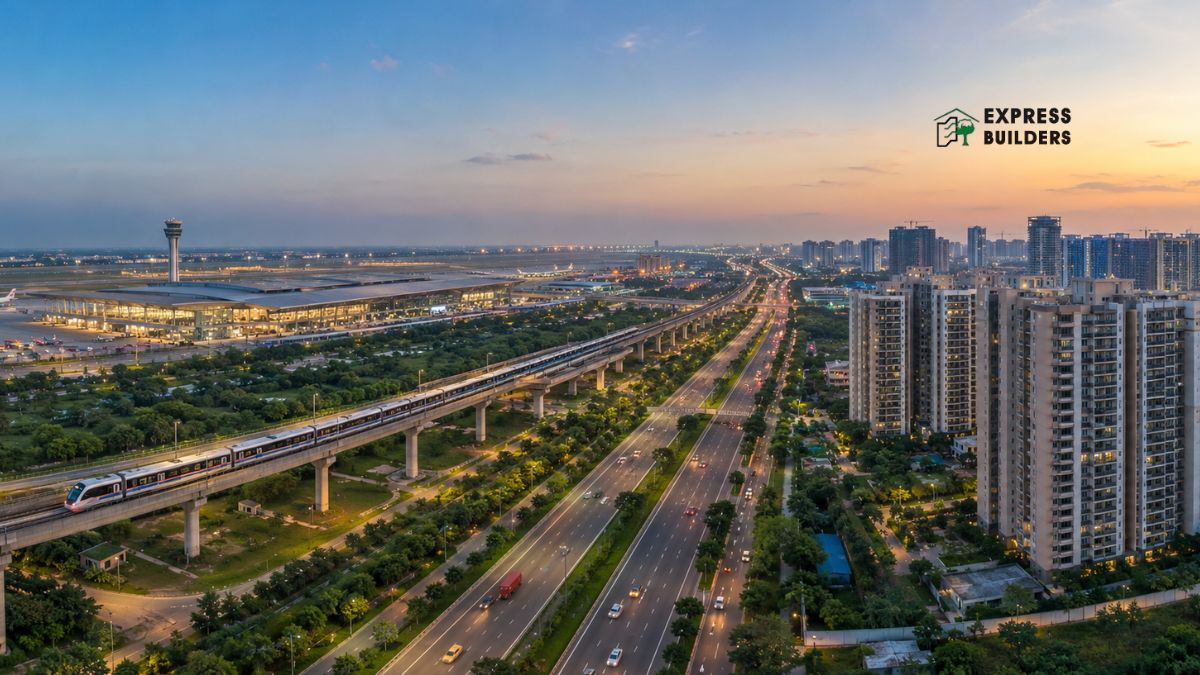
No infrastructure project has shaped Noida real estate and Greater Noida real estate more than the Jewar International Airport. Prime Minister Narendra Modi officially inaugurated Phase 1 of Noida International Airport at Jewar on March 28, 2026. The airport has been developed at a total investment of approximately Rs 11,200 crore. It sits strategically along the Yamuna Expressway in Gautam Buddha Nagar district. Phase 1 covers 1,334 hectares and handles up to 12 million passengers annually. A single 3,900-metre CAT III-B runway and a terminal building of over 1,01,590 square metres define the facility.
Commercial operations at the airport are scheduled to begin on June 15, 2026, with IndiGo as the inaugural carrier on five routes, and Akasa Air joining on June 16. At full development, the airport will have four runways and a projected capacity of over 70 million passengers per year, making it one of India’s largest aviation hubs. The airport is also a net-zero emissions facility, integrating energy-efficient and environmentally responsible systems.
Chief Minister Yogi Adityanath, present at the inauguration, said the airport will open a new trajectory of development for Uttar Pradesh. He pointed to the foundation stone laid in November 2021 and the time-bound execution it took to reach the inauguration. The airport is projected to create over 12,000 direct jobs in early-stage operations and more than 50,000 direct jobs within five years, with over one lakh direct and indirect jobs long-term.
The real estate impact is already measurable. Sectors along the Yamuna Expressway and the Noida-Greater Noida belt have witnessed a 50 to 70 percent jump in property values, with further appreciation expected as airport operations scale up.
Greater Noida Development: An Integrated Urban Vision
The Jewar International Airport is only one part of a larger story of Greater Noida development. The Yogi government has built an integrated ecosystem across this corridor. The Yamuna Expressway Industrial Development Authority (YEIDA) is being developed as North India’s largest multi-modal transport and industrial hub. The comprehensive connectivity plan aims to link the region through five modes, including air, road, rail, RRTS, and expressways.
The Yamuna Expressway Film City project in Sector 21, near Jewar, spans over 1,000 acres and is being developed through a public-private partnership at an estimated cost of Rs 65,000 crore. It will house world-class production studios, VFX facilities, film academies, and entertainment zones. The project is set for completion by June 2028 and will also drive the development of hotels, convention centres, and entertainment facilities in the surrounding area. Residential plots in the YEIDA region near the Film City are set to see price appreciation of up to 150 percent, according to market analysis.
Beyond film, Greater Noida is also emerging as a key data centre destination. The state government approved a large data centre project in Greater Noida earlier under the Yogi administration. Reliable power infrastructure and strong fibre connectivity make the region ideal for tech investment. A planned 1 GW AI and data centre hub further strengthens the investment case for this corridor.
Road Network and Expressway Connectivity
The UP Budget 2026 has proposed over Rs 34,000 crore for roads and bridge infrastructure across the state. Officials say improved connectivity is critical for attracting investment and reducing travel time across the region. The Uttar Pradesh Public Works Department has proposed road strengthening and widening projects worth over Rs 256 crore for Gautam Buddha Nagar in the 2026-27 financial year. These projects include widening and strengthening nearly 79 km of roads, along with rural road development under the Chief Minister Gram Sadak Yojana.
The Yamuna Expressway serves as the backbone of this corridor. It connects Greater Noida to Agra smoothly and now functions as the primary access road to the Jewar International Airport. Villages around Greater Noida and Jewar are rapidly integrating into industrial and urban development zones as road networks expand. Land values in villages near the airport have already seen sharp appreciation.
Metro and Rapid Rail: Urban Mobility for a Growing Region
Public transport infrastructure has expanded considerably under the current state leadership. The Noida Metro Aqua Line connects Noida and Greater Noida and handles a significant share of daily commuters. Plans for metro expansion along key sectors remain actively in progress. The proposed RRTS network will connect Delhi and the National Capital Region with YEIDA sectors and the Noida International Airport. This will mark a major step toward integrated modern urban transportation in the region. Metro connectivity to the Jewar airport belt will further support both residential and commercial real estate demand. Professionals working near the airport will need quality housing along these transit corridors. Retail and hospitality investments will follow as ridership grows.
Noida Real Estate: A Maturing, Multi-Sector Market
Noida real estate has moved well beyond its original identity as an IT and office corridor. The region now attracts investment across residential, commercial, logistics, and hospitality segments. Global and domestic corporations continue to set up operations along key expressway sectors. Sectors 62, 63, and 150 in Noida remain strong draws for IT and corporate occupiers. Sector 150 has emerged as a premium residential address, with green layouts, wide roads, and lower density making it highly desirable. Improved governance, transparent development authority policies, and reliable infrastructure delivery have together built investor confidence.
Key demand drivers for the region include the operational ramp-up of Noida International Airport, the International Film City, the planned AI and data centre hub, metro connectivity expansion, and large-scale industrial development by YEIDA. These drivers operate together and reinforce each other. As employment rises in the corridor, housing demand follows naturally. As housing demand grows, retail and hospitality investment follows.
YEIDA launched a new residential plot scheme in 2026 offering 973 plots near the Noida International Airport, spread across Sectors 15C, 18, and 24A along the Yamuna Expressway. Government-fixed allotment rates make these plots accessible to a wider range of buyers. Analysts project residential returns of 10 to 14 percent annual CAGR in this belt, with commercial real estate investors expecting 12 to 16 percent ROI post-airport stabilisation.
The Governance Factor: Why This Growth Is Sustainable
Infrastructure alone does not explain the scale of real estate growth in this region. The Yogi government has consistently paired infrastructure investment with improvements in law and order and ease of doing business. The Chief Minister has noted that improved law and order and robust infrastructure have together made Uttar Pradesh an attractive destination for investors. UP now has 16 functional airports compared to just a few in 2017, with the Jewar airport now the fifth international airport in the state. This pace reflects a broader commitment to time-bound execution. The double-engine government model, with aligned Central and state policy, has accelerated project delivery across the board. Investors have responded with confidence, and real estate markets have rewarded that confidence.
Looking Ahead
This comprehensive vision under Chief Minister Yogi Adityanath is expected to play a decisive role in advancing Uttar Pradesh toward the goal of becoming a one trillion dollar economy. As the state celebrates another Yogi Adityanath birthday on June 5, 2026, the evidence on the ground is clear. The airport is operational, the Film City is under construction, data centres are arriving, and road and metro networks are expanding. Noida real estate and Greater Noida real estate are not riding a speculative wave. They are growing on the back of real projects, real jobs, and real connectivity. For homebuyers and investors looking at the NCR, this corridor offers the strongest combination of affordability, upside potential, and state-backed infrastructure in North India today.
Ready to own a home in one of India’s fastest-growing real estate corridors?
Express Builder brings you thoughtfully designed homes in Noida and Greater Noida, right where infrastructure is reshaping the future. Book a site visit today and explore ready and upcoming residential options built for the next decade of growth. Connect with our team now and take the first step toward your dream home.
Frequently Asked Questions
Q1. How has Yogi Adityanath’s government directly impacted Noida real estate?
The Yogi government has driven Noida real estate growth through large-scale infrastructure investment. Key actions include the inauguration of the Noida International Airport at Jewar, allocation of Rs 34,000 crore for UP roads in Budget 2026, metro expansion, and active promotion of industrial and IT investment in the Gautam Buddha Nagar district. These interventions have improved connectivity, created employment, and strengthened residential and commercial demand across Noida and Greater Noida.
Q2. What is the current status of Jewar International Airport and how does it affect property values?
Jewar International Airport, officially known as Noida International Airport, was inaugurated on March 28, 2026. Commercial flight operations are scheduled to begin on June 15, 2026. Phase 1 has a capacity of 12 million passengers annually. Property values along the Yamuna Expressway corridor have already risen 50 to 70 percent since 2020. As operations scale up, analysts project further appreciation in sectors close to the airport.
Q3. Why is Greater Noida real estate considered a strong investment in 2026?
Greater Noida real estate offers a rare combination of affordable entry prices and strong growth fundamentals. The Jewar International Airport, International Film City, planned 1 GW data centre hub, and RRTS corridor all converge in this zone. Residential returns of 10 to 14 percent annual CAGR are projected in the belt, and government-backed YEIDA plots provide a transparent, lower-risk investment route for both end-users and investors.
Q4. What infrastructure projects under Yogi Adityanath are shaping Greater Noida development in 2026?
Several major projects are shaping Greater Noida development under the Yogi government in 2026. These include the inauguration of the Noida International Airport at Jewar, the 1,000-acre International Film City in Sector 21 near Yamuna Expressway, road widening projects worth Rs 256 crore in Gautam Buddha Nagar, YEIDA residential plot schemes, a 1 GW AI and data centre hub, and a proposed RRTS corridor connecting Delhi, YEIDA sectors, and the new airport. Together, these projects are turning Greater Noida into a fully integrated urban and industrial destination.
