
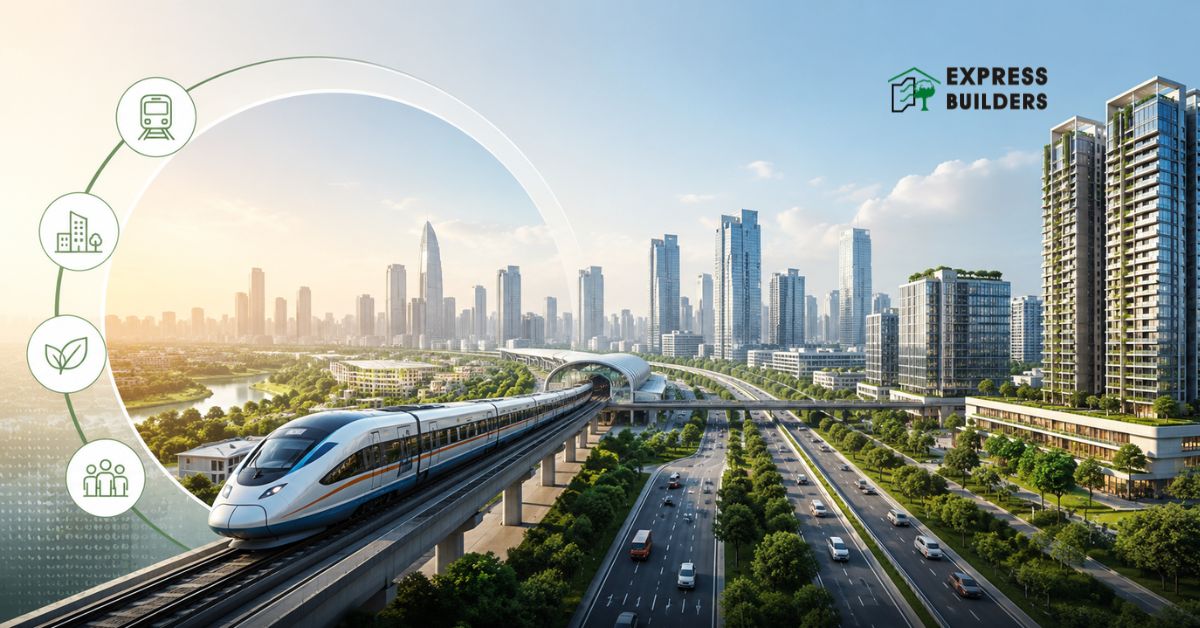
The National Capital Region is on the brink of a historic transformation. After years of planning, consultations, and revisions, the Delhi NCR Regional Plan 2041 is moving closer to implementation. The upcoming NCR Planning Board (NCRPB) meeting on June 16, 2026, could mark a major turning point. If approved and advanced as expected, the plan will shape how millions of people live, travel and invest across NCR over the next two decades.
This is not just another government policy document. Instead, it is a long-term blueprint designed to accommodate rapid population growth, strengthen infrastructure, and create new economic opportunities across Delhi, Haryana, Uttar Pradesh and Rajasthan. More importantly, it could redefine the future of NCR real estate.
Let’s explore what the Regional Plan 2041 proposes and why it matters for residents, businesses and property buyers today.
A Vision for a Future-Ready NCR
Today, the NCR is home to nearly 6 crore people. The region stretches across approximately 55,083 square kilometres and includes Delhi along with key districts in Haryana, Uttar Pradesh and Rajasthan.
However, the population is expected to grow significantly over the coming years. By 2041, NCR may need to accommodate more than 3 crore additional residents. As a result, the region requires a comprehensive strategy for housing, transportation, employment and civic infrastructure. This is where the Regional Plan 2041 comes in.
The NCR Planning Board envisions a region that is digitally connected, environmentally sustainable, economically competitive and globally significant. In fact, some projections suggest NCR could surpass Tokyo as the world’s most populous urban agglomeration within the next decade.
To support this vision, the plan proposes investments of nearly ₹20 lakh crore across infrastructure, mobility, housing, and urban development projects. Clearly, the scale of ambition is enormous.
The 30-Minute NCR: A Connectivity Revolution
Perhaps the most transformative aspect of the plan is its “30-Minute NCR” vision.
The objective is simple. Major cities such as Gurugram, Noida, Faridabad, and Ghaziabad should be accessible from Delhi within 30 minutes.
For millions of daily commuters, this could dramatically improve quality of life. Instead of spending hours in traffic, people could travel quickly and efficiently across the region. So, how will this happen? The answer lies in a large-scale expansion of regional transport infrastructure.
The plan prioritizes high-speed rail systems, enhanced Mass Transit Rail Systems (MTRS) and expanded Regional Rapid Transit System (RRTS) corridors. Together, these networks aim to reduce travel times and improve connectivity between key urban centres.
The Delhi-Meerut RRTS has already demonstrated the potential of this model. Building on that success, the plan proposes additional corridors such as Delhi-Panipat, Delhi-Alwar, and Delhi-SNB.
As these routes become operational, suburban and satellite cities could become far more attractive places to live. However, connectivity is not just about trains.
The plan also proposes Integrated Multimodal Transport Hubs where metro services, RRTS corridors, buses and last-mile transportation options converge in one location. Consequently, commuters will be able to switch between transport modes seamlessly.
In addition, planners are exploring heli-taxi services for select high-demand routes. While still in the feasibility stage, the proposal reflects the region’s ambition to adopt innovative mobility solutions.
New Smart Cities Could Redefine Urban Growth
While transportation forms the backbone of the plan, urban expansion is another major priority.
To accommodate future population growth, the Regional Plan 2041 proposes the development of up to eight new greenfield townships. Among the most notable proposals are the Panchgrams in Haryana.
These five planned urban centres will be developed along the 135-kilometre Kundli-Manesar-Palwal (KMP) Expressway. Authorities plan to extend development between two and six kilometres on either side of the corridor, covering approximately 2.5 lakh hectares. Each township could eventually house around 15 lakh residents.
To manage this large-scale initiative, the plan proposes a dedicated Panchgram Development Authority.
Meanwhile, Uttar Pradesh is preparing for substantial growth around the Yamuna Expressway Industrial Development Area (YEIDA).
This emerging greenfield city is being designed to accommodate nearly 20 lakh people. Its strategic location near Jewar International Airport, the proposed Film City and major expressways has already attracted significant investor attention. Importantly, these developments are not being planned as conventional cities.
Instead, they will incorporate smart-city infrastructure from the beginning. This includes intelligent traffic systems, fibre-optic connectivity, integrated utilities, walkable neighbourhoods, and technology-enabled governance.
As a result, future residents may benefit from more efficient and sustainable urban environments.
Why the KMP Corridor Is Emerging as NCR’s Next Growth Engine
Among the various development zones identified under the plan, the Central NCR (CNCR) stands out as one of the most significant.
The CNCR includes areas extending beyond Delhi and up to five kilometres beyond the Eastern and Western Peripheral Expressways. The NCR Planning Board has designated this area as the “Golden Ring of Opportunity.” That designation carries substantial importance.
The region will receive priority infrastructure investment, higher Floor Area Ratios (FAR), and support for dense mixed-use developments. In addition, planners intend to encourage Transit-Oriented Development (TOD) throughout the corridor.
Consequently, markets such as New Gurugram, Manesar, Sohna, Bahadurgarh and Sonepat are expected to benefit significantly.
Many of these locations have already witnessed growing real estate demand. Now, the Regional Plan provides an additional policy framework that could accelerate their long-term growth. Furthermore, the economic significance of the NCR cannot be overlooked.
The region currently contributes around 8% of India’s GDP. As India’s economy continues to expand, NCR is expected to remain one of the country’s most important growth engines.
Transit-Oriented Development Could Drive Future Property Appreciation
One of the most important themes running through the Regional Plan 2041 is Transit-Oriented Development. Rather than allowing cities to grow randomly, the plan encourages concentrated development around major transportation hubs.
This means residential projects, commercial spaces, retail centres, and civic amenities will be clustered around metro stations, RRTS stations and multimodal transport hubs.
For example, proposed hubs at Panchgaon Chowk in Manesar and Kherki Daula in Gurugram could become major economic and residential centres.
Historically, properties located near high-quality transit infrastructure have delivered stronger appreciation than surrounding markets. The reasons are simple.
People prefer shorter commutes. Businesses prefer better accessibility. Investors prefer locations with long-term demand drivers.
As the number of transport nodes increases across NCR, these advantages could spread across a much larger geography.
What This Means for Property Buyers and Investors
For homebuyers and investors, the implications are significant.
Large infrastructure projects often create the greatest opportunities before construction is fully completed. Once major transport networks become operational and development reaches maturity, property prices typically reflect those improvements. Today, many NCR growth corridors are still in the early stages of this transformation.
Locations such as the Yamuna Expressway, New Gurugram, the KMP belt and emerging zones around the Dwarka Expressway continue to benefit from strong policy support. The Regional Plan reinforces this support through higher development potential, smart-city requirements, and improved connectivity commitments.
As a result, these markets remain among the most closely watched real estate destinations in the region.
Similarly, families currently living closer to Delhi solely for convenience may soon have more options. Faster transit systems could make satellite cities practical alternatives without sacrificing accessibility.
The Bottom Line
The Delhi NCR Regional Plan 2041 represents far more than an infrastructure roadmap. It is a comprehensive vision for how one of the world’s largest urban regions will grow over the next two decades.
The plan combines faster transportation, new smart cities, sustainable development, and economic expansion into a single framework. Together, these initiatives have the potential to reshape where people live, where businesses operate and where future real estate demand emerges. Most importantly, this transformation is already underway.
As the NCRPB prepares for its upcoming board meeting, the region stands at the beginning of a once-in-a-generation urban shift.
For residents, it could mean better connectivity and improved quality of life. For businesses, it could unlock access to larger markets and talent pools.
And for property buyers and investors, it could redraw the map of opportunity across NCR. The only question is whether you position yourself before that transformation is fully reflected in the market.
The Delhi NCR Regional Plan 2041 has identified the growth corridors of tomorrow and the window to invest before full price appreciation is still open. Explore our premium residential projects in NCR’s most strategically located micro-markets. Get in touch with our experts today and take the first step toward your smartest property decision.
What is the Delhi NCR Regional Plan 2041?
The NCR Planning Board prepared the Delhi NCR Regional Plan 2041 as a long-term developmentblueprint. The plan focuses on improving transportation, housing, infrastructure, and sustainability across Delhi, Haryana, Uttar Pradesh, and Rajasthan. It aims to enhance connectivity, support future population growth, and promote balanced urban development throughout the NCR region.
How will the Regional Plan 2041 impact NCR real estate?
The plan is expected to boost real estate demand in emerging growth corridors through improved connectivity, new smart cities and Transit-Oriented Development (TOD). Areas near RRTS stations, the KMP Expressway, Yamuna Expressway and New Gurugram could benefit from increased infrastructure investment, making them attractive locations for homebuyers and investors.
