
Buying a home is exciting. But hidden costs can catch you off guard. Stamp duty is one of them. It often adds a big chunk to your total budget. That’s why a stamp duty calculator has become a must-have tool for every property buyer.
This guide breaks down what stamp duty means. It also shows you how to calculate it correctly. You’ll learn the factors that affect your final bill. And you’ll get answers to the most common questions buyers ask.
What Is Stamp Duty?

Stamp duty is a tax. State governments charge it on property transactions. You pay it when you register a property in your name. Without paying this tax, your ownership document has no legal standing.
Every state sets its own stamp duty rate. Rates usually range between 3% and 10% of the property value. The exact percentage depends on where the property sits. It also depends on the property type and the buyer’s profile.
Registration charges come on top of stamp duty. These charges cover the cost of recording your ownership in government records. Together, stamp duty and registration charges can add 5% to 12% to your purchase price.
Why Use a Stamp Duty Calculator?
Manual calculations take time. They also invite errors. A single wrong entry can throw off your entire budget. A stamp duty calculator removes this guesswork.
You simply enter a few details. The tool then gives you an instant, accurate estimate. This helps you plan your finances better. You avoid last-minute surprises during registration. You also compare costs across different cities before you decide where to buy.
Many buyers use this tool early in their property search. It helps them set a realistic budget. It also helps them negotiate better with sellers.
How to Calculate Stamp Duty and Registration Charges
The calculation process follows a simple formula. Multiply the property’s value by the applicable stamp duty rate. Then add the registration charge, which is usually a fixed percentage too.
Here’s the basic formula:
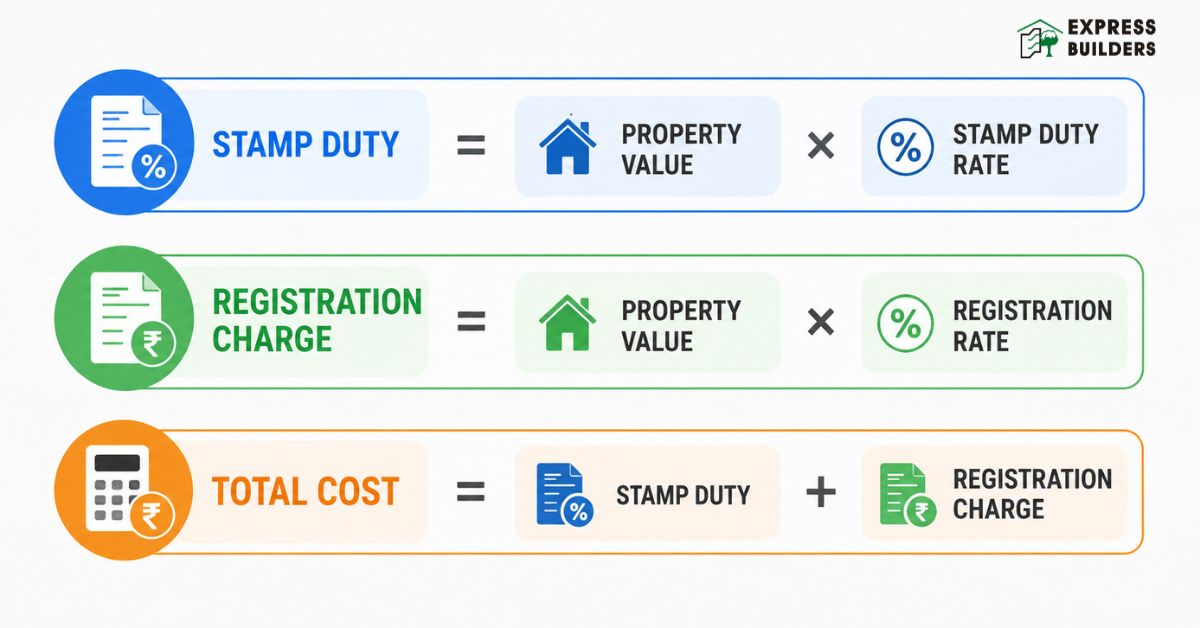
For example, imagine a property worth 50 lakh rupees. If the stamp duty rate is 5% and the registration charge is 1%, you pay 2.5 lakh as stamp duty and 50,000 as registration. Your total added cost becomes 3 lakh rupees.
This is why checking exact local rates matters. Rates differ across states and even across municipal zones.
How to Calculate Stamp Duty Value of Property
The stamp duty value isn’t always the same as your purchase price. Government authorities set a minimum property value for each area. This is called the circle rate or ready reckoner rate.
Stamp duty gets calculated on whichever amount is higher: your actual purchase price or the government’s set value. This rule prevents buyers and sellers from under-reporting property prices to save on tax.
To find your property’s stamp duty value, check your local sub-registrar’s website. You can also visit the revenue department portal for your state. These sources list current circle rates by locality.
Factors That Affect Stamp Duty
Several factors influence how much stamp duty you’ll pay. Understanding them helps you estimate costs accurately.
Location of the property plays a major role. Urban areas usually attract higher rates than rural zones.
Property type matters too. Commercial properties often carry higher stamp duty than residential ones.
Buyer’s gender affects rates in several states. Many governments offer discounted rates for women buyers to encourage property ownership.
The age of the buyer can also bring concessions. Senior citizens sometimes get reduced rates in certain states.
Property usage influences the rate as well. A property used for business purposes may attract a different rate than one used purely for residence.
Furnishing status can add to costs. Fully furnished properties sometimes attract slightly higher duty than unfurnished ones.
How Stamp Duty and Registration Is Calculated: Step-by-Step
Follow these steps for an accurate estimate.
- First, find your property’s market value. Check recent sale prices in your area.
- Second, check the government’s circle rate for that locality. Compare it with the market value.
- Third, apply the higher of the two values to your calculation.
- Fourth, multiply this value by your state’s stamp duty percentage.
- Fifth, add the registration charge, calculated separately at its own rate.
- Sixth, factor in any applicable rebates, such as discounts for women buyers.
This process gives you a fairly precise final number. An online tool automates all these steps, saving you time and reducing errors.
Common Mistakes to Avoid
Many buyers make avoidable errors during this process. Watch out for these pitfalls.
- Don’t use outdated rate information. Stamp duty rates change periodically. Always verify current rates before finalizing your budget.
- Don’t ignore registration charges. Some buyers only account for stamp duty and forget this additional cost.
- Don’t skip checking for rebates. Women buyers, senior citizens, and first-time buyers sometimes qualify for lower rates. Missing these discounts means overpaying.
- Don’t assume all property types follow the same rate. Commercial and residential properties often have different structures.
Final Thoughts
Understanding stamp duty protects your budget and your peace of mind. A clear grasp of this cost helps you plan your property purchase with confidence. Use available online tools to double-check your numbers before you commit to a purchase.
Buying property involves many moving parts. Getting your stamp duty calculation right removes one major source of stress. It lets you focus on the more exciting parts of homeownership.
Ready to plan your property purchase with confidence?
Estimate your exact stamp duty and registration costs before you sign any paperwork. A quick calculation today can save you from budget surprises tomorrow. Start planning smarter and move into your new home stress-free.
Looking for verified 1, 2 and 3BHK apartments for sale in Greater Noida? Get in touch with our team to schedule a personalised site visit and if you’re also considering more space, take a look at our 3 BHK flats in Greater Noida buying guide.
Frequently Asked Questions
How to calculate stamp duty and registration charges?
Multiply the property value by your state’s stamp duty rate. Add the registration charge, calculated separately at its own percentage. The sum gives you the total payable amount during property registration.
How to calculate stamp duty value of property?
Compare your property’s purchase price with the government’s circle rate for that area. Stamp duty applies to whichever value is higher. Check your local sub-registrar’s office for current circle rates.
How to calculate stamp duty & registration charges?
Use the formula: property value multiplied by the stamp duty percentage, plus property value multiplied by the registration percentage. Rates vary by state, so confirm local figures before calculating your final cost.
How stamp duty and registration is calculated?
Authorities calculate stamp duty using the higher of market value or government circle rate. Registration charges apply separately as a fixed percentage. Together, they form the total legal cost of property ownership transfer.
How to calculate property stamp duty?
Identify your state’s applicable rate first. Multiply this rate by your property’s assessed value, whichever is higher between market price and circle rate. This gives you the exact stamp duty amount owed.
