
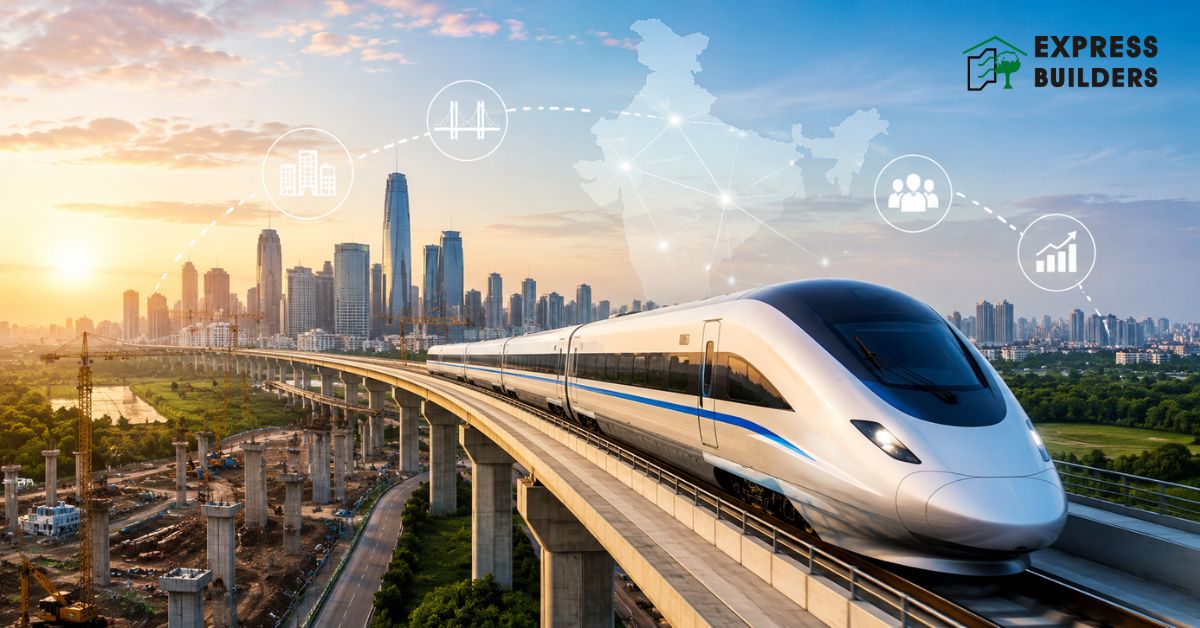
India is moving toward a faster future. With several high-speed rail projects under development, the country is building one of Asia’s most ambitious rail networks. As a result, commuters, investors, and urban planners are closely tracking every milestone.
However, the bullet train project in India is about more than just faster travel. It aims to transform connectivity, reduce travel time, and support economic growth across regions. In addition, improved accessibility could reshape where people live, work, and invest.
So, what does this mean for India’s future? Let us explore the key routes, expected timelines, and the potential impact on real estate and urban development.
What Is the Bullet Train Project in India?
India’s high-speed rail initiative aims to connect major cities through trains that can travel at speeds of 250 km/h to 350 km/h. To achieve this goal, the government has planned several high-speed rail corridors under the National High Speed Rail Corporation Limited (NHSRCL).
As these corridors become operational, they will significantly reduce travel time between major urban centres. Moreover, they will ease congestion on highways and reduce pressure on domestic air travel, creating a more efficient transportation network.
At the heart of this transformation is Japan’s renowned Shinkansen technology. Known for its exceptional safety standards, punctuality, and operational efficiency, the Shinkansen system will bring world-class high-speed rail capabilities to India. Consequently, passengers can expect faster, safer, and more reliable travel across key routes.
Mumbai Ahmedabad Bullet Train: The Flagship Corridor
The Mumbai Ahmedabad bullet train corridor is the most advanced high-speed rail project in India right now. This 508-kilometre route connects two of India’s most economically active cities.
Here are the key highlights of this corridor:
- Total Length: 508 km
- Stations: 12, including Surat, Vadodara, and Anand
- Design Speed: 350 km/h
- Travel Time: Approximately 2 hours (vs. 8 hours by train today)
Bullet Train India Completion Date: The Gujarat section of the Mumbai-Ahmedabad Bullet Train project is operational in 2026. Meanwhile, authorities aim to complete the entire corridor, including the undersea tunnel near Bandra-Kurla Complex (BKC), between 2027 and 2028.
The project has made significant progress in recent years. As of 2025, construction teams had completed more than 60% of the civil work in Gujarat. In addition, work on viaducts, stations, and depots continues at a rapid pace across the corridor.
Although land acquisition initially slowed progress, the project has largely overcome these challenges. Consequently, construction activities have accelerated, bringing India’s first high-speed rail corridor closer to reality.
Upcoming Bullet Trains in India: Other Key Corridors
The Mumbai-Ahmedabad route is just the beginning. India has identified seven more high-speed rail corridors under its long-term plan. Here is a look at the most significant upcoming bullet train routes in India:
1. Delhi Varanasi Bullet Train
This corridor stretches approximately 865 kilometres. It will pass through Agra, Lucknow, and Ayodhya- deeply significant cities both culturally and politically. The Delhi Varanasi bullet train will serve hundreds of millions of people in India’s most densely populated region. Detailed project reports are under preparation. Work is expected to begin in the next few years.
2. Delhi Ahmedabad Bullet Train
The Delhi Ahmedabad bullet train corridor covers roughly 886 kilometres. It will link the national capital with the financial hub of western India. Key cities like Jaipur and Ajmer fall along this route. This corridor will boost tourism in Rajasthan significantly.
3. Delhi Mumbai Bullet Train
This mega-corridor will span over 1,200 kilometres. It will connect two of India’s biggest cities with intermediate stops at major urban centres. Once complete, it will be one of the longest high-speed rail routes in Asia.
4. Chennai Mysuru Bengaluru Corridor
South India will not be left behind. This corridor will serve the booming tech belt of southern India, reducing travel time between Chennai and Bengaluru to under an hour.
5. Varanasi Howrah Corridor
This eastern corridor will connect Varanasi to Kolkata, bringing speed and efficiency to one of India’s busiest intercity routes.
Bullet Train India Progress: Where Do Things Stand in 2026?
Progress on bullet train routes in India has been steady. Here is a snapshot:
| Corridor | Status |
| Mumbai-Ahmedabad | Under active construction (60%+ done in Gujarat) |
| Delhi-Varanasi | DPR under preparation |
| Delhi-Ahmedabad | Feasibility study stage |
| Delhi-Mumbai | Pre-planning phase |
| Chennai-Bengaluru | Survey and planning phase |
The government has consistently increased budget allocations for high-speed rail infrastructure. International funding, particularly from Japan, continues to support the flagship Mumbai-Ahmedabad project.
Real Estate Impact of Bullet Trains in India
This is where things get really interesting for homebuyers and investors.
Every time a new transit corridor opens, property values near stations go up. This pattern has repeated in Japan, China, France, and now India. The real estate impact of bullet trains in India is already being felt even before the trains start running.
Here is what experts and data suggest:
Station Proximity Drives Premiums Properties within 25 km of bullet train stations are seeing early price appreciation. In cities like Surat, Vadodara, and Sabarmati (Ahmedabad), residential and commercial demand is rising.
New Micro-Markets Are Emerging Bullet train corridors create entirely new investment destinations. Areas that were once considered remote or peripheral are now attracting builders, retailers, and logistics players.
Commercial Real Estate Boom Office parks, retail spaces, and warehousing near high-speed stations attract businesses. Companies want to be close to fast-connectivity nodes.
Affordable Housing Shifts As cities become better connected, people are willing to live further from city centres. This reduces pressure on overpriced urban cores and opens up affordable housing options in Tier-2 cities along the corridor.
In short: if you are looking at long-term real estate investment in India, following the bullet train map is a smart strategy.
Why High-Speed Rail Matters for India’s Future
India adds millions of middle-class travellers to its transport network every year. Roads are congested. Airports are at capacity. Conventional trains are stretched. High-speed rail in India offers a third option: fast, clean, and scalable.
Beyond convenience, bullet trains are economic multipliers. They attract investment, create jobs, spur urbanisation in underdeveloped regions, and reduce carbon emissions compared to air travel.
Japan’s Shinkansen network added over $500 billion to its economy across five decades. India’s scale is even larger. The returns economic, social and environmental could be transformational.
Challenges Still Ahead
To be fair, the road ahead has bumps. Land acquisition remains complex in dense urban areas. Tunnelling near Mumbai’s coastline is technically demanding. Costs have escalated since the project began. And public awareness about bullet train timelines must be managed carefully.
But the resolve is clear. The infrastructure is being built. The blueprint is ambitious but grounded.
India is not dreaming of bullet trains anymore. It is building them.
The bullet train project in India represents a major milestone in the country’s infrastructure journey. Leading this transformation is the Mumbai-Ahmedabad Bullet Train corridor, while several other high-speed rail routes, including Delhi-Varanasi and Delhi-Ahmedabad, continue to move through various stages of planning and development.
As these projects advance, they are already influencing real estate markets across key regions. Improved connectivity is attracting investors, encouraging urban expansion, and creating new growth corridors. As a result, India’s economic landscape is gradually evolving around future high-speed rail networks.
Whether you commute daily, invest in real estate, or simply follow India’s development story, the country’s bullet train network is a trend worth watching closely.
If you are considering a property investment, locations near upcoming bullet train stations deserve special attention. Better connectivity often drives demand, supports infrastructure growth and boosts long-term property values. Therefore, exploring opportunities along India’s emerging high-speed rail corridors today could help you benefit from tomorrow’s growth. Contact Our Experts Today.
Frequently Asked Questions:
When will the first bullet train start operating in India?
India plans to launch its first bullet train on the Mumbai-Ahmedabad route in phases. The project is currently under construction, and authorities expect sections of the corridor to become operational before the full route opens. Once completed, the train will significantly reduce travel time between the two cities.
How will bullet trains affect real estate prices in India?
Bullet trains can increase real estate demand in areas near stations and along high-speed rail corridors. Improved connectivity often attracts businesses, homebuyers, and investors, which may lead to higher property values and faster urban development in surrounding regions.
What are the 7 routes of bullet trains in India?
Will India’s first bullet train run 100 km in 2027?
Yes. Current project timelines indicate that India plans to begin operating a 100-km section of the Mumbai–Ahmedabad Bullet Train corridor in Gujarat around 2027. This initial stretch will serve as the country’s first operational high-speed rail segment before the full corridor becomes operational.
