
Earthquakes strike without warning. They can damage or destroy poorly built structures within seconds. Earthquake resistant buildings are designed to withstand these powerful forces. Understanding how these buildings work helps homebuyers and investors make smarter decisions.
What Are Earthquake Resistant Buildings?
Earthquake resistant buildings use special engineering techniques. These techniques reduce the damage caused by seismic activity. Engineers design these structures to absorb and redirect earthquake energy. The buildings do not collapse easily even in strong tremors.
These structures are not fully “earthquake-proof.” However, they greatly minimize structural damage. They protect lives and reduce the cost of repairs. Modern codes in seismic zones now require earthquake resistant construction.
Why Earthquake Resistant Design Matters in India
India sits in a highly seismically active region. Over 59% of India’s land area falls in earthquake-prone zones. Major cities like Delhi, Mumbai, and Chennai face real seismic risks. The Bureau of Indian Standards (BIS) classifies India into four seismic zones.
Past earthquakes, like the 2001 Bhuj disaster, claimed thousands of lives. Most deaths occurred due to building collapse, not the earthquake itself. Earthquake resistant buildings directly save lives. This is why seismic-safe construction is no longer optional, it is essential.
Key Features of Earthquake Resistant Buildings
Engineers and architects use several proven strategies. These features work together to improve seismic safety:
1. Base Isolation Systems
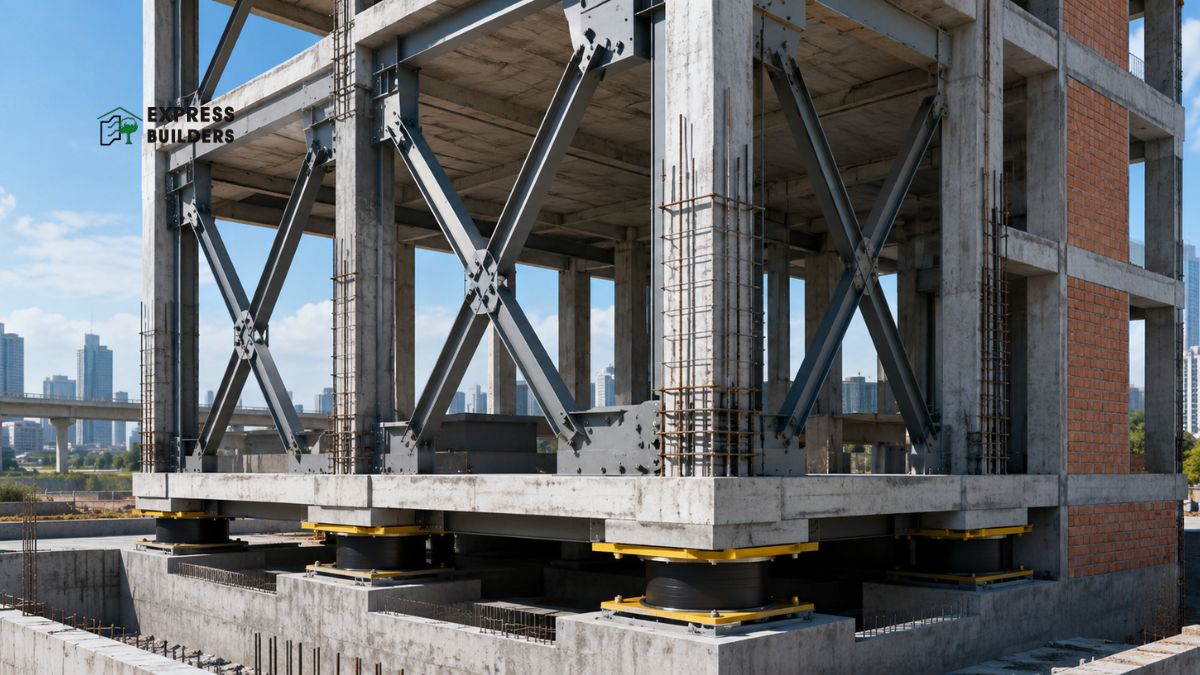
Base isolation separates the building from the ground. Engineers place flexible rubber or lead bearings beneath the structure. These bearings absorb seismic energy before it reaches the building. The structure moves independently from the ground during an earthquake.
2. Shear Walls
Shear walls are vertical reinforced concrete panels. They resist lateral forces from earthquakes and strong winds. Engineers place shear walls at key points in the building. These walls transfer seismic forces safely into the foundation.
3. Moment-Resisting Frames
These frames connect beams and columns with rigid joints. The joints allow the frame to flex and bend during an earthquake. The building absorbs energy through controlled deformation. This prevents sudden or catastrophic structural failure.
4. Damping Systems
Dampers act like shock absorbers inside buildings. They convert seismic energy into heat and reduce vibrations. Fluid viscous dampers and tuned mass dampers are widely used. These systems are common in high-rise earthquake resistant buildings.
5. Reinforced Concrete and Steel Structures
Reinforced concrete (RCC) frames with steel bars add ductility. Ductility allows materials to bend without breaking under seismic stress. Steel structures also perform well during earthquakes due to their high strength-to-weight ratio. Good construction quality ensures these materials behave as designed.
Role of Architectural Design in Seismic Safety
Good architectural design plays a critical role in earthquake resistance. Simple, symmetric building shapes perform better during earthquakes. Irregularly shaped buildings experience uneven stress distribution. Engineers prefer compact floor plans with uniform mass distribution.
Soft storey buildings are especially vulnerable. These have open ground floors with fewer walls, like parking areas. Engineers now add reinforced columns or shear walls on the ground floor. This prevents the lower level from collapsing first.
Building Materials That Enhance Earthquake Resistance
Material choice directly impacts seismic performance. The right materials absorb and distribute forces more effectively:
- High-grade TMT steel bars, improve ductility and tensile strength
- M25 or higher grade concrete, provides compression strength
- Fibre-reinforced concrete, adds crack resistance under dynamic loads
- Light-weight materials on upper floors, reduce overall building mass
- Pre-engineered steel structures, offer flexibility and faster construction
IS Codes and Standards for Seismic Construction in India
India follows specific IS codes for earthquake resistant design. IS 1893 defines the criteria for seismic design of structures. IS 4326 covers construction practices for earthquake resistance. IS 13920 addresses ductile detailing of reinforced concrete structures.
Reputable builders follow these codes strictly. Compliance ensures your home or office meets national safety standards. Always ask your developer about IS code compliance before you invest.
What to Look for When Buying an Earthquake Resistant Home
Not all buildings labelled “seismic safe” meet true standards. Here is what you should verify before purchasing:
- Structural design by qualified and certified engineers
- Use of approved construction materials and quality TMT steel
- Compliance with IS 1893 and relevant local building codes
- Soil test reports that confirm stable foundation ground
- Independent third-party quality audits during construction
Transparency from the developer builds trust. Ask to see structural drawings and soil test reports. A reliable developer will always share these documents with you.
Retrofitting Older Buildings for Seismic Safety
Millions of older buildings in India lack seismic safety features. Seismic retrofitting upgrades these existing structures. Engineers add shear walls, steel bracing, and new foundations. Retrofitting saves buildings without the cost of complete demolition.
The government has launched several retrofitting programs across seismic zones. These programs target public buildings like schools and hospitals first. Property owners can also voluntarily upgrade their buildings. Early retrofitting costs far less than post-earthquake repairs.
Final Words
Earthquake resistant buildings are a necessity, not a luxury. Proper design, quality materials, and code compliance save lives. Whether you are buying a home or planning a commercial project, seismic safety must be a top priority. Investing in an earthquake resistant structure protects your family, your assets, and your future.
Ready to Build Safe? Choose Express Builder
At Express Builder, we design every structure with seismic safety at its core. Our projects comply with all relevant IS codes and are backed by certified structural engineers. Your safety is our first promise.
Contact Express Builder today to learn more about our earthquake resistant projects. Book a FREE Site Visit Now! Walk through our construction site and see our quality standards firsthand. Experience the Express Builder difference, where safety meets excellence. Limited slots available. Book your visit today!
Frequently Asked Question
Q1. What makes a building earthquake resistant?
A building becomes earthquake resistant through a combination of structural design, quality materials, and engineering systems. Engineers use shear walls, base isolation, moment-resisting frames, and damping systems. These elements work together to absorb, redirect, and dissipate seismic energy. Compliance with national IS codes and proper construction practices are equally important.
Q2. Are all new buildings in India earthquake resistant?
Not necessarily. All new buildings in seismic zones must follow IS 1893 and related codes. However, implementation and quality control vary. Buildings constructed by certified developers who follow IS standards and use qualified structural engineers are more likely to meet seismic safety requirements. Always verify compliance with your developer before purchasing.
Q3. Is an earthquake resistant building more expensive to build?
Earthquake resistant construction typically adds 5–15% to the overall building cost. This depends on the seismic zone and the design features used. However, this added cost is a worthwhile investment. It significantly reduces the risk of structural damage, injury, and costly post-earthquake repairs. The long-term financial and safety benefits far outweigh the additional upfront expense.
Q4. Can older buildings be made earthquake resistant?
Yes. Engineers use a process called seismic retrofitting to upgrade existing buildings. This involves adding reinforced shear walls, steel bracing, and improved foundations. Retrofitting significantly improves a building’s ability to withstand seismic forces. It is a cost-effective alternative to demolition and rebuilding. Property owners in high-risk zones should consider getting a seismic assessment done for their existing structures.
