
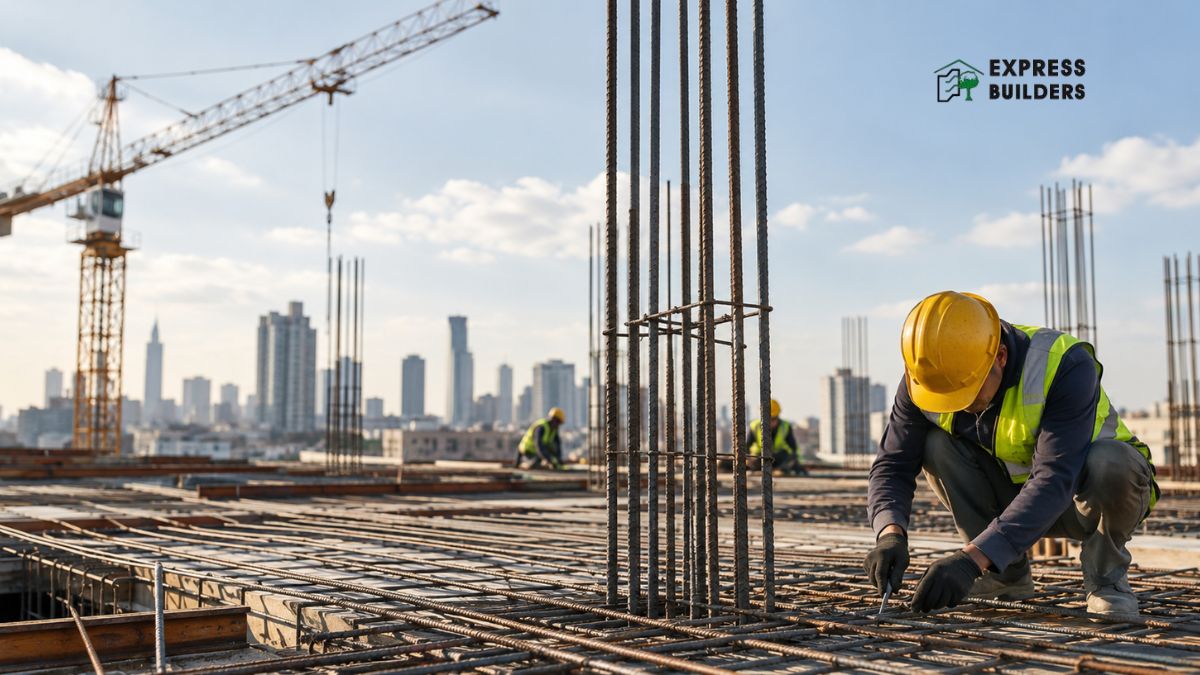
Construction surrounds us every day. Yet, most people do not know what holds buildings together. RCC is the answer to that question. Understanding RCC meaning in construction helps you appreciate modern engineering. It also helps you make smarter decisions when building your home or office.
What Is RCC? Full Form and Basic Meaning
RCC stands for Reinforced Cement Concrete. It is one of the most widely used materials in construction today. Builders combine three key materials to create RCC: cement, aggregates (sand and gravel), and steel reinforcement.
Plain concrete handles compressive forces well. However, it cracks easily under tension. Steel reinforcement solves this problem perfectly. Steel absorbs tensile stress while concrete handles compression. Together, they create a material that is strong in all directions.
You can find RCC in homes, bridges, dams, and skyscrapers. Its versatility makes it the top choice for structural engineers worldwide. The RCC meaning in construction, therefore, goes beyond a simple definition. It represents strength, durability, and reliability in every structure.
Brief History of Reinforced Cement Concrete
The concept of reinforcing concrete dates back to the 19th century. Joseph Monier, a French gardener, first used metal bars inside concrete flowerpots in 1849. Engineers soon recognized its structural potential.
Joseph Louis Lambot built a small boat using wire-reinforced cement in 1848. William B. Wilkinson patented reinforced concrete floors in 1854. By the late 1800s, engineers adopted RCC widely across Europe and America.
In the 20th century, RCC became the global standard for construction. Today, engineers use computer-aided design to optimize every RCC structure. Modern RCC construction is safer, stronger, and more efficient than ever.
Key Components of RCC
Every RCC structure depends on the quality of its core components. Each material plays a vital role in the final product.
- Cement
Cement acts as the binding agent in RCC. Ordinary Portland Cement (OPC) is the most common type used. It reacts with water to form a hard paste that binds all materials together.
- Aggregates
Aggregates include fine materials like sand and coarse materials like gravel or crushed stone. They provide volume and reduce the overall cost of construction. Aggregates must be clean, durable, and free from organic material.
- Water
Water triggers the chemical reaction that hardens cement. Engineers use a specific water-cement ratio to achieve optimal strength. Too much water weakens the mix significantly.
- Steel Reinforcement
Steel bars, also called rebars, form the skeleton of any RCC structure. They resist tensile forces that concrete cannot handle alone. Engineers place steel bars strategically based on load requirements and design specifications.
- Admixtures
Modern RCC often includes chemical or mineral admixtures. These materials improve workability, durability, and setting time. Common admixtures include fly ash, silica fume, and plasticizers.
How RCC Differs from Plain Cement Concrete (PCC)
Many people confuse RCC with PCC (Plain Cement Concrete). Both contain cement, aggregates, and water. However, RCC adds steel reinforcement, and this changes everything.
PCC works well only under compressive loads. RCC handles both compression and tension effectively. PCC suits applications like floor levelling and road sub-bases. RCC suits structural elements like beams, columns, slabs, and foundations.
In terms of cost, PCC is cheaper upfront. However, RCC offers better long-term value. It resists cracking, lasts longer, and requires less maintenance. Most modern structures rely on RCC because safety cannot be compromised.
Types of RCC Structures
Engineers design several types of RCC structural elements. Each element serves a specific purpose in a building.
RCC Slab
Slabs form the floors and roofs of buildings. Engineers design them to carry loads from above and transfer them to beams or walls. Flat slabs, two-way slabs, and ribbed slabs are popular slab types.
RCC Beam
Beams carry loads horizontally and transfer them to columns or walls. They resist bending forces acting on the structure. Simply supported, cantilever, and continuous beams are common RCC beam types.
RCC Column
Columns carry vertical loads from beams and slabs down to the foundation. They primarily handle compressive forces. Rectangular, circular, and L-shaped columns are used depending on structural needs.
RCC Foundation
The foundation distributes the entire building load safely to the ground. Shallow foundations like raft slabs and footings are common in residential construction. Deep foundations like pile foundations suit larger structures.
RCC Retaining Wall
Retaining walls hold back soil on slopes and embankments. RCC retaining walls are far more durable than masonry alternatives. They prevent soil erosion and structural damage caused by earth pressure.
RCC Staircase
Staircases in modern buildings are mostly made of RCC. They offer excellent fire resistance and durability. Engineers can design them in various shapes, including straight, spiral, and helical forms.
The RCC Construction Process
Understanding the RCC construction process helps buyers evaluate project quality. Each step impacts the final structural performance.
- Structural Design: Structural engineers create detailed drawings based on load calculations.
- Material Procurement: High-quality cement, steel, and aggregates are sourced and tested.
- Formwork Setup: Temporary wooden or metal molds give concrete its desired shape.
- Steel Reinforcement Placement: Steel bars are bent, tied, and placed inside the formwork precisely.
- Concrete Mixing: Cement, aggregates, water, and admixtures are mixed in correct proportions.
- Concrete Pouring: Workers pour the mixed concrete into formwork uniformly and without gaps.
- Compaction: Vibrators remove air bubbles and ensure uniform density throughout.
- Curing: Workers keep concrete moist for at least 28 days to achieve full strength.
- Formwork Removal: Once concrete gains sufficient strength, workers carefully remove formwork.
- Quality Testing: Engineers test concrete cubes for compressive strength at regular intervals.
Each step requires trained workers, proper equipment, and strict quality control. Skipping any step can compromise the entire structure’s safety and lifespan.
Advantages of RCC in Construction
RCC dominates the construction industry for good reason. Its advantages outweigh almost every alternative available today.
- High Strength: RCC handles heavy loads from floors, furniture, and occupants easily.
- Durability: Properly constructed RCC structures last over 100 years with minimal maintenance.
- Fire Resistance: Concrete is naturally fire-resistant and protects steel from extreme heat.
- Versatility: Engineers can mold RCC into virtually any shape or size required.
- Cost-Effective: Despite higher upfront costs, RCC offers excellent value over its lifetime.
- Seismic Resistance: RCC structures with proper design resist earthquake forces effectively.
- Low Maintenance: Unlike steel or timber, RCC does not corrode, rot, or require painting.
- Water Resistance: Dense RCC construction resists water penetration in wet environments.
- Sound Insulation: Thick RCC walls and slabs reduce noise transmission between rooms.
- Thermal Mass: Concrete absorbs and slowly releases heat, improving indoor temperature comfort.
Common Applications of RCC in Modern Construction
RCC appears in virtually every category of construction project. Its applications span residential, commercial, and infrastructure sectors.
- Residential Buildings: Apartment complexes, independent homes, and villas use RCC frames.
- Commercial Buildings: Malls, offices, hospitals, and hotels depend on RCC structural systems.
- Bridges and Flyovers: RCC handles the immense dynamic loads of road and rail traffic.
- Dams and Reservoirs: RCC resists enormous water pressure in hydraulic structures.
- Tunnels and Underpasses: RCC lines tunnel walls to resist soil and groundwater pressure.
- Industrial Structures: Factories, warehouses, and power plants use RCC for durability.
- Marine Structures: Ports, jetties, and sea walls use special RCC mixes for saltwater resistance.
- Pavements and Roads: RCC pavements handle heavy truck traffic better than asphalt alternatives.
Grades of Concrete Used in RCC
Concrete grades indicate the characteristic compressive strength measured in N/mm². Choosing the right grade is critical for structural safety.
- M15 Grade: Used in minor works like pathways and plinth protection around buildings.
- M20 Grade: The minimum grade allowed for RCC structures in residential construction.
- M25 Grade: Commonly used in beams, columns, and slabs for multi-storey buildings.
- M30 Grade and Above: Required for high-rise buildings, bridges, and industrial structures.
Structural engineers specify the correct grade based on load requirements and environmental conditions. Using a lower grade than specified can lead to serious structural failures.
Quality Control in RCC Construction
Quality control separates a safe structure from a dangerous one. Responsible builders follow strict quality protocols at every stage.
Engineers conduct slump tests to check concrete workability before pouring. They cast concrete cubes and test them at 7 days and 28 days. Cube test results confirm whether the concrete meets its specified grade.
Steel reinforcement must meet IS specifications for tensile strength and elongation. Inspectors check bar diameters, spacing, and cover depth before concrete placement. Cover blocks ensure adequate concrete cover over steel, protecting it from corrosion.
Curing is the most commonly neglected quality step. Insufficient curing reduces concrete strength significantly. Proper curing with water, wet hessian, or curing compounds is non-negotiable for durable structures.
Limitations of RCC
RCC is excellent but not without limitations. Understanding its shortcomings helps engineers design better structures.
- Weight: RCC is heavy, increasing foundation and column sizes in tall structures.
- Tensile Weakness: Without steel, plain concrete cracks easily under tension.
- Long Curing Time: RCC needs 28 days to reach full design strength, slowing construction schedules.
- Repair Difficulty: Damaged RCC is hard to repair without compromising structural integrity.
- Corrosion Risk: Steel reinforcement corrodes if concrete cover is inadequate or porous.
- Cracking Risk: Shrinkage cracks can appear if concrete mix proportions or curing are improper.
Engineers address these limitations through careful design, proper material selection, and strict construction practices.
Future Trends in RCC Construction
RCC continues to evolve with technology and research. New innovations are making RCC structures stronger, lighter, and more sustainable.
- High-Performance Concrete (HPC): Advanced mixes with silica fume and superplasticizers achieve strengths above 100 MPa.
- Fibre-Reinforced Concrete (FRC): Steel or polypropylene fibres reduce cracking and improve impact resistance.
- Self-Compacting Concrete (SCC): SCC flows into formwork without vibration, improving construction efficiency.
- Green Concrete: Builders replace cement partially with industrial waste like fly ash or slag to reduce carbon emissions.
- Smart Monitoring: Embedded sensors in RCC structures track real-time stress and strain levels remotely.
These innovations ensure that RCC remains the material of choice in construction for many decades ahead.
Frequently Asked Questions
Q1. What is RCC and PCC in construction?
RCC (Reinforced Cement Concrete) combines cement, aggregates, and steel bars for structural strength. PCC (Plain Cement Concrete) uses only cement, sand, and aggregates without steel reinforcement.
Q2. How is RCC different from PCC?
RCC contains steel reinforcement, making it strong in tension and compression. PCC lacks steel and handles only compression. RCC suits structural elements; PCC suits non-structural base layers.
Q3. What is RCC and ACC in construction?
RCC (Reinforced Cement Concrete) uses steel bars for structural strength. ACC (Autoclaved Aerated Concrete) is a lightweight, precast block material used mainly for non-load-bearing walls and partitions.
Q4. Why is RCC used in construction?
RCC offers exceptional strength, durability, fire resistance, and versatility. It handles both compressive and tensile forces effectively. Its long lifespan and low maintenance make it ideal for all structures.
Ready to Build with the Best?
Now that you understand RCC meaning in construction, you deserve a builder who applies these standards perfectly. Every structure Express Builder constructs uses high-grade RCC, certified materials, and expert engineers. We build homes that stand the test of time.
Contact Express Builder today, and let’s build your dream home on a foundation you can trust!
Book a Site Visit with Express Builders! See our RCC construction quality firsthand. Our experts will walk you through every structural detail. Visit our site and experience the Express Builder difference, because your future home deserves nothing but the best. Book your slot now!
